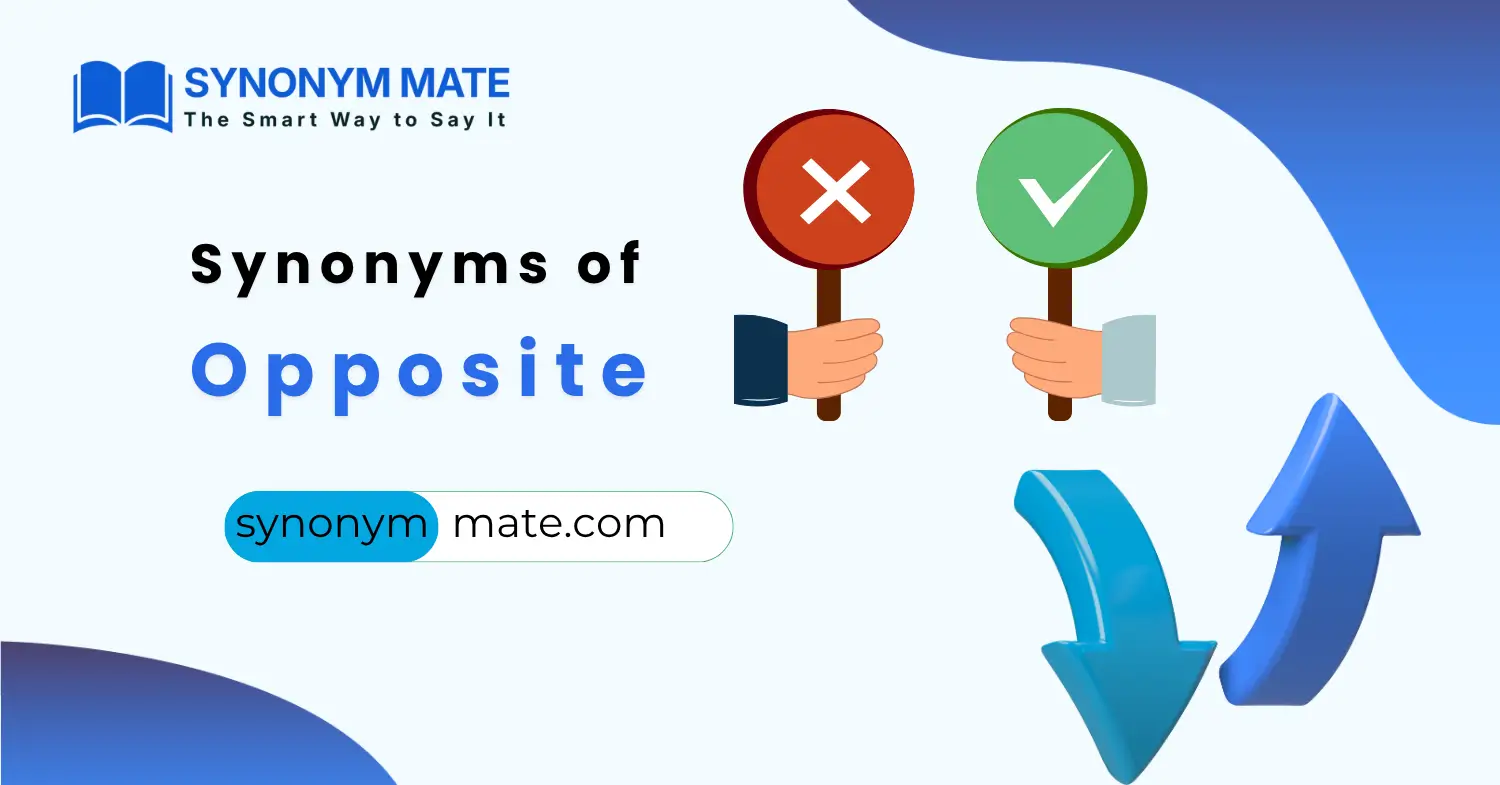

Synonyms of opposite often appear when you want to show contrast. Imagine saying “hot” and needing a better word than just “cold.” That’s where variety helps.
In daily life, we compare things all the time. You might describe two ideas, people, or opinions as completely different or opposite.
Learning synonyms of opposite makes your English clearer and more expressive. It helps students, bloggers, and writers avoid repetition.
If you use synonyms of opposite, your communication becomes stronger. These words are common in essays, conversations, and storytelling.
📚 What Does “synonyms of opposite” Really Mean?
The word opposite can be a noun, adjective, or preposition.
In simple English, it means something completely different or facing another thing.
Native speakers use it to describe contrast, disagreement, or direction.
Common contexts:
- Comparing ideas
- Describing directions
- Showing contrast
🧠 Connotative Meaning
(Connotation means the emotional feeling a word carries beyond its basic meaning.)
Positive tone: Balance, contrast
Negative tone: Conflict, disagreement
Neutral tone: Difference
📖 Etymology
“Opposite” comes from Latin oppositus, meaning “placed against.”
- Old English: No exact form
- Middle English: Adopted from Latin via French
- Modern English: Used widely for contrast and difference
🔊 Pronunciation (US & UK – IPA)
- US: /ˈɑpəzɪt/
- UK: /ˈɒpəzɪt/
🔤 Syllables
- op-po-site
🧩 Affixation Pattern
- Root: posit (place)
- Prefix: op- (against)
- Suffix: -ite
📖 SYNONYMS LIST
Antonym (noun) — US: /ˈæntəˌnɪm/ | UK: /ˈæntənɪm/
Meaning: A word that has the opposite meaning of another word.
Examples:
- “Hot” is an antonym of “cold.”
- Students learn antonyms in class.
Reverse (noun/adj) — US: /rɪˈvɜrs/ | UK: /rɪˈvɜːs/
Meaning: Something going in the opposite direction.
Examples:
- He took the reverse route.
- The result was the reverse.
Contrary (adj/noun) — US: /ˈkɑntrɛri/ | UK: /ˈkɒntrəri/
Meaning: Completely different or opposing.
Examples:
- His opinion is contrary.
- She took a contrary view.
Opposing (adj) — US: /əˈpoʊzɪŋ/ | UK: /əˈpəʊzɪŋ/
Meaning: Acting against something.
Examples:
- Opposing teams played well.
- They had opposing views.
Contradictory (adj) — US: /ˌkɑntrəˈdɪktəri/ | UK: /ˌkɒntrəˈdɪktəri/
Meaning: Saying the exact opposite.
Examples:
- His statements were contradictory.
- The data looked confusing.
Inverse (adj/noun) — US: /ɪnˈvɜrs/ | UK: /ɪnˈvɜːs/
Meaning: Opposite in position or effect.
Examples:
- They have an inverse relationship.
- The result is inverse.
Opposed (adj) — US: /əˈpoʊzd/ | UK: /əˈpəʊzd/
Meaning: Against something.
Examples:
- He is opposed to the plan.
- She felt strongly opposed.
Polar (adj) — US: /ˈpoʊlər/ | UK: /ˈpəʊlə/
Meaning: Completely opposite extremes.
Examples:
- They have polar views.
- Their ideas are far apart.
Different (adj) — US: /ˈdɪfrənt/ | UK: /ˈdɪfrənt/
Meaning: Not the same.
Examples:
- They are different people.
- The answers are different.
Contrasting (adj) — US: /kənˈtræstɪŋ/ | UK: /kənˈtrɑːstɪŋ/
Meaning: Showing clear differences.
Examples:
- The colors are contrasting.
- It creates visual interest.
Opponent (noun) — US: /əˈpoʊnənt/ | UK: /əˈpəʊnənt/
Meaning: Someone against another.
Examples:
- He defeated his opponent.
- The opponent was strong.
Adverse (adj) — US: /ˈædvɜrs/ | UK: /ˈædvɜːs/
Meaning: Unfavorable or against.
Examples:
- They faced adverse conditions.
- The result was negative.
Antithetical (adj) — US: /ˌæntɪˈθɛtɪkəl/ | UK: /ˌæntɪˈθɛtɪkəl/
Meaning: Directly opposite in meaning.
Examples:
- Their ideas are antithetical.
- It shows contrast clearly.
Counter (adj) — US: /ˈkaʊntər/ | UK: /ˈkaʊntə/
Meaning: Acting against something.
Examples:
- He made a counter argument.
- It worked against them.
Opposite side (noun phrase) — US/UK similar
Meaning: The other side facing you.
Examples:
- He stood on the opposite side.
- The shop is across the street.
Against (prep) — US: /əˈɡɛnst/ | UK: /əˈɡɛnst/
Meaning: In opposition to something.
Examples:
- He voted against it.
- She stood against the idea.
Divergent (adj) — US: /daɪˈvɜrdʒənt/ | UK: /daɪˈvɜːdʒənt/
Meaning: Moving in different directions.
Examples:
- Their paths are divergent.
- Ideas became separate.
Conflict (noun) — US: /ˈkɑnflɪkt/ | UK: /ˈkɒnflɪkt/
Meaning: A disagreement or clash.
Examples:
- There was a conflict.
- They argued strongly.
Opposition (noun) — US: /ˌɑpəˈzɪʃən/ | UK: /ˌɒpəˈzɪʃən/
Meaning: Strong disagreement.
Examples:
- The plan faced opposition.
- Many people disagreed.
Contrarian (noun) — US: /kənˈtrɛriən/ | UK: /kənˈtrɛəriən/
Meaning: A person who always disagrees.
Examples:
- He is a contrarian.
- She challenges ideas often.
Inverse relation (noun) — US: /ɪnˈvɜrs rɪˈleɪʃən/ | UK: /ɪnˈvɜːs rɪˈleɪʃən/
Meaning: A relationship where one thing increases while the other decreases.
Examples:
- Price and demand show an inverse relation.
- Their results follow an inverse relation.
Negative counterpart (noun) — US: /ˈnɛɡətɪv ˈkaʊntərˌpɑrt/ | UK: /ˈnɛɡətɪv ˈkaʊntəpɑːt/
Meaning: Something that exists as the opposite version of another.
Examples:
- This idea has a negative counterpart.
- Every action has a counterpart.
Opposing force (noun) — US: /əˈpoʊzɪŋ fɔrs/ | UK: /əˈpəʊzɪŋ fɔːs/
Meaning: A force acting against another.
Examples:
- Gravity is an opposing force.
- The team faced an opposing force.
Reverse side (noun) — US: /rɪˈvɜrs saɪd/ | UK: /rɪˈvɜːs saɪd/
Meaning: The other or opposite side of something.
Examples:
- Check the reverse side.
- The answer is on the reverse side.
Opposite end (noun) — US: /ˈɑpəzɪt ɛnd/ | UK: /ˈɒpəzɪt ɛnd/
Meaning: The far or completely different side.
Examples:
- He stood at the opposite end.
- Their views are at opposite ends.
Conflicting idea (noun) — US: /kənˈflɪktɪŋ aɪˈdiə/ | UK: /kənˈflɪktɪŋ aɪˈdɪə/
Meaning: An idea that disagrees with another.
Examples:
- She shared a conflicting idea.
- The plan faced conflicting ideas.
Contrast (noun) — US: /ˈkɑntræst/ | UK: /ˈkɒntrɑːst/
Meaning: A clear difference between two things.
Examples:
- The contrast is obvious.
- The colors create contrast.
Dichotomy (noun) — US: /daɪˈkɑtəmi/ | UK: /daɪˈkɒtəmɪ/
Meaning: A division into two completely opposite parts.
Examples:
- There is a clear dichotomy.
- The concept shows contrast.
Polarity (noun) — US: /poʊˈlærɪti/ | UK: /pəʊˈlærɪti/
Meaning: The state of having opposite qualities.
Examples:
- The polarity is strong.
- Their opinions show polarity.
Disagreement (noun) — US: /ˌdɪsəˈɡrimənt/ | UK: /ˌdɪsəˈɡriːmənt/
Meaning: A lack of agreement.
Examples:
- There was a disagreement.
- They argued over it.
Resistance (noun) — US: /rɪˈzɪstəns/ | UK: /rɪˈzɪstəns/
Meaning: Opposition to something.
Examples:
- The plan met resistance.
- He showed resistance.
Counterpoint (noun) — US: /ˈkaʊntərˌpɔɪnt/ | UK: /ˈkaʊntəpɔɪnt/
Meaning: An opposing idea or argument.
Examples:
- She offered a counterpoint.
- It balanced the discussion.
Reverse direction (noun) — US: /rɪˈvɜrs dəˈrɛkʃən/ | UK: /rɪˈvɜːs dɪˈrɛkʃən/
Meaning: Moving in the opposite way.
Examples:
- The car moved in reverse direction.
- He changed direction.
Opposite pole (noun) — US: /ˈɑpəzɪt poʊl/ | UK: /ˈɒpəzɪt pəʊl/
Meaning: One of two extreme ends.
Examples:
- They are at opposite poles.
- Their views are extreme.
Counterforce (noun) — US: /ˈkaʊntərˌfɔrs/ | UK: /ˈkaʊntəfɔːs/
Meaning: A force that acts against another.
Examples:
- The counterforce stopped it.
- Balance needs counterforce.
Opposite extreme (noun) — US: /ˈɑpəzɪt ɪkˈstrim/ | UK: /ˈɒpəzɪt ɪkˈstriːm/
Meaning: A completely different or extreme side.
Examples:
- He went to the opposite extreme.
- Their choices differ greatly.
Contradiction (noun) — US: /ˌkɑntrəˈdɪkʃən/ | UK: /ˌkɒntrəˈdɪkʃən/
Meaning: A direct disagreement or denial.
Examples:
- His words were a contradiction.
- The facts showed contradiction.
Opposition force (noun) — US: /ˌɑpəˈzɪʃən fɔrs/ | UK: /ˌɒpəˈzɪʃən fɔːs/
Meaning: A force that resists another.
Examples:
- The opposition force was strong.
- It blocked progress.
Reverse position (noun) — US: /rɪˈvɜrs pəˈzɪʃən/ | UK: /rɪˈvɜːs pəˈzɪʃən/
Meaning: A position opposite to another.
Examples:
- He took a reverse position.
- She changed her stance.
Counter view (noun) — US: /ˈkaʊntər vju/ | UK: /ˈkaʊntə vjuː/
Meaning: An opinion that opposes another.
Examples:
- She shared a counter view.
- It challenged the idea.
🔍 SYNONYMS BY TONE
Positive: contrast, different, divergent
Neutral: opposite, inverse, contrary
Negative: conflict, opposition, adverse
Playful: reverse, flip side
Tone matters because it changes whether your message sounds neutral, critical, or dramatic.
⚖️ MINI COMPARISON
Opposite vs Antonym vs Contrary
- Opposite: General difference
- Antonym: Word-level opposite
- Contrary: Strong disagreement
🧠 CONTEXT-BASED USAGE
Daily conversation:
“That’s the opposite of what I said.”
Writing/blogging:
Use “contrast” or “contrary.”
Academic:
Use “antonym” or “inverse.”
Creative:
Use “polar” or “flip side.”
⚠️ COMMON MISTAKES & NATIVE USAGE
Mistakes:
- Using “antonym” in non-language contexts
- Overusing “opposite” repeatedly
- Confusing “different” with “opposite”
Register Notes:
- Formal: antithetical, inverse
- Informal: opposite, flip side
(You can explore related vocabulary like “synonyms of difference.”)
🧩 REAL-LIFE MINI SCENARIOS
Workplace:
Two teams had opposing ideas.
Social:
They hold opposite opinions.
Media:
Characters show contrasting traits.
Writing:
Authors use contrast for effect.
✅ Conclusion
Learning synonyms of opposite helps you express contrast clearly. It improves your vocabulary and makes communication stronger.
These words allow you to avoid repetition. They also help you sound more natural and confident in English.
Students, writers, and speakers benefit from this knowledge. It supports both academic and daily communication.
Start practicing today. Use these synonyms in your sentences and conversations to build fluency.
📝 Practice Exercises
Choose the correct synonym:
- Word opposite:
a) antonym b) beast c) wolf - Strong disagreement:
a) opposition b) canine c) alpha - Different direction:
a) divergent b) hunter c) beast - Opposite meaning:
a) inverse b) wolf c) predator - Against something:
a) opposed b) alpha c) canine - Visual difference:
a) contrast b) brute c) wolf - Strong clash:
a) conflict b) alpha c) hunter - Opposite extremes:
a) polar b) beast c) wolf - Logical opposite:
a) antonym b) predator c) brute - Acting against:
a) counter b) wolf c) beast
Answer Key:
1-a, 2-a, 3-a, 4-a, 5-a, 6-a, 7-a, 8-a, 9-a, 10-a
Reflection Task:
Write one sentence using any synonym of “opposite” to describe two ideas or situations.