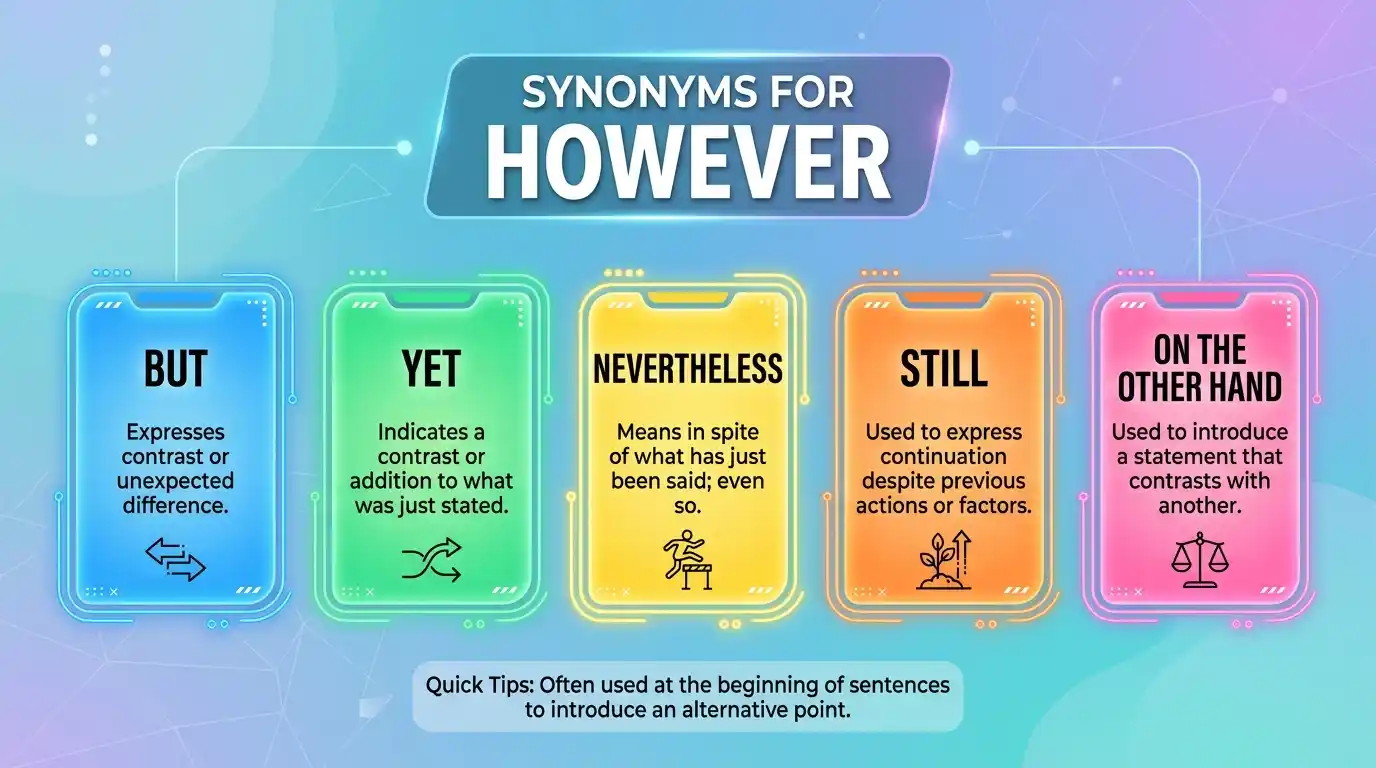

A synonym for however is nevertheless, nonetheless, still, yet, even so, or on the other hand. These words express contrast or show that an idea remains true despite another fact. The best alternative depends on your sentence, tone, and intended meaning. For formal writing, use nevertheless or nonetheless. For everyday writing, but or still may sound more natural.
Key Takeaways
- Nevertheless and nonetheless work well in formal and academic writing.
- But, yet, and still offer simpler ways to express contrast.
- On the other hand introduces a different viewpoint or consideration.
- Not every synonym fits every sentence. Choose a word that matches your intended meaning.
- Correct punctuation matters when replacing however with another transition word.
What Does However Mean?
The word however introduces a contrast between two ideas. It often shows that the second statement differs from, or limits, what the reader might expect from the first statement.
For example:
- The restaurant looked expensive. However, the meals were affordable.
- Maya was tired. However, she finished her homework.
- The plan seemed simple. However, it required careful preparation.
In each example, however connects two related ideas that contrast with each other.
According to Cambridge Dictionary, however also has other meanings. It can mean “in whatever way” or “to whatever degree,” as in “However you choose to organize the files, keep them secure.” In that sentence, a contrast synonym such as nevertheless would not work.
Therefore, before choosing a synonym, identify how the word functions in your sentence. Cambridge Dictionary explains these different uses.
15 Best Synonyms for However
The following alternatives help you express contrast without repeating however in every paragraph.
| Synonym | Meaning or use | Example |
|---|---|---|
| 1. Nevertheless | Despite that fact | The task was difficult; nevertheless, she completed it. |
| 2. Nonetheless | In spite of what was mentioned | The evidence was limited; nonetheless, the team continued. |
| 3. Still | Even so; despite that | It was raining. Still, we went outside. |
| 4. Yet | Despite expectations | He is young, yet he is very experienced. |
| 5. Even so | Despite the situation | The tickets were expensive. Even so, we bought them. |
| 6. But | Introduces a contrasting idea | I wanted to go, but I was busy. |
| 7. On the other hand | Presents another viewpoint | The apartment is small. On the other hand, it is affordable. |
| 8. In contrast | Highlights a difference | Sales increased in June. In contrast, July sales declined. |
| 9. Conversely | Indicates an opposite relationship | Some plants thrive in shade. Conversely, others need direct sunlight. |
| 10. That said | Introduces a qualification | The book is lengthy. That said, it is easy to follow. |
| 11. Even though | Introduces a condition that does not prevent an outcome | Even though it was cold, we went hiking. |
| 12. Although | Introduces a contrasting subordinate clause | Although the road was narrow, the driver continued. |
| 13. Despite this | Shows that something remains true | The forecast looked poor. Despite this, the event continued. |
| 14. In spite of that | Expresses contrast despite a fact | The first attempt failed. In spite of that, he tried again. |
| 15. All the same | Means nevertheless or despite that | The journey was long. All the same, we enjoyed it. |
These expressions overlap in meaning, but their grammar and emphasis differ. For more alternatives, consult the Cambridge English Thesaurus.
Formal and Academic Alternatives
If you are writing an essay, research paper, business report, or professional email, choose an alternative that communicates your point precisely.
Nevertheless: Use this word when the second statement remains true despite the first.
Example: The sample size was small; nevertheless, the findings offered useful insights.
Nonetheless: This has a similar meaning to nevertheless and often suits formal writing.
Example: The initial results were inconclusive; nonetheless, further research was justified.
Conversely: Use this when presenting an opposite relationship rather than a simple exception.
Example: Higher prices may reduce demand. Conversely, lower prices may attract more buyers.
In contrast: Use this to emphasize a difference between two people, situations, results, or ideas.
Example: The first experiment produced consistent results. In contrast, the second showed considerable variation.
Despite this: Choose this phrase when you want to show that an outcome occurred even though the preceding fact might suggest otherwise.
Example: The project faced several delays. Despite this, the team delivered the final report on time.
Simple and Conversational Alternatives
For emails, conversations, blog posts, and everyday writing, shorter expressions can sound more natural.
But: The simplest option for joining contrasting ideas.
Example: I like the design, but the price is too high.
Still: Use it to show that a fact does not change the outcome.
Example: The weather was unpleasant. Still, we enjoyed our trip.
Yet: This often emphasizes an unexpected contrast.
Example: The instructions were simple, yet several people made mistakes.
Even so: Use it when you want to acknowledge a problem and then show that it did not prevent an action.
Example: The restaurant was crowded. Even so, we found a table.
That said: This works well when you want to qualify your previous statement or introduce a limitation.
Example: The software is easy to use. That said, beginners may need help with the advanced features.
Which Synonym for However Should You Use?
The right choice depends on the relationship between your ideas and the tone of your writing.
| Your writing situation | Best alternative | Why it works |
|---|---|---|
| Academic essay | Nevertheless | Expresses a clear contrast in a formal tone |
| Research paper | Nonetheless | Acknowledges a limitation without dismissing the main point |
| Casual conversation | But | Short, familiar, and direct |
| Professional email | That said | Introduces a qualification politely |
| Comparing two options | On the other hand | Presents another perspective |
| Showing opposite results | In contrast | Makes a difference clear |
| Expressing an unexpected result | Yet | Highlights a surprising outcome |
| Acknowledging a difficulty | Even so | Shows that the difficulty did not change the outcome |
Consider this example:
Original: The product is affordable. However, it lacks several useful features.
You could rewrite it in different ways:
- Formal: The product is affordable. Nevertheless, it lacks several useful features.
- Conversational: The product is affordable, but it lacks several useful features.
- Balanced: The product is affordable. On the other hand, it lacks several useful features.
- Concise: The product is affordable, yet it lacks several useful features.
Each version communicates a similar contrast, but the tone and emphasis change slightly.
How to Use However Synonyms in Sentences
Knowing a synonym is only part of the task. You also need to understand how the replacement affects sentence structure.
However vs. But
Both words express contrast, but they follow different punctuation patterns when joining independent clauses.
Correct: The proposal was promising, but it needed more work.
Correct: The proposal was promising; however, it needed more work.
Incorrect: The proposal was promising, however it needed more work.
The last example joins two independent clauses with only a comma. This creates a comma splice. Use a semicolon before however, or replace it with but and keep the comma.
However vs. Although
Although introduces a subordinate clause, while however commonly acts as a linking adverb.
Compare these examples:
- However: The road was flooded. However, the bus arrived on time.
- Although: Although the road was flooded, the bus arrived on time.
Both sentences express contrast, but their structures differ. You cannot simply replace however with although without adjusting the sentence.
Punctuation Rules for However Alternatives
Follow these basic rules to keep your writing clear.
1. Use a semicolon or period with however.
Correct: The deadline was tight; however, the team finished early.
Correct: The deadline was tight. However, the team finished early.
2. Use a comma before but when joining two independent clauses.
Correct: I called the office, but nobody answered.
3. Place a comma after introductory transitions when appropriate.
Correct: Nevertheless, the manager approved the request.
Correct: Even so, we decided to continue.
4. Use although with a complete subordinate clause.
Correct: Although the task was difficult, she completed it.
Incorrect: Although, the task was difficult, she completed it.
5. Use on the other hand when presenting another perspective.
Correct: The house is spacious. On the other hand, it is far from the city center.
Punctuation can vary with sentence structure, but the goal remains the same: make the relationship between your ideas easy to follow.
Common Mistakes to Avoid
Writers sometimes replace however with a word that does not express the intended relationship. Watch out for these common errors.
Mistake 1: Treating every synonym as interchangeable
Nevertheless and conversely do not express exactly the same relationship. The first acknowledges a fact without changing the outcome; the second indicates an opposing relationship.
Mistake 2: Using overly formal words in casual writing
A sentence such as “I wanted pizza; nonetheless, I ordered a sandwich” is grammatically sound, but it may sound unnecessarily formal in a text message. “I wanted pizza, but I ordered a sandwich” is more natural.
Mistake 3: Repeating the same transition too often
Using however in every paragraph can make your writing repetitive. Choose transitions based on meaning instead of replacing every occurrence with another word mechanically.
Mistake 4: Confusing contrast with cause and effect
Words such as therefore, consequently, and as a result usually indicate a result, not a contrast. They are not suitable replacements when you want to express opposition between ideas.
Mistake 5: Ignoring sentence structure
Replacing although with nevertheless, for example, may require rewriting the entire sentence. Always check that the new word fits grammatically.
Frequently Asked Questions
What is a more formal word for however?
Nevertheless and nonetheless are strong formal alternatives to however. Both communicate that something remains true despite a preceding fact. For example, “The results were limited; nevertheless, they offered valuable insight.” Choose the word that sounds natural in your sentence rather than using formal vocabulary simply to sound more academic.
What can I use instead of however in an essay?
For an essay, consider nevertheless, nonetheless, in contrast, conversely, and although. Use nevertheless or nonetheless to acknowledge a limitation, in contrast to compare differences, and although to introduce a contrasting clause. Your choice should reflect the logical relationship between your ideas.
Can I start a sentence with however?
Yes. You can start a sentence with however when it introduces a contrast with the preceding statement.
Example: “The first approach failed. However, the second approach worked.”
Place a comma after however in this introductory use. If you use it between two independent clauses, place a semicolon or period before it instead of joining the clauses with only a comma.
Is however the same as nevertheless?
They often have the same meaning when they express contrast, and you can frequently use one instead of the other. However, nevertheless tends to sound more formal. Neither word works as a substitute for every use of however, such as “However you arrange the books, keep the labels visible.”
What is the difference between however and although?
However commonly links contrasting statements, while although introduces a subordinate clause. For example, “It was raining. However, we went outside” uses two independent sentences. “Although it was raining, we went outside” combines the ideas into one sentence with a subordinate clause.
Final Thoughts
If you are wondering what is a synonym for however, start with nevertheless, nonetheless, still, yet, even so, or but. These alternatives help you express contrast without repeating the same word.
For academic writing, nevertheless and nonetheless are useful choices. For everyday communication, but and still often sound more natural. Use in contrast when comparing differences and although when your sentence structure calls for a subordinate clause.
The best synonym is not necessarily the most sophisticated one. It is the word or phrase that expresses your intended meaning clearly and fits the grammar of your sentence.