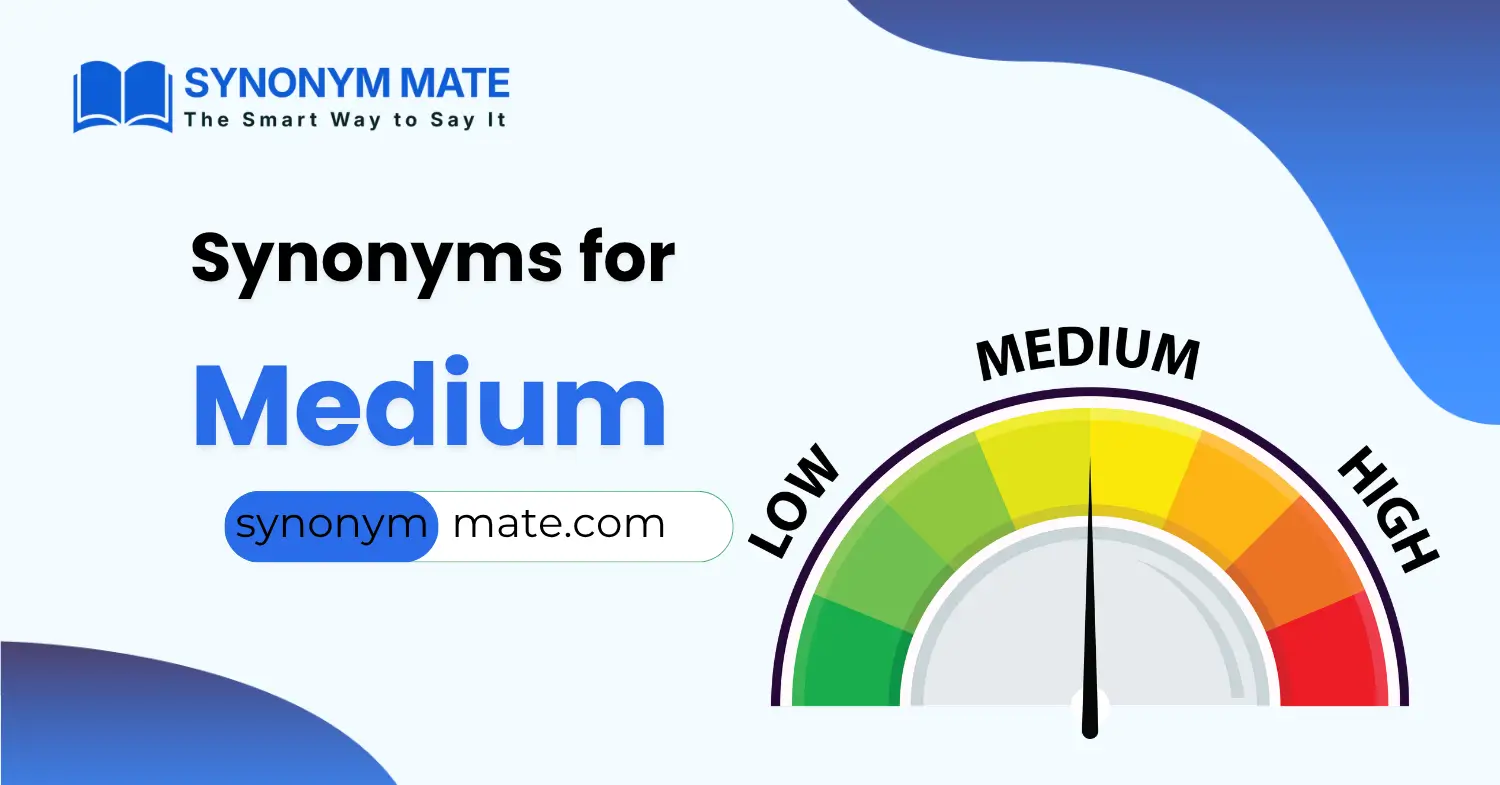

Synonyms for medium often come up when you’re describing something that’s not too big or too small. Imagine ordering a coffee and choosing a “medium” size it’s the safe, balanced option most people pick.
In daily life, we use synonyms for medium to describe size, intensity, or level. For example, you might say “moderate heat” instead of “medium heat” while cooking.
Learning synonyms for medium helps you sound more natural and precise. It adds variety to your speech and makes your writing feel richer and less repetitive.
For students, bloggers, and writers, synonyms for medium are essential. They improve clarity, boost creativity, and help you express ideas more effectively in everyday English.
📚 What Does “Medium” Really Mean?
Medium is a versatile word. It usually describes something that is in the middle range.
It can refer to size, level, amount, or intensity. For example, “medium size,” “medium difficulty,” or “medium heat.”
In simple terms, medium means not too much and not too little.
Part of Speech:
- Noun (a means or method)
- Adjective (moderate in size or degree)
🧠 Connotative Meaning
- Positive tone: Balanced, suitable, reasonable
- Negative tone: Average, unremarkable (in some contexts)
- Neutral tone: Middle level, standard
(Connotation: the emotional or cultural meaning a word carries beyond its basic definition.)
📖 Etymology
The word medium comes from Latin “medium,” meaning “middle” or “center.”
- Old English (450–1100): Not directly used; similar ideas expressed with “middel”
- Middle English (1100–1500): Influenced by Latin and French forms
- Modern English (1500–Present): “Medium” adopted directly, widely used in science and daily speech
🔊 Pronunciation
- US: /ˈmiː.di.əm/
- UK: /ˈmiː.di.əm/
🔠 Syllables
me-di-um
🧩 Affixation Pattern
- Root: medi (middle)
- Prefix: none
- Suffix: -um
📖 Synonyms for Medium
Moderate (Adjective) — US /ˈmɑː.də.rət/ | UK /ˈmɒd.ər.ət/
Meaning: Not extreme; within a middle range.
Examples:
- The temperature is moderate today.
- He prefers moderate exercise.
Average (Adjective) — US /ˈæv.ər.ɪdʒ/ | UK /ˈæv.ər.ɪdʒ/
Meaning: Typical or usual in amount or level.
Examples:
- His score was average.
- This is an average-sized room.
Intermediate (Adjective) — US /ˌɪn.t̬ɚˈmiː.di.ət/ | UK /ˌɪn.təˈmiː.di.ət/
Meaning: Between beginner and advanced.
Examples:
- She joined an intermediate class.
- His skills are intermediate.
Midrange (Adjective) — US /ˈmɪd.reɪndʒ/ | UK /ˈmɪd.reɪndʒ/
Meaning: In the middle level of quality or price.
Examples:
- This is a midrange phone.
- I prefer midrange options.
Middling (Adjective) — US /ˈmɪd.lɪŋ/ | UK /ˈmɪd.lɪŋ/
Meaning: Fairly average, not very good or bad.
Examples:
- The results were middling.
- He gave a middling performance.
Fair (Adjective) — US /fer/ | UK /feə/
Meaning: Reasonably good but not excellent.
Examples:
- She did a fair job.
- The result was fair.
Balanced (Adjective) — US /ˈbæl.ənst/ | UK /ˈbæl.ənst/
Meaning: Even and not extreme.
Examples:
- The diet is balanced.
- He has a balanced approach.
Standard (Adjective) — US /ˈstæn.dɚd/ | UK /ˈstæn.dəd/
Meaning: Normal or commonly accepted level.
Examples:
- This is standard practice.
- The size is standard.
Typical (Adjective) — US /ˈtɪp.ɪ.kəl/ | UK /ˈtɪp.ɪ.kəl/
Meaning: Common or expected.
Examples:
- That’s a typical day.
- His answer was typical.
Central (Adjective) — US /ˈsen.trəl/ | UK /ˈsen.trəl/
Meaning: In the middle position.
Examples:
- The office is central.
- Meet at the central point.
Middle (Adjective) — US /ˈmɪd.əl/ | UK /ˈmɪd.əl/
Meaning: Located between two ends.
Examples:
- Sit in the middle seat.
- Choose the middle option.
Median (Adjective) — US /ˈmiː.di.ən/ | UK /ˈmiː.di.ən/
Meaning: The middle value in a group.
Examples:
- The median income increased.
- Use the median score.
Ordinary (Adjective) — US /ˈɔːr.dən.er.i/ | UK /ˈɔː.dɪ.nər.i/
Meaning: Not special or unusual.
Examples:
- It’s an ordinary day.
- He lives an ordinary life.
Modest (Adjective) — US /ˈmɑː.dɪst/ | UK /ˈmɒd.ɪst/
Meaning: Not large or extreme.
Examples:
- She earns a modest income.
- The results were modest.
Temperate (Adjective) — US /ˈtem.pɚ.ət/ | UK /ˈtem.pər.ət/
Meaning: Mild and moderate.
Examples:
- The climate is temperate.
- He has a temperate personality.
Fairly (Adverb) — US /ˈfer.li/ | UK /ˈfeə.li/
Meaning: To a moderate degree.
Examples:
- It’s fairly easy.
- She did fairly well.
Mid-sized (Adjective) — US /ˈmɪd.saɪzd/ | UK /ˈmɪd.saɪzd/
Meaning: Neither large nor small.
Examples:
- It’s a mid-sized car.
- They bought a mid-sized house.
Mid-level (Adjective) — US /ˈmɪd ˌlev.əl/ | UK /ˈmɪd ˌlev.əl/
Meaning: In the middle rank or level.
Examples:
- He has a mid-level job.
- Choose a mid-level plan.
In-between (Adjective) — US /ˌɪn bɪˈtwiːn/ | UK /ˌɪn bɪˈtwiːn/
Meaning: Between two extremes.
Examples:
- It’s an in-between size.
- He chose the in-between option.
Halfway (Adjective/Adverb) — US /ˈhæf.weɪ/ | UK /ˈhɑːf.weɪ/
Meaning: At the middle point.
Examples:
- We are halfway there.
- Stop at the halfway mark.
Moderate-sized (Adjective) — US /ˈmɑː.də.rət saɪzd/ | UK /ˈmɒd.ər.ət saɪzd/
Meaning: Of medium size.
Examples:
- It’s a moderate-sized room.
- They own a moderate-sized business.
Intermediate-level (Adjective) — US /ˌɪn.t̬ɚˈmiː.di.ət ˌlev.əl/ | UK /ˌɪn.təˈmiː.di.ət ˌlev.əl/
Meaning: Between beginner and advanced level.
Examples:
- This is an intermediate-level course.
- He works at an intermediate-level position.
Moderate-level (Adjective) — US /ˈmɑː.də.rət ˌlev.əl/ | UK /ˈmɒd.ər.ət ˌlev.əl/
Meaning: At a middle level.
Examples:
- The risk is moderate-level.
- Choose moderate-level difficulty.
Central-range (Adjective) — US /ˈsen.trəl reɪndʒ/ | UK /ˈsen.trəl reɪndʒ/
Meaning: Within the middle range.
Examples:
- Prices fall in the central-range.
- The scores are central-range.
Median-level (Adjective) — US /ˈmiː.di.ən ˌlev.əl/ | UK /ˈmiː.di.ən ˌlev.əl/
Meaning: At the middle level.
Examples:
- Income is median-level.
- Choose median-level options.
Fair-sized (Adjective) — US /ˈfer.saɪzd/ | UK /ˈfeə.saɪzd/
Meaning: Reasonably large but not big.
Examples:
- It’s a fair-sized garden.
- They own a fair-sized shop.
Reasonable (Adjective) — US /ˈriː.zən.ə.bəl/ | UK /ˈriː.zən.ə.bəl/
Meaning: Within acceptable limits.
Examples:
- The price is reasonable.
- That’s a reasonable choice.
So-so (Adjective, Informal) — US /ˈsoʊ.soʊ/ | UK /ˈsəʊ.səʊ/
Meaning: Neither good nor bad.
Examples:
- The movie was so-so.
- I feel so-so today.
Neither large nor small (Phrase) — US /ˈniː.ðɚ/ | UK /ˈnaɪ.ðə/
Meaning: Exactly in the middle size.
Examples:
- The house is neither large nor small.
- It’s a balanced size.
Medium-sized (Adjective) — US /ˈmiː.di.əm saɪzd/ | UK /ˈmiː.di.əm saɪzd/
Meaning: Of average size.
Examples:
- It’s a medium-sized bag.
- They live in a medium-sized city.
Midpoint (Noun) — US /ˈmɪd.pɔɪnt/ | UK /ˈmɪd.pɔɪnt/
Meaning: The exact middle point.
Examples:
- Meet at the midpoint.
- We reached the midpoint.
Centralized (Adjective) — US /ˈsen.trə.laɪzd/ | UK /ˈsen.trə.laɪzd/
Meaning: Focused in the middle.
Examples:
- The system is centralized.
- Power is centralized.
Balanced-level (Adjective) — US /ˈbæl.ənst ˌlev.əl/ | UK /ˈbæl.ənst ˌlev.əl/
Meaning: Even and moderate level.
Examples:
- Maintain a balanced-level diet.
- The workload is balanced-level.
Typical-level (Adjective) — US /ˈtɪp.ɪ.kəl ˌlev.əl/ | UK /ˈtɪp.ɪ.kəl ˌlev.əl/
Meaning: At a normal level.
Examples:
- The score is typical-level.
- It’s a typical-level task.
Moderate-range (Adjective) — US /ˈmɑː.də.rət reɪndʒ/ | UK /ˈmɒd.ər.ət reɪndʒ/
Meaning: Within a middle range.
Examples:
- Prices are moderate-range.
- Choose moderate-range options.
Average-level (Adjective) — US /ˈæv.ər.ɪdʒ ˌlev.əl/ | UK /ˈæv.ər.ɪdʒ ˌlev.əl/
Meaning: At a typical level.
Examples:
- Skills are average-level.
- The difficulty is average-level.
Fair-level (Adjective) — US /fer ˌlev.əl/ | UK /feə ˌlev.əl/
Meaning: Reasonably moderate level.
Examples:
- The performance is fair-level.
- It’s a fair-level result.
🔍 Synonyms for “Medium” by Tone
Positive: balanced, moderate, temperate
Neutral: average, standard, middle
Negative: ordinary, middling
Playful/Informal: in-between, halfway
Tone matters because the same word can sound positive or dull depending on context.
⚖️ “Medium” vs Close Alternatives
| Word | Meaning | Tone | Use |
|---|---|---|---|
| Medium | Middle level | Neutral | General use |
| Moderate | Controlled level | Positive | Formal writing |
| Average | Typical level | Slightly negative | Statistics |
🧠 Context-Based Usage
Daily conversation:
People use “medium” for food, clothing, and choices.
Writing or blogging:
Writers prefer “moderate” or “balanced” for clarity.
Professional tone:
“Intermediate” or “mid-level” sounds more precise.
Creative use:
“In-between” feels more natural and expressive.
⚠️ Common Mistakes & Native Usage
Common mistakes:
- Using “average” when you mean “moderate”
- Overusing “medium” in writing
Register notes:
- “Medium” = neutral
- “Moderate” = formal
- “In-between” = informal
🧩 Real-Life Mini Scenarios
Workplace:
Choose a mid-level plan for your project.
Social:
Order a medium drink at a café.
Media:
Review describes a film as average.
Writing:
Use “balanced tone” instead of “medium tone.”
✅ Conclusion
Learning synonyms for medium gives you more control over your language. It helps you avoid repetition and sound more natural in both speaking and writing.
These words allow you to express small differences in meaning. That makes your communication clearer and more engaging for readers and listeners.
For students and writers, this skill improves essays, blogs, and conversations. It builds confidence and makes your English feel more advanced.
Start practicing today. Use these synonyms in emails, daily conversations, and writing tasks to strengthen your vocabulary step by step.
📝 Practice Exercise
Choose the best synonym:
- The weather is not too hot or cold.
A) Extreme B) Moderate C) Huge - His performance was normal.
A) Average B) Brilliant C) Tiny - She is not a beginner or expert.
A) Intermediate B) Weak C) Strong - The meal is well-proportioned.
A) Balanced B) Messy C) Loud - The result was not special.
A) Ordinary B) Amazing C) Rare - The phone is not cheap or expensive.
A) Midrange B) Luxury C) Basic - The class is between easy and hard.
A) Intermediate B) Easy C) Difficult - The size is neither big nor small.
A) Medium B) Huge C) Tiny - The tone is calm and mild.
A) Temperate B) Angry C) Harsh - The job is not entry-level or senior.
A) Mid-level B) Low C) High
Answer Key:
1-B, 2-A, 3-A, 4-A, 5-A, 6-A, 7-A, 8-A, 9-A, 10-A
Reflection Task:
Write one sentence using any synonym for “medium” in your daily life.