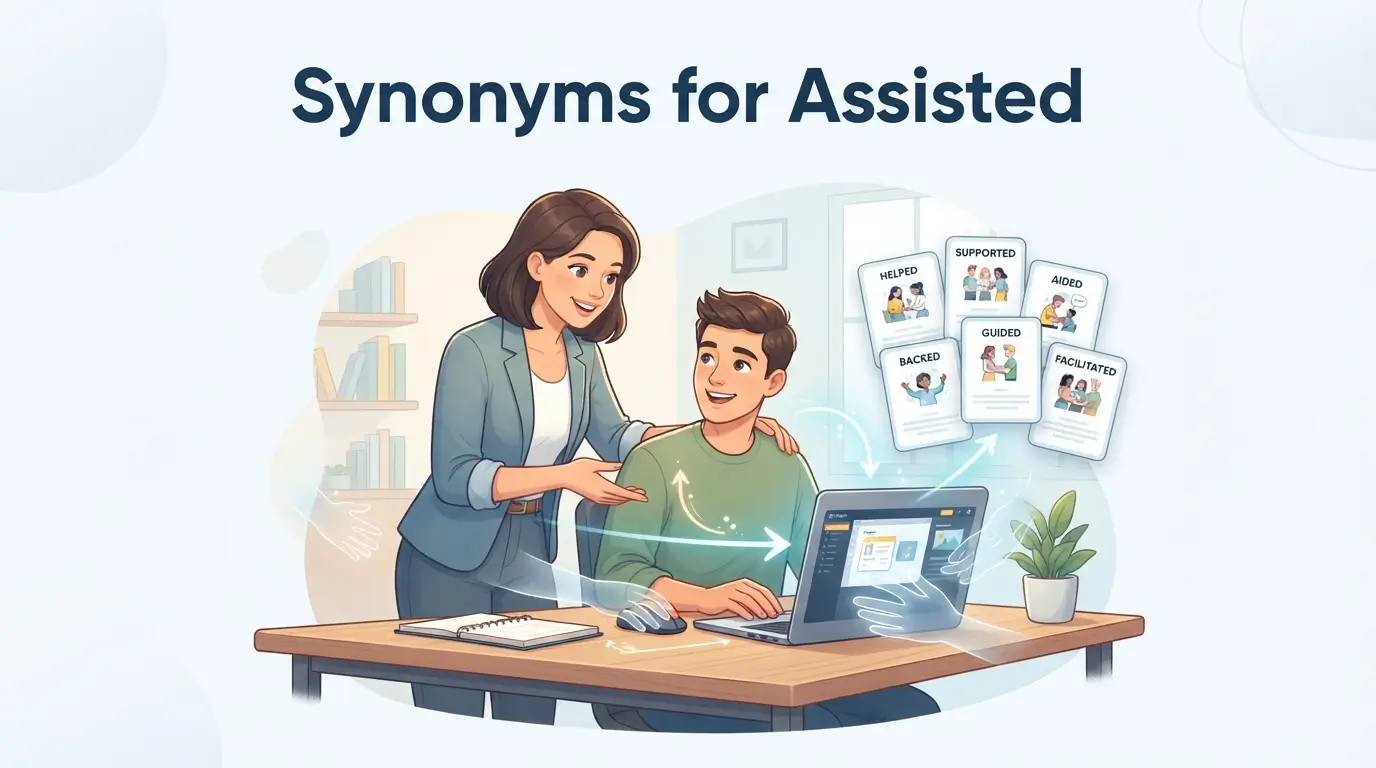

Synonyms for assisted become useful when you want your English to sound more precise. Imagine a student who receives help with a difficult assignment or a colleague who helps finish a project on time.
In both cases, you could say someone “assisted,” but another word may express the situation more clearly. Words such as “helped,” “aided,” and “supported” can add useful differences.
Learning synonyms for assisted helps students, bloggers, writers, and everyday English users avoid repeating the same word. It also makes communication more natural.
The word “assisted” is common because people often describe help in work, education, healthcare, customer service, and daily situations. Knowing synonyms for assisted gives you more choices.
What Does “Assisted” Really Mean?
“Assisted” is the past tense and past participle of the verb assist. It means helped someone do something or made a task easier to complete.
For example:
“The teacher assisted the student with the project.”
This means the teacher helped the student complete the project.
Native speakers usually understand “assisted” as a relatively neutral word. It often sounds slightly more formal than “helped.”
You may see it in professional, academic, medical, technical, and everyday contexts.
Part of speech: Verb
Simple definition: Assisted means helped someone or supported an activity, task, or process.
The word can describe direct physical help, intellectual guidance, practical support, or participation in completing something.
Connotative Meaning
What is connotation? (Connotation is the feeling, association, or implied meaning that a word can carry beyond its basic dictionary definition.)
Positive Tone
“Assisted” can have a positive tone when it describes useful cooperation or meaningful support.
For example:
“The volunteer assisted elderly visitors.”
Here, the word suggests helpful action and cooperation.
Negative Tone
“Assisted” itself is usually not negative. However, some related words can suggest unwanted or harmful help.
For example, abetted can describe helping someone commit wrongdoing.
Neutral Tone
“Assisted” is mainly neutral. It simply tells us that someone helped another person or contributed to a task.
That neutral quality makes it suitable for many professional and academic situations.
Etymology
The word assist comes from Latin assistere, meaning “to stand by” or “to stand near.” It developed through French forms before entering English.
Old English: 450–1100
“Assist” was not a standard native Old English word. Old English mainly used Germanic vocabulary for ideas such as helping, supporting, and serving.
Middle English: 1100–1500
The word entered English through Anglo-French and Middle French forms influenced by Latin. Its sense developed around standing by, helping, or being present to support someone.
Modern English: 1500–Present
“Assist” became firmly established in Modern English. Today, “assisted” appears in everyday speech as well as professional, academic, medical, technical, and administrative writing.
Pronunciation
Assisted
- US: /əˈsɪstɪd/
- UK: /əˈsɪstɪd/
Syllables
as-sist-ed
Affixation Pattern of Assisted
Root: sist
Prefix: as- (historically related to Latin ad- meaning “to” or “toward”)
Suffix: -ed
The modern English word is best understood as assist + -ed, where -ed marks the past tense or past participle.
Synonyms List
Below are 40 useful synonyms and close alternatives for “assisted.” Some are exact replacements in many contexts, while others work better in specific situations.
Helped (Verb) — US: /hɛlpt/ | UK: /hɛlpt/
Meaning: Helped means gave someone support or made something easier to do.
Examples:
- My brother helped me move the furniture.
- She helped her friend prepare for the interview.
Aided (Verb) — US: /ˈeɪdɪd/ | UK: /ˈeɪdɪd/
Meaning: Aided means provided help or support to someone or something.
Examples:
- The guide aided the visitors during the tour.
- New software aided the research team.
Supported (Verb) — US: /səˈpɔrtɪd/ | UK: /səˈpɔːtɪd/
Meaning: Supported means gave help, encouragement, or practical assistance.
Examples:
- Her parents supported her career choice.
- The charity supported families after the storm.
Backed (Verb) — US: /bækt/ | UK: /bækt/
Meaning: Backed means supported a person, idea, plan, or effort.
Examples:
- Several colleagues backed his proposal.
- The community backed the local project.
Facilitated (Verb) — US: /fəˈsɪləˌteɪtɪd/ | UK: /fəˈsɪlɪteɪtɪd/
Meaning: Facilitated means made an action or process easier.
Examples:
- The manager facilitated communication between the teams.
- The new system facilitated faster reporting.
Served (Verb) — US: /sɜrvd/ | UK: /sɜːvd/
Meaning: Served can mean provided useful help or fulfilled a helpful purpose.
Examples:
- The assistant served as a link between the departments.
- This guide served as a useful reference for students.
Guided (Verb) — US: /ˈɡaɪdɪd/ | UK: /ˈɡaɪdɪd/
Meaning: Guided means helped someone by giving direction or advice.
Examples:
- The mentor guided me through the application.
- Her teacher guided the class toward the correct answer.
Advised (Verb) — US: /ədˈvaɪzd/ | UK: /ədˈvaɪzd/
Meaning: Advised means gave someone suggestions or useful information.
Examples:
- The lawyer advised him to read the contract carefully.
- My supervisor advised me on the next step.
Counseled (Verb) — US: /ˈkaʊnsəld/ | UK: /ˈkaʊnsəld/
Meaning: Counseled means gave careful advice or guidance.
Examples:
- The counselor counseled students about career choices.
- The manager counseled the employee after the incident.
Mentored (Verb) — US: /ˈmɛntərd/ | UK: /ˈmentɔːd/
Meaning: Mentored means helped someone develop skills through guidance and experience.
Examples:
- She mentored several young writers.
- His manager mentored him during his first year.
Coached (Verb) — US: /koʊtʃt/ | UK: /kəʊtʃt/
Meaning: Coached means trained or guided someone toward better performance.
Examples:
- The trainer coached the new employees.
- Her instructor coached her before the competition.
Trained (Verb) — US: /treɪnd/ | UK: /treɪnd/
Meaning: Trained means taught someone the skills needed for a task or role.
Examples:
- The company trained new staff members.
- The nurse trained the volunteers in basic procedures.
Educated (Verb) — US: /ˈɛdʒəˌkeɪtɪd/ | UK: /ˈedʒʊkeɪtɪd/
Meaning: Educated means taught someone knowledge or skills.
Examples:
- The program educated parents about online safety.
- The campaign educated people about recycling.
Instructed (Verb) — US: /ɪnˈstrʌktɪd/ | UK: /ɪnˈstrʌktɪd/
Meaning: Instructed means gave someone directions or taught them how to do something.
Examples:
- The technician instructed us how to operate the device.
- The teacher instructed the students to check their answers.
Directed (Verb) — US: /dəˈrɛktɪd/ | UK: /daɪˈrektɪd/
Meaning: Directed means guided someone toward an action, place, or goal.
Examples:
- The receptionist directed me to the correct office.
- The supervisor directed the team during the emergency.
Advised (Verb) — US: /ədˈvaɪzd/ | UK: /ədˈvaɪzd/
Meaning: Advised means offered information or recommendations to help someone decide.
Examples:
- The doctor advised him to rest.
- She advised the team about the presentation format.
Encouraged (Verb) — US: /ɪnˈkɜrɪdʒd/ | UK: /ɪnˈkʌrɪdʒd/
Meaning: Encouraged means gave someone confidence or motivation to act.
Examples:
- Her friends encouraged her to apply.
- The teacher encouraged students to ask questions.
Motivated (Verb) — US: /ˈmoʊtəˌveɪtɪd/ | UK: /ˈməʊtɪveɪtɪd/
Meaning: Motivated means helped create the desire or energy to achieve something.
Examples:
- The coach motivated the players before the match.
- Her success motivated me to study harder.
Strengthened (Verb) — US: /ˈstrɛŋθənd/ | UK: /ˈstreŋθənd/
Meaning: Strengthened means made something or someone stronger or more capable.
Examples:
- The training strengthened his communication skills.
- Their cooperation strengthened the entire team.
Reinforced (Verb) — US: /ˌriːɪnˈfɔrst/ | UK: /ˌriːɪnˈfɔːst/
Meaning: Reinforced means gave additional support to something already present.
Examples:
- The examples reinforced the main lesson.
- Extra staff reinforced the security team.
Collaborated (Verb) — US: /kəˈlæbəˌreɪtɪd/ | UK: /kəˈlæbəreɪtɪd/
Meaning: Collaborated means worked together to achieve a shared goal.
Examples:
- The two departments collaborated on the report.
- Local artists collaborated on the project.
Cooperated (Verb) — US: /koʊˈɑpəˌreɪtɪd/ | UK: /kəʊˈɒpəreɪtɪd/
Meaning: Cooperated means worked willingly with others.
Examples:
- Everyone cooperated during the event.
- The witnesses cooperated with the investigation.
Contributed (Verb) — US: /kənˈtrɪbjətɪd/ | UK: /kənˈtrɪbjʊtɪd/
Meaning: Contributed means gave time, effort, ideas, or resources to something.
Examples:
- Several writers contributed to the magazine.
- She contributed valuable ideas during the meeting.
Participated (Verb) — US: /pɑrˈtɪsəˌpeɪtɪd/ | UK: /pɑːˈtɪsɪpeɪtɪd/
Meaning: Participated means took part in an activity or event.
Examples:
- More than fifty students participated in the workshop.
- I participated in the community cleanup.
Volunteered (Verb) — US: /ˌvɑlənˈtɪrd/ | UK: /ˌvɒlənˈtɪəd/
Meaning: Volunteered means offered help or service willingly.
Examples:
- Several parents volunteered at the school.
- He volunteered to organize the files.
Attended (Verb) — US: /əˈtɛndɪd/ | UK: /əˈtendɪd/
Meaning: Attended can mean provided care, service, or attention to someone.
Examples:
- A nurse attended the injured passenger.
- The staff attended to every guest promptly.
Accompanied (Verb) — US: /əˈkʌmpənid/ | UK: /əˈkʌmpənid/
Meaning: Accompanied means went somewhere with someone, often to provide support.
Examples:
- Her sister accompanied her to the appointment.
- A guide accompanied the group through the museum.
Assisted (Verb) — US: /əˈsɪstɪd/ | UK: /əˈsɪstɪd/
Meaning: Assisted means helped someone complete a task or deal with a situation.
Examples:
- The receptionist assisted the visitors.
- A technician assisted us with the installation.
Helped Out (Phrasal Verb) — US: /hɛlpt aʊt/ | UK: /helpt aʊt/
Meaning: Helped out means gave practical help, especially when someone needed it.
Examples:
- Can you help me out with these boxes?
- My neighbor helped out while I was away.
Lent a Hand (Phrase) — US: /lɛnt ə hænd/ | UK: /lent ə hænd/
Meaning: Lent a hand means offered practical help.
Examples:
- My friends lent a hand during the move.
- Dad lent a hand in the kitchen.
Pitched In (Phrasal Verb) — US: /pɪtʃt ɪn/ | UK: /pɪtʃt ɪn/
Meaning: Pitched in means joined others in helping with a task.
Examples:
- Everyone pitched in after the event.
- The whole family pitched in to clean the house.
Took Part (Phrase) — US: /tʊk pɑrt/ | UK: /tʊk pɑːt/
Meaning: Took part means participated in an activity.
Examples:
- I took part in the school debate.
- They took part in the community program.
Made Easier (Phrase) — US: /meɪd ˈiːziər/ | UK: /meɪd ˈiːziə/
Meaning: Made easier means reduced the difficulty of an action or task.
Examples:
- The checklist made the process easier.
- Her explanation made the lesson easier.
Simplified (Verb) — US: /ˈsɪmpləˌfaɪd/ | UK: /ˈsɪmplɪfaɪd/
Meaning: Simplified means made something easier to understand or complete.
Examples:
- The teacher simplified the difficult concept.
- The new form simplified the application process.
Enabled (Verb) — US: /ɪˈneɪbəld/ | UK: /ɪˈneɪbəld/
Meaning: Enabled means made it possible for someone to do something.
Examples:
- The scholarship enabled her to continue studying.
- Better equipment enabled the team to work faster.
Empowered (Verb) — US: /ɪmˈpaʊərd/ | UK: /ɪmˈpaʊəd/
Meaning: Empowered means gave someone the confidence, authority, or ability to act.
Examples:
- The training empowered employees to solve problems.
- Education empowered the community to make informed choices.
Supplied (Verb) — US: /səˈplaɪd/ | UK: /səˈplaɪd/
Meaning: Supplied means provided something needed for a task or purpose.
Examples:
- The organization supplied food to the families.
- The school supplied students with learning materials.
Provided (Verb) — US: /prəˈvaɪdɪd/ | UK: /prəˈvaɪdɪd/
Meaning: Provided means gave something useful or necessary.
Examples:
- The company provided training for new staff.
- The website provided useful background information.
Furnished (Verb) — US: /ˈfɜrnɪʃt/ | UK: /ˈfɜːnɪʃt/
Meaning: Furnished means supplied something that was needed.
Examples:
- The office furnished the team with new equipment.
- The report furnished useful evidence for the study.
Promoted (Verb) — US: /prəˈmoʊtɪd/ | UK: /prəˈməʊtɪd/
Meaning: Promoted means supported or encouraged the development of something.
Examples:
- The campaign promoted healthy eating.
- The teacher promoted teamwork in class.
Advanced (Verb) — US: /ədˈvænst/ | UK: /ədˈvɑːnst/
Meaning: Advanced means helped something progress or develop.
Examples:
- The research advanced our understanding of the topic.
- Her work advanced the project considerably.
Abetted (Verb) — US: /əˈbɛtɪd/ | UK: /əˈbetɪd/
Meaning: Abetted means helped or encouraged someone to do something, usually something wrong.
Examples:
- The suspect was accused of abetting the crime.
- He knowingly abetted the illegal activity.
Note: “Abetted” is not a neutral replacement for “assisted.” It normally carries a negative meaning.
Synonyms for “Assisted” by Tone
Tone matters because two words can communicate help while creating very different impressions.
Positive
These choices can emphasize useful cooperation, growth, or encouragement:
- Supported
- Guided
- Mentored
- Encouraged
- Empowered
- Strengthened
- Reinforced
- Coached
- Motivated
- Volunteered
These words work well when the helper plays an active and constructive role.
Neutral
These options usually describe help without adding a strong emotional judgment:
- Helped
- Assisted
- Aided
- Facilitated
- Provided
- Supplied
- Contributed
- Participated
- Attended
- Accompanied
- Enabled
- Simplified
They fit many everyday, academic, and professional contexts.
Negative
A few related words can suggest problematic assistance:
- Abetted
- Backed, when used in a harmful context
- Enabled, when the context involves harmful behavior
Context determines the tone. For example, “enabled the team to succeed” sounds positive, while “enabled harmful behavior” sounds negative.
Playful / Informal
These expressions sound more conversational:
- Helped out
- Lent a hand
- Pitched in
- Took part
They are useful in casual conversations but may sound less formal in academic writing.
“Assisted” vs Close Alternatives
Assisted vs Helped
The terms assisted and helped have almost the same basic meaning.
“Helped” is more common in everyday English and usually sounds natural in conversation.
“Assisted” often sounds more formal or professional.
- Everyday: “She helped me with my homework.”
- Formal: “She assisted me with the research.”
Assisted vs Aided
“Aided” is close to “assisted,” but it can sound more formal or literary.
Use “aided” when you want to emphasize that someone or something contributed to a successful result.
- “The nurse assisted the patient.”
- “The new technology aided the research.”
Assisted vs Supported
“Supported” can mean more than direct help. It may involve emotional encouragement, financial resources, practical assistance, or approval.
For example, a friend can support your career even without directly completing any task for you.
How “Assisted” Changes by Context
Daily Conversation
In casual speech, helped is usually the most natural choice.
Instead of saying:
“My brother assisted me with my bags.”
Most speakers would simply say:
“My brother helped me with my bags.”
“Assisted” is still grammatically correct, but it sounds more formal.
Writing or Blogging
Writers can use “assisted” when they want a professional tone.
For example:
“The research assistant assisted the author with data collection.”
However, writers should not use “assisted” repeatedly. Alternatives such as “supported,” “guided,” and “facilitated” can make the text more varied.
Professional or Academic Tone
“Assisted,” “aided,” “facilitated,” and “supported” work well in professional and academic contexts.
The best choice depends on the exact type of help.
A person can guide a process, facilitate an activity, support a team, or aid an investigation.
Creative or Informal Use
Creative writing often benefits from more expressive choices.
Instead of:
“He assisted his friend.”
You might write:
“He lent a hand when his friend needed help.”
This creates a warmer and more conversational feeling.
Common Mistakes & Native Usage
Mistake 1: Using “Assisted” Everywhere
“Assisted” is useful, but repeating it can make writing sound stiff.
Instead, choose a word that explains the exact kind of help.
Use guided for direction, mentored for long-term development, and facilitated for making a process easier.
Mistake 2: Treating Every Synonym as Interchangeable
Synonyms rarely have exactly the same meaning in every sentence.
For example, “participated” means took part, while “assisted” means helped. Someone can participate without actually helping.
Mistake 3: Using “Abetted” as a Simple Synonym
This is an important distinction.
“Abetted” often refers to helping someone do something wrong. Therefore, replacing “assisted” with “abetted” can completely change the meaning.
Mistake 4: Ignoring Formality
“Lent a hand” sounds friendly and conversational.
“Facilitated” sounds professional.
“Helped” works across many situations.
Choosing the right register makes your English sound more natural.
Register Notes
Formal: facilitated, aided, advised, counseled, provided
Neutral: helped, assisted, supported, guided
Informal: helped out, lent a hand, pitched in
Professional: facilitated, supported, advised, enabled
Negative or problematic: abetted
Real-Life Examples Using “Assisted”
Workplace
A new employee struggles with a complicated reporting system. A colleague shows the employee each step.
You could say:
“The senior employee assisted the new team member with the report.”
Or:
“The senior employee guided the new team member through the report.”
Social Situation
A neighbor helps someone carry heavy furniture upstairs.
You could say:
“My neighbor helped me move the furniture.”
“Helped” sounds more natural than “assisted” in this casual situation.
Media and Pop Culture
A documentary may describe a producer who helped a director organize interviews.
A professional sentence could be:
“The producer assisted the director during the filming process.”
Writing and Storytelling
A character may support another character during a difficult moment.
Instead of repeatedly using “assisted,” a writer could use “supported,” “guided,” or “lent a hand,” depending on the scene.
Practice Exercise: Choose the Best Synonym
Choose the word or phrase that best fits each situation.
Question 1
The teacher gave the student useful directions during the project.
A. Abetted
B. Guided
C. Pitched in
D. Furnished
Question 2
Everyone joined together to clean the community center.
A. Pitched in
B. Advised
C. Counseled
D. Directed
Question 3
The lawyer gave her client professional advice.
A. Participated
B. Accompanied
C. Advised
D. Simplified
Question 4
The new software made the reporting process easier.
A. Facilitated
B. Mentored
C. Volunteered
D. Attended
Question 5
A senior employee helped a junior employee develop professional skills over several months.
A. Supplied
B. Mentored
C. Backed
D. Attended
Question 6
A friend gave you practical help while you moved to a new house.
A. Lent a hand
B. Counseled
C. Advanced
D. Educated
Question 7
The charity gave families food and other necessary materials.
A. Guided
B. Supplied
C. Coached
D. Participated
Question 8
The trainer taught new workers how to use the equipment.
A. Trained
B. Backed
C. Contributed
D. Accompanied
Question 9
The organization encouraged people to learn about environmental protection.
A. Promoted
B. Abetted
C. Directed
D. Furnished
Question 10
The suspect knowingly helped another person commit a crime.
A. Supported
B. Guided
C. Abetted
D. Volunteered
Question 11
The scholarship made it possible for the student to continue studying.
A. Enabled
B. Attended
C. Helped out
D. Participated
Question 12
Several employees willingly joined the project and worked together.
A. Cooperated
B. Counseled
C. Furnished
D. Advised
Answer Key: 1-B | 2-A | 3-C | 4-A | 5-B | 6-A | 7-B | 8-A | 9-A | 10-C | 11-A | 12-A
Reflection Task
Write three short sentences using helped, assisted, and supported. Then explain how the tone or meaning changes in each sentence.
Conclusion
Learning synonyms for assisted gives you more than a longer vocabulary list. It helps you choose words that match the exact type of help you want to describe.
“Helped” sounds natural in daily English, while “facilitated,” “aided,” and “supported” can fit more specific situations. Small choices can improve clarity.
For students, bloggers, and writers, these alternatives reduce repetition and make ideas easier to understand. They also make emails, essays, and articles sound more natural.
Keep practicing these words in real sentences. Try using them in emails, essays, and daily conversations, and notice how each one changes the meaning or tone.