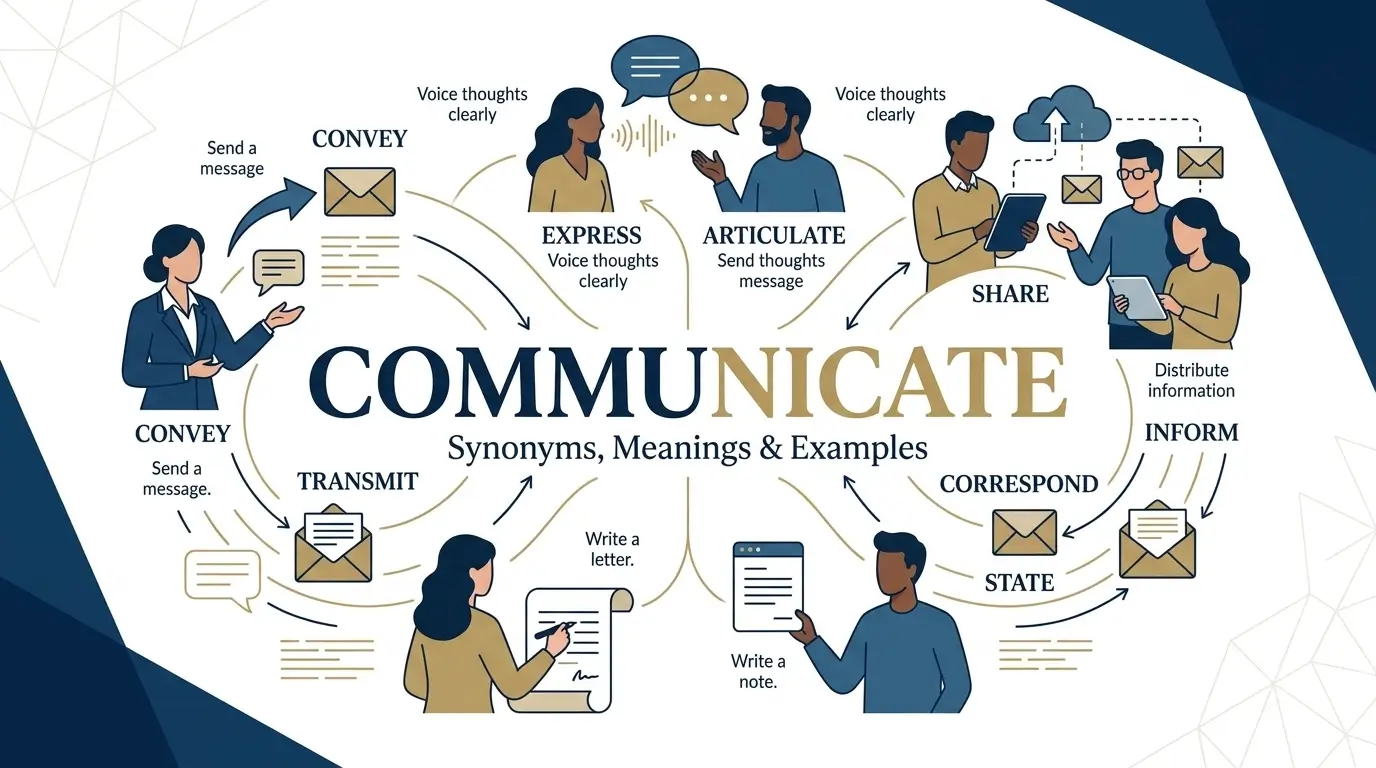

Synonyms for communicate can help you express ideas without using the same word again and again. Imagine writing an important email and repeating “communicate” in every sentence. Your writing may quickly sound repetitive.
People communicate every day in different ways. They speak, write, explain, signal, and share ideas. Choosing the right alternative can make your message clearer and more natural.
Learning synonyms for communicate also helps you build a stronger vocabulary. Students can improve essays, while bloggers and content writers can make their work more engaging and precise.
Whether you communicate at work, in class, online, or with friends, the right word matters. This guide explains useful synonyms with meanings, pronunciation, examples, and contexts.
What Does “Communicate” Really Mean?
Communicate is mainly a verb. It means to share or exchange information, ideas, thoughts, or feelings with another person or group.
You communicate when you speak to a friend, send an email, explain instructions, or use body language.
Native speakers use communicate in both formal and everyday situations. The word usually focuses on sharing information in a way that another person can understand.
It commonly appears in personal conversations, workplaces, education, media, technology, and professional writing.
Simple definition: To communicate means to give, receive, or exchange information and ideas.
Connotative Meaning
What is connotation? (The emotional or cultural feeling that a word suggests beyond its basic meaning.)
Positive Tone
Words such as connect, engage, and share can suggest openness, understanding, and cooperation.
Negative Tone
Words such as broadcast, dictate, or lecture may sound one-sided in some situations.
Neutral Tone
Words such as inform, convey, state, and transmit usually sound factual and emotionally neutral.
Tone matters because communication is not only about information. Your word choice can also show attitude and purpose.
Etymology
The word communicate comes from the Latin word communicare, which means “to share” or “to make common.”
Old English (450–1100)
Old English did not commonly use the modern word communicate. Speakers used native words connected with speaking, telling, and sharing information.
Middle English (1100–1500)
Latin and French strongly influenced English during this period. Words related to communicate gradually entered learned and formal English.
Modern English (1500–Present)
The word developed its modern meaning of sharing information, thoughts, feelings, and messages.
Today, people use it for speech, writing, signals, technology, media, and body language.
Pronunciation
- US: /kəˈmjuːnəkeɪt/
- UK: /kəˈmjuːnɪkeɪt/
Syllables
com-mu-ni-cate
Affixation Pattern of Communicate
Root: communic
Prefix: None in modern English analysis
Suffix: -ate
Related forms include communication and communicative.
Synonyms List
Here are useful alternatives for communicate. Each word has its own meaning and works best in a specific context.
Converse (Verb) — US /kənˈvɜːrs/ | UK /kənˈvɜːs/
Meaning: To talk with someone in a two-way conversation.
Examples:
- They conversed for hours after dinner.
- I enjoy conversing with new people.
Talk (Verb) — US /tɔːk/ | UK /tɔːk/
Meaning: To speak with someone in an informal or general way.
Examples:
- We need to talk about the project.
- She talked with her teacher after class.
Speak (Verb) — US /spiːk/ | UK /spiːk/
Meaning: To say words aloud or address someone.
Examples:
- Please speak clearly during the meeting.
- He spoke to the manager yesterday.
Discuss (Verb) — US /dɪˈskʌs/ | UK /dɪˈskʌs/
Meaning: To talk about a subject in detail with others.
Examples:
- Let’s discuss the new plan.
- The students discussed the novel.
Interact (Verb) — US /ˌɪntərˈækt/ | UK /ˌɪntərˈækt/
Meaning: To communicate and respond to another person or group.
Examples:
- Children interact through play.
- The brand interacts with customers online.
Connect (Verb) — US /kəˈnekt/ | UK /kəˈnekt/
Meaning: To establish understanding or communication with someone.
Examples:
- Good teachers connect with students.
- The speaker connected with the audience.
Engage (Verb) — US /ɪnˈɡeɪdʒ/ | UK /ɪnˈɡeɪdʒ/
Meaning: To involve someone in meaningful communication.
Examples:
- The campaign engaged young readers.
- Try to engage your audience with questions.
Correspond (Verb) — US /ˌkɔːrəˈspɑːnd/ | UK /ˌkɒrəˈspɒnd/
Meaning: To communicate, especially through letters or messages.
Examples:
- We corresponded by email.
- She regularly corresponds with her editor.
Exchange (Verb) — US /ɪksˈtʃeɪndʒ/ | UK /ɪksˈtʃeɪndʒ/
Meaning: To give and receive information or ideas.
Examples:
- The teams exchanged useful ideas.
- We exchanged phone numbers.
Share (Verb) — US /ʃer/ | UK /ʃeə/
Meaning: To give information, ideas, or feelings to others.
Examples:
- Please share your opinion.
- He shared the news with his family.
Convey (Verb) — US /kənˈveɪ/ | UK /kənˈveɪ/
Meaning: To successfully express an idea, feeling, or message.
Examples:
- Her face conveyed surprise.
- The article conveys an important message.
Express (Verb) — US /ɪkˈspres/ | UK /ɪkˈspres/
Meaning: To show or state thoughts and feelings.
Examples:
- She expressed her concerns calmly.
- Art can express deep emotions.
Articulate (Verb) — US /ɑːrˈtɪkjəleɪt/ | UK /ɑːˈtɪkjəleɪt/
Meaning: To express an idea clearly and effectively.
Examples:
- He articulated his point well.
- She can articulate complex ideas simply.
Voice (Verb) — US /vɔɪs/ | UK /vɔɪs/
Meaning: To openly express an opinion or concern.
Examples:
- Employees voiced their concerns.
- She voiced her support for the plan.
State (Verb) — US /steɪt/ | UK /steɪt/
Meaning: To clearly say or write information.
Examples:
- The report states the facts.
- Please state your reason clearly.
Declare (Verb) — US /dɪˈkler/ | UK /dɪˈkleə/
Meaning: To communicate something openly and firmly.
Examples:
- The leader declared his decision.
- She declared her intentions clearly.
Announce (Verb) — US /əˈnaʊns/ | UK /əˈnaʊns/
Meaning: To communicate news publicly.
Examples:
- They announced the winner today.
- The company announced a major change.
Inform (Verb) — US /ɪnˈfɔːrm/ | UK /ɪnˈfɔːm/
Meaning: To give someone important information.
Examples:
- Please inform me of any changes.
- The school informed parents quickly.
Notify (Verb) — US /ˈnoʊtɪfaɪ/ | UK /ˈnəʊtɪfaɪ/
Meaning: To officially tell someone about something.
Examples:
- Please notify the office immediately.
- The app notified users about the update.
Advise (Verb) — US /ədˈvaɪz/ | UK /ədˈvaɪz/
Meaning: To communicate guidance or recommendations.
Examples:
- The lawyer advised her to wait.
- Please advise us about the next step.
Brief (Verb) — US /briːf/ | UK /briːf/
Meaning: To give someone important information in a short form.
Examples:
- The manager briefed the team.
- She briefed us before the event.
Explain (Verb) — US /ɪkˈspleɪn/ | UK /ɪkˈspleɪn/
Meaning: To communicate information in a way that helps others understand.
Examples:
- Can you explain this rule?
- The guide explained the process clearly.
Describe (Verb) — US /dɪˈskraɪb/ | UK /dɪˈskraɪb/
Meaning: To communicate details about someone or something.
Examples:
- Please describe what happened.
- She described the place beautifully.
Relate (Verb) — US /rɪˈleɪt/ | UK /rɪˈleɪt/
Meaning: To tell or communicate a story or experience.
Examples:
- He related the events in detail.
- She related an interesting experience.
Recount (Verb) — US /rɪˈkaʊnt/ | UK /rɪˈkaʊnt/
Meaning: To communicate a story by telling events.
Examples:
- She recounted her journey.
- He recounted the incident calmly.
Report (Verb) — US /rɪˈpɔːrt/ | UK /rɪˈpɔːt/
Meaning: To communicate facts or events formally.
Examples:
- The journalist reported the news.
- Please report the problem immediately.
Present (Verb) — US /prɪˈzent/ | UK /prɪˈzent/
Meaning: To communicate information to an audience in an organized way.
Examples:
- She presented her findings.
- They presented the plan to the team.
Demonstrate (Verb) — US /ˈdemənstreɪt/ | UK /ˈdemənstreɪt/
Meaning: To communicate an idea by showing it clearly.
Examples:
- The teacher demonstrated the technique.
- His actions demonstrated confidence.
Signal (Verb) — US /ˈsɪɡnəl/ | UK /ˈsɪɡnəl/
Meaning: To communicate through a sign, movement, or action.
Examples:
- She signaled for help.
- The light signaled that the machine was ready.
Gesture (Verb) — US /ˈdʒestʃər/ | UK /ˈdʒestʃə/
Meaning: To communicate through physical movement.
Examples:
- He gestured toward the door.
- She gestured for me to sit down.
Indicate (Verb) — US /ˈɪndɪkeɪt/ | UK /ˈɪndɪkeɪt/
Meaning: To communicate or show information indirectly.
Examples:
- The results indicate progress.
- Her silence indicated concern.
Impart (Verb) — US /ɪmˈpɑːrt/ | UK /ɪmˈpɑːt/
Meaning: To communicate knowledge or information.
Examples:
- Teachers impart valuable knowledge.
- She imparted useful advice.
Transmit (Verb) — US /trænzˈmɪt/ | UK /trænzˈmɪt/
Meaning: To send information, signals, or messages.
Examples:
- The device transmits data quickly.
- Radio stations transmit programs daily.
Broadcast (Verb) — US /ˈbrɔːdkæst/ | UK /ˈbrɔːdkɑːst/
Meaning: To communicate information to a large audience.
Examples:
- The station broadcast the interview.
- They broadcast the announcement live.
Disseminate (Verb) — US /dɪˈsemɪneɪt/ | UK /dɪˈsemɪneɪt/
Meaning: To spread information widely.
Examples:
- Researchers disseminate their findings.
- The organization disseminated safety advice.
Publicize (Verb) — US /ˈpʌblɪsaɪz/ | UK /ˈpʌblɪsaɪz/
Meaning: To communicate information publicly to gain attention.
Examples:
- The group publicized the event online.
- They publicized the campaign widely.
Liaise (Verb) — US /liˈeɪz/ | UK /liˈeɪz/
Meaning: To communicate and cooperate between people or groups.
Examples:
- She liaises with several departments.
- The manager liaised with the client.
Confer (Verb) — US /kənˈfɜːr/ | UK /kənˈfɜː/
Meaning: To communicate by discussing something together.
Examples:
- The doctors conferred before deciding.
- We conferred about the proposal.
Negotiate (Verb) — US /nɪˈɡoʊʃieɪt/ | UK /nɪˈɡəʊʃieɪt/
Meaning: To communicate to reach an agreement.
Examples:
- The companies negotiated for weeks.
- She negotiated a fair solution.
Consult (Verb) — US /kənˈsʌlt/ | UK /kənˈsʌlt/
Meaning: To communicate with someone to seek advice or information.
Examples:
- Consult your supervisor first.
- The team consulted an expert.
Tell (Verb) — US /tel/ | UK /tel/
Meaning: To communicate information directly to someone.
Examples:
- Please tell me the truth.
- She told us about the change.
Message (Verb) — US /ˈmesɪdʒ/ | UK /ˈmesɪdʒ/
Meaning: To communicate with someone through a written digital message.
Examples:
- Message me when you arrive.
- He messaged his colleague this morning.
Write (Verb) — US /raɪt/ | UK /raɪt/
Meaning: To communicate ideas through written words.
Examples:
- She wrote to her professor.
- Write your thoughts in a journal.
Reach Out (Verb Phrase) — US /riːtʃ aʊt/ | UK /riːtʃ aʊt/
Meaning: To contact someone and begin communication.
Examples:
- Feel free to reach out anytime.
- She reached out to an old friend.
Get Across (Phrasal Verb) — US /ɡet əˈkrɔːs/ | UK /ɡet əˈkrɒs/
Meaning: To successfully communicate an idea.
Examples:
- He got his point across clearly.
- The writer gets the message across well.
Put Across (Phrasal Verb) — US /pʊt əˈkrɔːs/ | UK /pʊt əˈkrɒs/
Meaning: To explain or communicate an idea effectively.
Examples:
- She put her ideas across confidently.
- The teacher put the lesson across simply.
Make Known (Verb Phrase) — US /meɪk noʊn/ | UK /meɪk nəʊn/
Meaning: To communicate information so others become aware of it.
Examples:
- He made his decision known.
- The company made the policy known.
Reveal (Verb) — US /rɪˈviːl/ | UK /rɪˈviːl/
Meaning: To communicate information that was previously hidden.
Examples:
- She revealed the final result.
- The report revealed new details.
Synonyms for “Communicate” by Tone
Tone matters because the same message can sound friendly, formal, direct, or distant depending on the word you choose.
Positive
Connect, engage, share, interact, exchange, and express often suggest openness and meaningful interaction.
Neutral
Inform, convey, state, explain, tell, describe, and transmit focus mainly on sharing information.
Formal
Articulate, disseminate, impart, notify, liaise, correspond, and convey work well in professional or academic writing.
Informal
Talk, message, reach out, get across, and put across sound more natural in relaxed conversation.
Negative or One-Sided
Broadcast, declare, and publicize can sometimes suggest communication that moves mainly in one direction.
“Communicate” vs Close Alternatives
Communicate vs Convey
The term Communicate is a broad word. It can involve speaking, writing, signals, or technology.
Convey focuses more closely on successfully expressing a specific meaning, feeling, or message.
Use communicate for the overall process. Use convey when the message itself is important.
Communicate vs Inform
Inform means giving someone facts or important information.
Communicate can include facts, emotions, opinions, and ideas.
Use inform when your main goal is to make someone aware of something.
Communicate vs Express
Express often focuses on feelings, opinions, and personal thoughts.
Communicate is broader and can include almost any form of information exchange.
Use express when emotion or personal opinion is important.
How “Communicate” Changes by Context
Daily Conversation
In everyday speech, people often say talk, tell, speak, or share instead of communicate.
For example, “We need to talk” sounds more natural than “We need to communicate” in many casual situations.
Writing or Blogging
Writers often use convey, express, explain, describe, and get across.
These alternatives help avoid repetition and make writing more precise.
You may also internally link related articles about synonyms for explain, synonyms for express, or synonyms for share when building a strong vocabulary content cluster.
Professional or Academic Tone
In formal settings, communicate, articulate, convey, disseminate, notify, and liaise often work well.
Choose a word that matches your audience and purpose.
Creative or Informal Use
Creative writing may use reveal, signal, gesture, voice, or express.
These words can show communication without repeatedly saying that someone communicated.
Common Mistakes Learners Make
A common mistake is treating every synonym as interchangeable.
For example, broadcast does not mean the same thing as talk. Broadcasting usually sends information to a large audience.
Another mistake is using communicate when a simpler word sounds more natural.
Instead of saying, “I communicated with my friend yesterday,” many native speakers simply say, “I talked to my friend yesterday.”
Learners also confuse communicate and communicate with.
You can communicate an idea to someone. You can also communicate with a person.
Register Notes
Formal vs informal: Use notify, disseminate, and articulate in formal situations. Use talk, tell, and message in casual situations.
Spoken vs written English: Phrasal verbs such as get across are common in speech. Words such as convey and disseminate appear more often in formal writing.
Native usage tip: Native speakers usually choose the most specific verb. Instead of repeatedly using communicate, they often describe exactly how the communication happened.
Real-Life Examples Using “Communicate”
Workplace
A manager must communicate clear goals to the team.
A more specific sentence could say, “The manager briefed the team on the new goals.”
Social Situations
Friends communicate through conversation, messages, and body language.
You might naturally say, “We talked about it over coffee.”
Media and Pop Culture
News organizations communicate information through reports and broadcasts.
A journalist may report an event, while a television station may broadcast it.
Writing or Storytelling
Writers communicate ideas through characters, scenes, and dialogue.
A strong story can convey emotion without directly explaining every feeling.
Exercise: Practice Synonyms for Communicate
Choose the Best Word
1. You need to officially tell employees about a schedule change.
A. Gesture
B. Notify
C. Recount
D. Converse
2. A writer wants to show a character’s feelings clearly.
A. Broadcast
B. Express
C. Negotiate
D. Liaise
3. Two friends are having a relaxed conversation.
A. Disseminate
B. Talk
C. Transmit
D. Declare
4. A teacher shows students exactly how to complete a task.
A. Demonstrate
B. Publicize
C. Correspond
D. Reveal
5. A television channel sends news to millions of viewers.
A. Consult
B. Broadcast
C. Confer
D. Gesture
Choose the Most Natural Alternative
6. You want to communicate your idea clearly during a presentation.
A. Get across
B. Notify
C. Signal
D. Recount
7. Researchers share their findings widely with the public.
A. Converse
B. Disseminate
C. Whisper
D. Gesture
8. A friend sends you a text on your phone.
A. Message
B. Declare
C. Impart
D. Demonstrate
9. Two departments communicate and coordinate their work.
A. Liaise
B. Broadcast
C. Reveal
D. Recount
10. A person openly shares an opinion during a meeting.
A. Voice
B. Transmit
C. Signal
D. Publicize
Test Your Understanding of Context
11. You give someone important facts they need to know.
A. Inform
B. Gesture
C. Negotiate
D. Recount
12. A speaker successfully makes the audience understand an important message.
A. Get across
B. Broadcast
C. Notify
D. Correspond
13. Two companies discuss terms to reach an agreement.
A. Negotiate
B. Reveal
C. Describe
D. Signal
14. Someone’s face silently shows that they feel worried.
A. Convey
B. Message
C. Correspond
D. Announce
15. You contact someone to begin a conversation.
A. Reach out
B. Recount
C. Broadcast
D. Declare
Answer Key: 1-B | 2-B | 3-B | 4-A | 5-B | 6-A | 7-B | 8-A | 9-A | 10-A | 11-A | 12-A | 13-A | 14-A | 15-A
Reflection Task
Think about a conversation, email, or message you had today. Which synonym for communicate best describes what you did? Write one or two sentences explaining your choice.
Conclusion
Learning synonyms for communicate gives you more control over your English. Instead of repeating one verb, you can choose words that match your exact meaning and situation.
A stronger vocabulary can improve writing, blogging, speaking, and daily communication. Small changes in word choice can make your ideas clearer and more natural.
Remember that synonyms are not always identical. Talk feels casual, convey focuses on meaning, and articulate highlights clear expression. Context helps you choose the right word.
Try using a few new alternatives in your next email, essay, blog post, or daily conversation. The more you practice, the easier it becomes to communicate with clarity and confidence