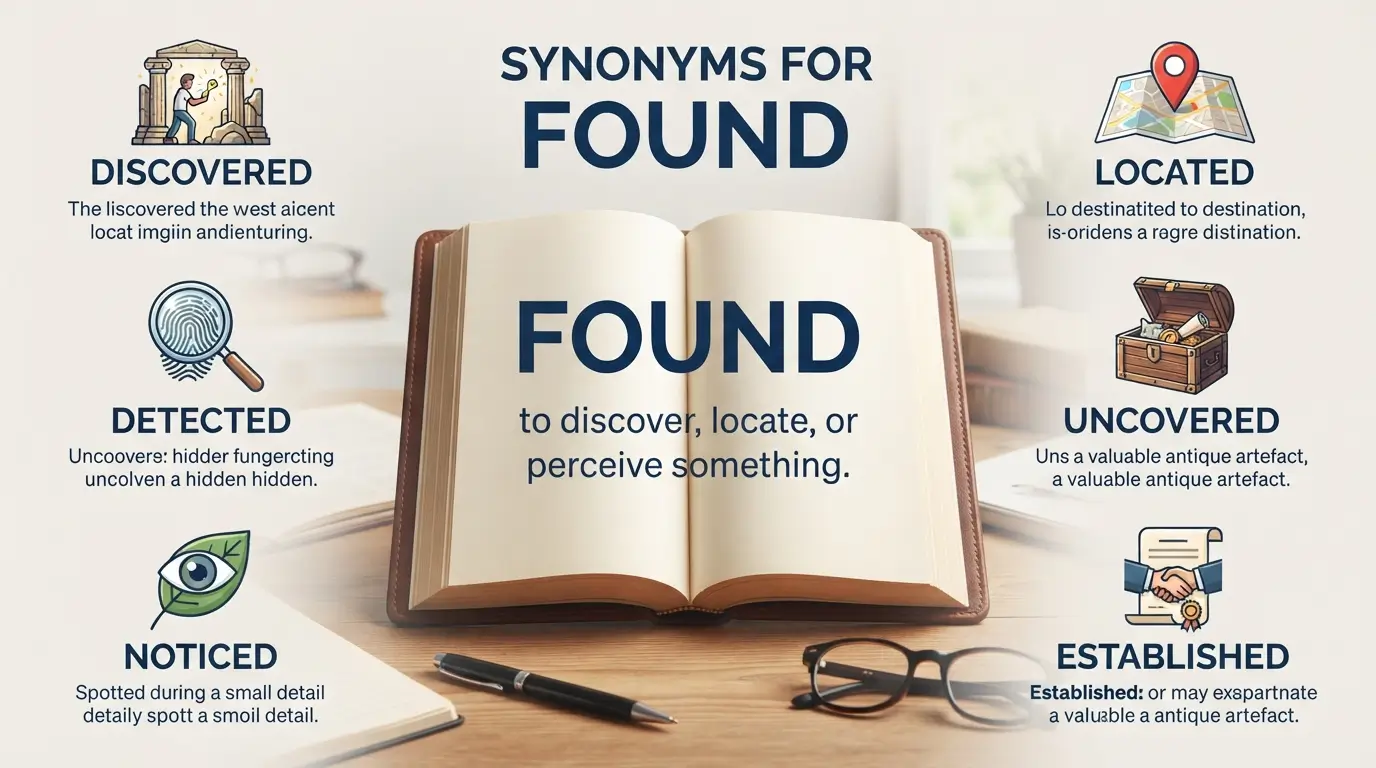

Synonyms for found can make a simple sentence much more precise. Imagine telling a friend, “I found my keys,” and then wanting to explain exactly how you discovered them or where they appeared.
A student may write “I found the answer,” while a blogger may choose “discovered” or “uncovered” for a stronger effect. These small choices can make English sound more natural.
Synonyms for found are especially useful because the word is extremely common. Students, bloggers, content writers, and daily English users all need alternatives to avoid repetition.
Learning synonyms for found also helps you understand context. The best replacement depends on whether you discovered something, located something, or established something new.
What Does “Found” Really Mean?
The word found has more than one important meaning in English.
In the most common sense, found is the past tense and past participle of find. It means that someone discovered, located, noticed, or came across something.
For example:
- “I found my wallet under the sofa.”
- “She found an interesting article online.”
- “We found the missing document.”
Native speakers use found naturally in everyday conversation, writing, journalism, academic work, and professional communication.
The word can describe finding a physical object, discovering information, noticing an idea, meeting something unexpectedly, or reaching an answer.
There is another meaning of found that comes from the verb found, meaning “to establish” or “to create.”
For example:
- “They founded a new school.”
- “The scientist founded the organization in 2010.”
In this second sense, found means to establish something, not to discover it.
So, context matters. If you say, “She found a company,” the meaning may be unclear or grammatically different from “She founded a company.”
As a vocabulary learner, it is important to separate these meanings before choosing a synonym.
Connotative Meaning
Connotation (the feeling or idea that a word suggests beyond its basic dictionary meaning) can change how found feels in a sentence.
Positive Tone
Found can suggest success, discovery, relief, or excitement.
“I finally found my lost phone” suggests a positive result.
Words such as discovered, uncovered, and identified can also create a sense of achievement.
Negative Tone
Found can sometimes appear in unpleasant situations.
For example:
- “The police found evidence at the scene.”
- “They found serious errors in the report.”
Words such as detected, uncovered, or exposed can sound more serious.
Neutral Tone
In most everyday situations, found is neutral.
“I found the book” simply states that someone located it.
The emotional effect usually comes from the surrounding words rather than from found itself.
Etymology of “Found”
The word found, in the sense of discovering or locating something, comes from the verb find.
Find developed from Old English findan, meaning “to find,” “discover,” or “come upon.” It is related to older Germanic forms that carried the idea of coming across or discovering something.
Old English: 450–1100
Old English used findan for the idea of finding, discovering, or coming upon something.
The modern form found did not exist exactly as it appears today, but it developed from this older Germanic verb.
Middle English: 1100–1500
During Middle English, forms of find became closer to modern English spelling and pronunciation.
The past-tense form eventually developed into found, which became the established form used with the verb find.
Modern English: 1500–Present
Modern English uses found as the past tense and past participle of find.
The separate verb found, meaning “establish,” has a different history. It comes through Old French and Latin and developed around the idea of establishing a base or foundation.
This distinction explains why found can have two very different meanings in modern English.
Pronunciation of “Found”
US: /faʊnd/
UK: /faʊnd/
Syllables
found
It is a one-syllable word.
Affixation Pattern of “Found”
Root: found / find
Prefix: none
Suffix: none
The word functions as an irregular past-tense form of find.
Synonyms List
The following alternatives focus mainly on found in the sense of discovering, locating, noticing, or obtaining something. Some later alternatives address the second meaning of found, which means establishing something.
Discovered (Verb) — US /dɪˈskʌvər/ | UK /dɪˈskʌvə/
Meaning: Discovered means found something that was previously unknown, hidden, or unnoticed.
Examples:
- Scientists discovered a new species in the forest.
- Maya discovered an old photo in her grandmother’s drawer.
Located (Verb) — US /ˈloʊkeɪtɪd/ | UK /ləʊˈkeɪtɪd/
Meaning: Located means found the exact place or position of something.
Examples:
- The team located the missing file quickly.
- We located the hotel using the street map.
Spotted (Verb) — US /ˈspɑːtɪd/ | UK /ˈspɒtɪd/
Meaning: Spotted means noticed or saw something, often suddenly.
Examples:
- I spotted Sarah near the entrance.
- He spotted a mistake in the final paragraph.
Noticed (Verb) — US /ˈnoʊtɪst/ | UK /ˈnəʊtɪst/
Meaning: Noticed means became aware of something through seeing, hearing, or observing it.
Examples:
- She noticed a strange mark on the wall.
- I noticed that the door was open.
Detected (Verb) — US /dɪˈtektɪd/ | UK /dɪˈtektɪd/
Meaning: Detected means found something that may be difficult to notice.
Examples:
- The test detected a small error.
- The sensor detected movement outside.
Identified (Verb) — US /aɪˈdentɪfaɪd/ | UK /aɪˈdentɪfaɪd/
Meaning: Identified means recognized or established exactly what something or someone was.
Examples:
- The researcher identified the main cause.
- Police identified the person from the photograph.
Uncovered (Verb) — US /ʌnˈkʌvərd/ | UK /ʌnˈkʌvəd/
Meaning: Uncovered means found something that was hidden or not previously known.
Examples:
- The journalist uncovered new evidence.
- Workers uncovered an old stone wall.
Revealed (Verb) — US /rɪˈviːld/ | UK /rɪˈviːld/
Meaning: Revealed means made something previously hidden or unknown known.
Examples:
- The report revealed several problems.
- The investigation revealed the truth.
Encountered (Verb) — US /ɪnˈkaʊntərd/ | UK /ɪnˈkaʊntəd/
Meaning: Encountered means came across someone or something, often unexpectedly.
Examples:
- We encountered heavy traffic on the way home.
- She encountered an unfamiliar word while reading.
Came Across (Phrasal Verb) — US /keɪm əˈkrɔːs/ | UK /keɪm əˈkrɒs/
Meaning: Came across means found or discovered something by chance.
Examples:
- I came across an old diary yesterday.
- He came across a useful website while researching.
Stumbled Upon (Phrasal Verb) — US /ˈstʌmbəld əˈpɑːn/ | UK /ˈstʌmbəld əˈpɒn/
Meaning: Stumbled upon means discovered something unexpectedly or by chance.
Examples:
- We stumbled upon a quiet beach.
- She stumbled upon an interesting historical fact.
Unearthed (Verb) — US /ʌnˈɜːrθt/ | UK /ʌnˈɜːθt/
Meaning: Unearthed means discovered something hidden, especially after searching or digging.
Examples:
- Archaeologists unearthed ancient pottery.
- The investigation unearthed several forgotten records.
Retrieved (Verb) — US /rɪˈtriːvd/ | UK /rɪˈtriːvd/
Meaning: Retrieved means found and brought back something that was stored, lost, or difficult to reach.
Examples:
- She retrieved the document from the archive.
- He retrieved his bag from the car.
Recovered (Verb) — US /rɪˈkʌvərd/ | UK /rɪˈkʌvəd/
Meaning: Recovered means found or regained something that had been lost or taken away.
Examples:
- The police recovered the stolen painting.
- I recovered my missing files from the computer.
Regained (Verb) — US /rɪˈɡeɪnd/ | UK /rɪˈɡeɪnd/
Meaning: Regained means got something back after losing it.
Examples:
- She regained access to her account.
- The team regained control of the game.
Rediscovered (Verb) — US /ˌriːdɪˈskʌvərd/ | UK /ˌriːdɪˈskʌvəd/
Meaning: Rediscovered means found or appreciated something again after it had been forgotten or overlooked.
Examples:
- I rediscovered my love of reading.
- The museum rediscovered several forgotten paintings.
Observed (Verb) — US /əbˈzɜːrvd/ | UK /əbˈzɜːvd/
Meaning: Observed means noticed something carefully through attention or study.
Examples:
- The doctor observed unusual behavior.
- Researchers observed changes in the experiment.
Saw (Verb) — US /sɔː/ | UK /sɔː/
Meaning: Saw means noticed or viewed something with your eyes.
Examples:
- I saw your keys on the table.
- She saw a familiar face in the crowd.
Found Out (Phrasal Verb) — US /faʊnd aʊt/ | UK /faʊnd aʊt/
Meaning: Found out means discovered information or learned a fact.
Examples:
- I found out the truth yesterday.
- She found out that her class had moved rooms.
Learned (Verb) — US /lɜːrnd/ | UK /lɜːnd/
Meaning: Learned means gained knowledge or discovered information.
Examples:
- We learned the answer during the lesson.
- He learned about the change this morning.
Determined (Verb) — US /dɪˈtɜːrmɪnd/ | UK /dɪˈtɜːmɪnd/
Meaning: Determined means discovered or established something after investigation or calculation.
Examples:
- The study determined the likely cause.
- Engineers determined the safest route.
Established (Verb) — US /ɪˈstæblɪʃt/ | UK /ɪˈstæblɪʃt/
Meaning: Established means confirmed something as true, known, or certain.
Examples:
- The investigation established the facts.
- The researchers established a clear connection.
Disclosed (Verb) — US /dɪˈskloʊzd/ | UK /dɪˈskləʊzd/
Meaning: Disclosed means revealed information that was previously private or unknown.
Examples:
- The company disclosed the results.
- She disclosed important details during the interview.
Exposed (Verb) — US /ɪkˈspoʊzd/ | UK /ɪkˈspəʊzd/
Meaning: Exposed means revealed something hidden, especially a problem or wrongdoing.
Examples:
- The audit exposed serious weaknesses.
- The article exposed false claims.
Recognized (Verb) — US /ˈrekəɡnaɪzd/ | UK /ˈrekəɡnaɪzd/
Meaning: Recognized means identified someone or something because you knew or remembered it.
Examples:
- I recognized his voice immediately.
- She recognized the building from the photograph.
Realized (Verb) — US /ˈriːəlaɪzd/ | UK /ˈrɪəlaɪzd/
Meaning: Realized means became aware of or understood something.
Examples:
- I realized my mistake after reading the email.
- She realized that the answer was obvious.
Traced (Verb) — US /treɪst/ | UK /treɪst/
Meaning: Traced means found the source, history, path, or location of something by following clues.
Examples:
- Investigators traced the message to its source.
- She traced her family history through old records.
Pinpointed (Verb) — US /ˈpɪnpɔɪntɪd/ | UK /ˈpɪnpɔɪntɪd/
Meaning: Pinpointed means found the exact location, cause, or detail of something.
Examples:
- The team pinpointed the source of the noise.
- Doctors pinpointed the cause of the problem.
Sourced (Verb) — US /sɔːrst/ | UK /sɔːst/
Meaning: Sourced means found or obtained something from a particular place or person.
Examples:
- The chef sourced fresh vegetables locally.
- The writer sourced the information from official records.
Obtained (Verb) — US /əbˈteɪnd/ | UK /əbˈteɪnd/
Meaning: Obtained means got or acquired something, often after making an effort.
Examples:
- She obtained permission from the manager.
- We obtained the information from the archive.
Secured (Verb) — US /sɪˈkjʊrd/ | UK /sɪˈkjʊəd/
Meaning: Secured means successfully obtained something that was needed or wanted.
Examples:
- The researcher secured the documents.
- They secured a copy of the original contract.
Acquired (Verb) — US /əˈkwaɪərd/ | UK /əˈkwaɪəd/
Meaning: Acquired means obtained or gained something over time.
Examples:
- She acquired valuable knowledge through practice.
- The library acquired several rare books.
Gained (Verb) — US /ɡeɪnd/ | UK /ɡeɪnd/
Meaning: Gained means obtained or received something beneficial.
Examples:
- He gained useful experience during the internship.
- She gained confidence after several presentations.
Attained (Verb) — US /əˈteɪnd/ | UK /əˈteɪnd/
Meaning: Attained means successfully reached or achieved something desired.
Examples:
- The student attained a high level of fluency.
- The team attained its main objective.
Achieved (Verb) — US /əˈtʃiːvd/ | UK /əˈtʃiːvd/
Meaning: Achieved means successfully reached a goal or desired result.
Examples:
- She achieved her academic goal.
- The team achieved strong results this year.
Reached (Verb) — US /riːtʃt/ | UK /riːtʃt/
Meaning: Reached means arrived at or successfully achieved a particular point or result.
Examples:
- We reached the correct conclusion.
- The researchers reached an agreement.
Came Upon (Phrasal Verb) — US /keɪm əˈpɑːn/ | UK /keɪm əˈpɒn/
Meaning: Came upon means discovered or met something unexpectedly.
Examples:
- We came upon an empty cabin in the woods.
- He came upon an interesting passage in the book.
Ran Across (Phrasal Verb) — US /ræn əˈkrɔːs/ | UK /ræn əˈkrɒs/
Meaning: Ran across means found or encountered something unexpectedly.
Examples:
- I ran across an old friend downtown.
- She ran across a useful article online.
Founded (Verb) — US /ˈfaʊndɪd/ | UK /ˈfaʊndɪd/
Meaning: Founded means created or established an organization, institution, company, or movement.
Examples:
- She founded a local reading group.
- The organization was founded by several teachers.
Created (Verb) — US /kriˈeɪtɪd/ | UK /kriˈeɪtɪd/
Meaning: Created means made or brought something new into existence.
Examples:
- The artist created a new collection.
- They created a program for young learners.
Set Up (Phrasal Verb) — US /set ʌp/ | UK /set ʌp/
Meaning: Set up means created, organized, or established something.
Examples:
- They set up a new study group.
- She set up an online learning community.
Started (Verb) — US /ˈstɑːrtɪd/ | UK /ˈstɑːtɪd/
Meaning: Started means began something or caused something to begin.
Examples:
- He started a small discussion group.
- They started a new community project.
Launched (Verb) — US /lɔːntʃt/ | UK /lɔːntʃt/
Meaning: Launched means officially introduced or started a new project, product, service, or initiative.
Examples:
- The team launched a new educational program.
- She launched a writing project last month.
Instituted (Verb) — US /ˈɪnstətuːtɪd/ | UK /ˈɪnstətuːtɪd/
Meaning: Instituted means formally introduced or established a system, rule, or practice.
Examples:
- The school instituted a new attendance policy.
- The organization instituted annual training sessions.
Formed (Verb) — US /fɔːrmd/ | UK /fɔːrmd/
Meaning: Formed means created or organized something into a particular group or structure.
Examples:
- The students formed a study group.
- Local residents formed a volunteer team.
Originated (Verb) — US /əˈrɪdʒəneɪtɪd/ | UK /əˈrɪdʒəneɪtɪd/
Meaning: Originated means began or developed from a particular person, place, or source.
Examples:
- The tradition originated in the region.
- The idea originated during a classroom discussion.
Devised (Verb) — US /dɪˈvaɪzd/ | UK /dɪˈvaɪzd/
Meaning: Devised means developed or created a plan, method, or solution through careful thought.
Examples:
- The team devised a better solution.
- She devised a simple study method.
Developed (Verb) — US /dɪˈveləpt/ | UK /dɪˈveləpt/
Meaning: Developed means created, improved, or gradually brought something into existence.
Examples:
- Researchers developed a new method.
- She developed an effective learning plan.
Conceived (Verb) — US /kənˈsiːvd/ | UK /kənˈsiːvd/
Meaning: Conceived means formed an idea or plan in the mind.
Examples:
- He conceived the idea during a long journey.
- The author conceived a new story concept.
Synonyms for “Found” by Tone
Tone matters because two words can have similar meanings but create different impressions.
Positive Synonyms
Positive alternatives often suggest successful discovery or useful results.
- Discovered
- Uncovered
- Rediscovered
- Identified
- Recovered
- Achieved
- Attained
- Gained
For example, “She discovered a better method” sounds more purposeful than simply saying “She found a better method.”
Neutral Synonyms
Neutral words work well in everyday speech and general writing.
- Found
- Located
- Noticed
- Saw
- Retrieved
- Obtained
- Reached
- Encountered
- Came across
- Came upon
These choices usually do not add a strong emotional feeling.
Negative or Serious Synonyms
Some alternatives work better when the discovery involves a problem, secret, or unpleasant fact.
- Detected
- Exposed
- Uncovered
- Revealed
- Disclosed
- Traced
For example, “The audit detected errors” sounds more professional than “The audit found errors.”
Playful or Informal Synonyms
Casual conversations often use phrasal verbs.
- Came across
- Stumbled upon
- Ran across
- Came upon
- Found out
These expressions can make everyday English sound more natural.
“Found” vs Close Alternatives
Found vs Discovered
The term Found is broader and more common.
“I found an interesting book” sounds completely natural.
Discovered often suggests that the thing was new, unknown, surprising, or especially interesting.
“I discovered an interesting historical fact” sounds more purposeful.
Found vs Located
Located focuses on position.
“I found my phone” simply says you got it back.
“I located my phone” emphasizes that you identified where it was.
Found vs Noticed
Noticed focuses on awareness.
“I found a crack in the wall” can mean you discovered it.
“I noticed a crack in the wall” emphasizes seeing or becoming aware of it.
How “Found” Changes by Context
Daily Conversation
In everyday English, found is usually the easiest and most natural choice.
You can say:
- “I found your book.”
- “I found my glasses.”
- “I found a great restaurant.”
- “I found out about the event.”
Casual alternatives such as came across, spotted, and ran across also work well.
Writing or Blogging
Bloggers often use stronger alternatives to avoid repeating found.
Instead of:
“Researchers found an interesting pattern.”
You might write:
“Researchers discovered an interesting pattern.”
For investigative content, uncovered, revealed, or identified may be more precise.
However, do not replace found simply to sound sophisticated. Clear English is usually better than unnecessarily formal vocabulary.
Creative or Informal English
Creative writing can use expressive alternatives.
“Found” is simple and flexible.
“Stumbled upon” suggests surprise.
“Came upon” can sound literary.
“Unearthed” creates an image of something hidden being brought into view.
For storytelling, the choice can influence the mood of the entire sentence.
Common Mistakes & Native Usage
Mistake 1: Using Every Synonym in Every Context
Not every synonym for found works everywhere.
You can say:
“I found my keys.”
But “I uncovered my keys” sounds strange unless the keys were hidden.
Choose the word that matches the situation.
Mistake 2: Confusing Found With Founded
This is one of the most important grammar distinctions.
Found can mean discovered or located.
“I found the book.”
Founded means established.
“She founded the organization.”
The two words look similar, but their meanings are different.
Mistake 3: Using Discovered for Simple Locations
“Discovered my keys” is grammatically possible, but native speakers usually say:
“I found my keys.”
Discovered often suggests something new, hidden, surprising, or previously unknown.
Mistake 4: Using Formal Words in Casual Speech
Words such as identified and determined can sound too formal in a simple conversation.
For example:
“I found my wallet.”
sounds more natural than:
“I located my wallet.”
Both are correct, but the first is more conversational.
Mistake 5: Overusing “Found”
Repeatedly using the same verb can make writing feel flat.
Instead of writing:
“We found several problems. I found new evidence. We found another cause.”
You can write:
“We identified several problems. The investigation uncovered new evidence. Researchers detected another cause.”
The result sounds more precise and engaging.
Register Notes
Formal English
Professional and academic alternatives include:
- Identified
- Detected
- Determined
- Established
- Located
- Uncovered
- Disclosed
- Obtained
Informal English
Natural conversational choices include:
- Found
- Saw
- Spotted
- Came across
- Ran across
- Stumbled upon
- Found out
Spoken English
Simple words usually sound best in conversation.
“Where did you find it?”
is much more natural than:
“Where did you locate it?”
Written English
Written English gives you more freedom to select a precise verb.
For example:
“The investigation uncovered previously unknown evidence.”
This provides more detail than simply saying:
“The investigation found evidence.”
Real-Life Examples Using “Found”
Workplace
A manager reviews a report and notices several errors.
Instead of saying:
“We found errors.”
The manager might write:
“We identified several errors in the report.”
This sounds clear and professional.
Social Situations
A friend loses a wallet at a café.
Later, someone returns it.
You can simply say:
“They found your wallet.”
There is no need for a complicated synonym.
Media and Pop Culture
A journalist discovers information that was previously hidden.
A strong sentence might be:
“The investigation uncovered new evidence.”
The word uncovered creates a more investigative tone.
Writing and Storytelling
A character enters an abandoned house and discovers an old letter.
A writer could say:
“She stumbled upon an old letter.”
This sounds more vivid than:
“She found an old letter.”
The best synonym depends on the mood you want to create.
Why Synonyms for Found Matter in English
Vocabulary growth is not only about learning difficult words.
It is about learning the right word for the right situation.
The word found is useful because it works in many contexts. However, its broad meaning can sometimes hide important details.
Compare these sentences:
“I found a problem.”
“I detected a problem.”
“An issue was detected.”
“I uncovered a problem.”
All four can be correct, but they create different meanings.
Found is general.
Detected suggests careful observation or a system.
Identified suggests recognition or analysis.
Uncovered suggests that something was hidden.
That is why learning synonyms can improve both accuracy and style.
Exercise
Choose the best answer for each situation. Focus on meaning and context.
1. You finally locate your lost keys under the sofa. Which word sounds most natural?
A. Found
B. Exposed
C. Formulated
D. Instituted
2. A scientist discovers a species that nobody has previously documented. Which word fits best?
A. Spotted
B. Discovered
C. Started
D. Retrieved
3. A security system detects unusual movement. Which synonym is most precise?
A. Detected
B. Came across
C. Founded
D. Created
4. A journalist reveals hidden information about a major investigation. Which word fits best?
A. Located
B. Exposed
C. Reached
D. Obtained
5. You see your friend in a crowded shopping mall. Which casual synonym works well?
A. Spotted
B. Formulated
C. Instituted
D. Attained
6. You unexpectedly discover an interesting article while browsing online.
A. Came across
B. Founded
C. Achieved
D. Established
7. Police recover a stolen painting.
A. Conceived
B. Recovered
C. Started
D. Noticed
8. Researchers establish the exact cause of a problem after studying evidence.
A. Determined
B. Saw
C. Ran across
D. Created
9. A person becomes aware of a small spelling error while reading.
A. Noticed
B. Launched
C. Founded
D. Acquired
10. Someone creates a nonprofit organization.
A. Found
B. Founded
C. Spotted
D. Retrieved
11. An investigation finds information that was deliberately hidden.
A. Uncovered
B. Started
C. Gained
D. Reached
12. You find an old childhood photo by chance.
A. Stumbled upon
B. Instituted
C. Attained
D. Formulated
13. A researcher recognizes the main cause of a problem.
A. Identified
B. Built
C. Launched
D. Started
14. You want a simple verb for everyday conversation about locating your phone.
A. Found
B. Disclosed
C. Established
D. Formulated
15. A company officially introduces a new educational program.
A. Launched
B. Spotted
C. Retrieved
D. Noticed
Reflection Task
Write five original sentences using these words:
found, discovered, located, noticed, uncovered
Then explain in one sentence why you chose each word.
Answer Key: 1-A | 2-B | 3-A | 4-B | 5-A | 6-A | 7-B | 8-A | 9-A | 10-B | 11-A | 12-A | 13-A | 14-A | 15-A
Conclusion
Learning synonyms for found helps you move beyond basic vocabulary. You can describe discovery, location, observation, recovery, and investigation with greater accuracy.
The key is not to replace found every time. Native speakers use it often because it is simple, natural, and flexible in everyday English.
For students, bloggers, writers, and professionals, the right synonym can make a sentence clearer and more precise. It can also make writing feel less repetitive.
Practice these alternatives in emails, essays, blog posts, and daily conversations. The more you use them in real situations, the more naturally they will become part of your vocabulary.