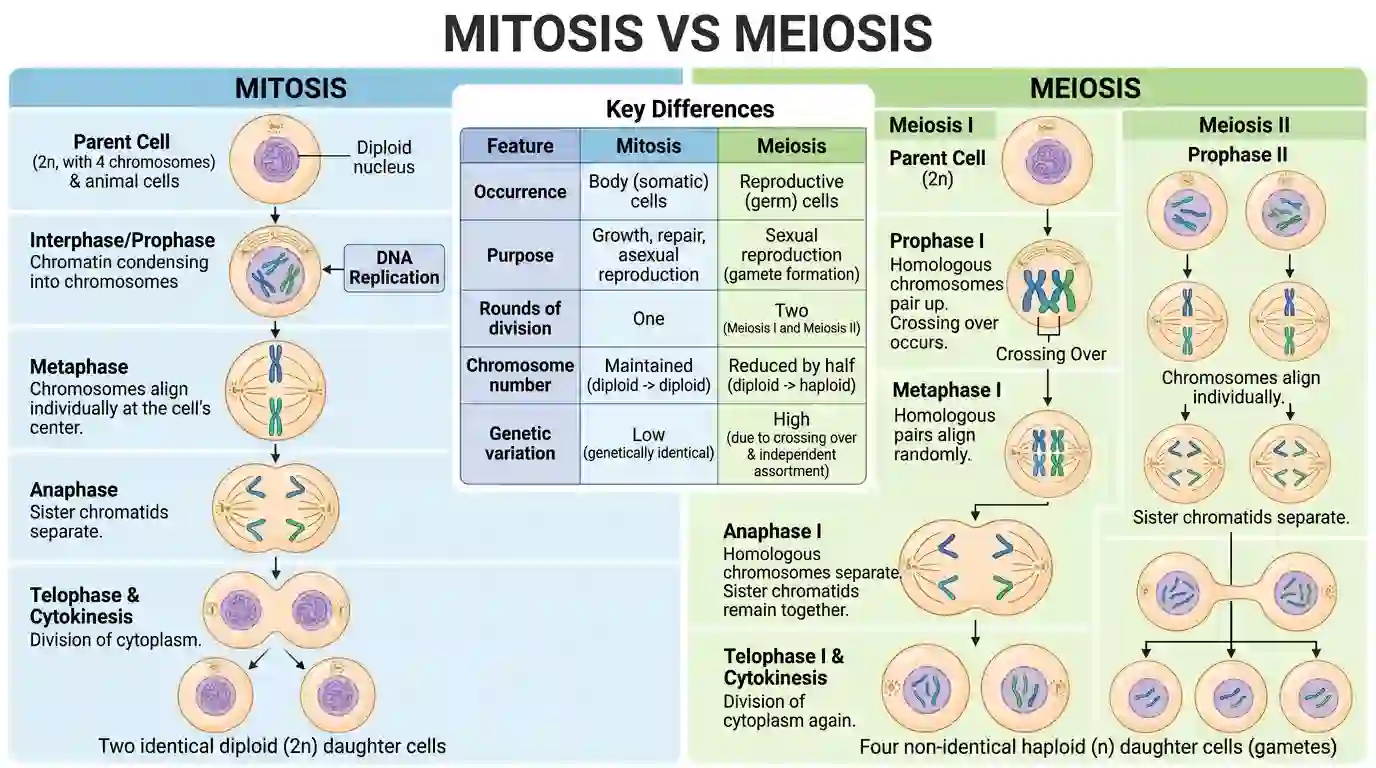

Mitosis vs meiosis describes two different ways cells divide. Mitosis usually produces two genetically similar cells with the same chromosome number as the parent cell, supporting growth and repair. Meiosis involves two divisions and produces four genetically different haploid cells for sexual reproduction. Meiosis also creates genetic variation through processes such as crossing over and independent assortment.
Key Takeaways
- Mitosis has one nuclear division, while meiosis has two.
- Mitosis usually produces two daughter cells; meiosis usually produces four.
- Mitosis generally maintains chromosome number; meiosis reduces it by half.
- Meiosis I separates homologous chromosomes, while meiosis II separates sister chromatids.
- Crossing over and chromosome assortment during meiosis help create genetic variation.
What Is the Difference Between Mitosis and Meiosis?
Mitosis and meiosis are both forms of nuclear division, but they have different jobs.
Mitosis helps an organism grow, replace old cells, and repair damaged tissue. In a typical diploid animal cell, one nuclear division produces two daughter cells with the same number of chromosome sets as the parent.
Meiosis is associated with sexual reproduction. It starts with a diploid cell and uses two nuclear divisions to produce four haploid cells. These cells are genetically different because chromosomes are reshuffled during meiosis.
The easiest way to remember the difference is:
Mitosis maintains. Meiosis reduces and reshuffles.
Mitosis vs Meiosis: Side-by-Side Comparison
| Feature | Mitosis | Meiosis |
|---|---|---|
| Main purpose | Growth, repair, and cell replacement | Production of haploid reproductive cells |
| Nuclear divisions | 1 | 2 |
| Typical daughter cells | 2 | 4 |
| Chromosome number | Usually maintained | Reduced by half |
| Genetic similarity | Usually genetically similar | Genetically different |
| Homologous chromosomes pair? | No | Yes, during meiosis I |
| Crossing over | No | Yes, during prophase I |
| First major separation | Sister chromatids | Homologous chromosomes |
| Second division | None | Sister chromatids separate in meiosis II |
| Main role | Body maintenance and growth | Sexual reproduction and genetic variation |
This comparison reflects the standard diploid-animal model commonly taught in introductory biology. Biology becomes more complicated in plants and other organisms because their life cycles can use mitosis and meiosis differently.
How Mitosis Works
Mitosis is a single nuclear division. Before division begins, the cell replicates its DNA during the S phase of interphase. Each chromosome therefore consists of two sister chromatids.
During mitosis, those sister chromatids are separated so that each new nucleus receives an equivalent chromosome set. The cell then divides through cytokinesis.
The familiar stages are:
- Prophase: Chromosomes condense and the mitotic spindle begins forming.
- Metaphase: Chromosomes line up individually at the cell’s middle.
- Anaphase: Sister chromatids separate and move toward opposite sides.
- Telophase: New nuclei form around the separated chromosomes.
- Cytokinesis: The cell’s cytoplasm divides, producing daughter cells.
In a typical diploid animal cell, the result is two diploid daughter cells. Mitosis therefore allows chromosome number to remain stable from parent cell to daughter cells.
What Mitosis Produces
Mitosis is important for everyday biological maintenance. For example, replacing cells in tissues and supporting growth requires new cells. When a cell divides by mitosis, its daughter nuclei normally receive the same chromosome sets as the original nucleus.
The phrase “genetically identical” is useful for basic biology, but it is not an absolute statement about every cell in every situation. DNA mutations can occur, so real biological cells are not guaranteed to be perfectly identical.
How Meiosis Works
Meiosis is more complex because the cell divides twice after one round of DNA replication.
The first division is meiosis I, and the second is meiosis II.
Meiosis I
Meiosis I is the key difference between meiosis and mitosis.
During prophase I, homologous chromosomes pair with one another. DNA can be exchanged between non-sister chromatids in a process called crossing over.
During metaphase I, homologous chromosome pairs line up at the cell’s middle. Their orientation contributes to different chromosome combinations in the resulting cells.
During anaphase I, homologous chromosomes separate. Importantly, the sister chromatids remain together at this point.
By the end of meiosis I, the chromosome sets have been reduced from two to one. This is why meiosis I is called a reduction division.
Meiosis II
Meiosis II resembles mitosis in an important way: sister chromatids separate.
There is no second round of DNA replication between meiosis I and meiosis II. The two cells produced by meiosis I divide again, eventually producing four haploid cells.
The final cells have one chromosome set rather than two and are genetically different from one another.
Why Does Meiosis Create Genetic Variation?
Meiosis does more than reduce chromosome number. It also helps generate genetic variation.
One source is crossing over during prophase I. Homologous chromosomes pair and exchange sections of DNA. This can create chromosomes carrying new combinations of genetic information.
Another source is the independent assortment of homologous chromosome pairs during metaphase I. Different chromosome combinations can enter the resulting cells.
Random fertilization can create still more variation when gametes combine, although fertilization itself occurs after meiosis.
This is why meiosis is not simply “mitosis twice.” The first meiotic division has a fundamentally different chromosome arrangement and separation pattern.
Mitosis vs Meiosis in Humans
Humans provide a straightforward example.
Most human body cells are diploid, meaning they contain 46 chromosomes arranged in 23 pairs. Mitosis allows these cells to divide while maintaining the chromosome number.
Human reproductive cells, such as sperm and eggs, are haploid. They contain 23 chromosomes. Meiosis produces cells with one chromosome from each homologous pair.
When sperm and egg unite during fertilization, their chromosome sets combine to form a diploid zygote with 46 chromosomes.
So, in the basic human example:
Mitosis: 46 → two cells with 46 chromosomes each
Meiosis: 46 → four haploid products with 23 chromosomes each
This chromosome-number difference is one of the most important facts to remember when studying mitosis and meiosis.
How to Remember Mitosis vs Meiosis for a Test
If you need a quick memory trick, focus on three questions.
1. How many divisions?
Mitosis = one.
Meiosis = two.
2. What separates first?
Mitosis = sister chromatids.
Meiosis I = homologous chromosomes.
3. What is the final result?
Mitosis = usually two cells with the parent’s chromosome number.
Meiosis = usually four haploid cells with genetic differences.
A useful exam clue is the appearance of terms such as crossing over, tetrads, homologous pairs, gametes, or haploid. These strongly point toward meiosis. Terms such as growth, repair, replacement, or identical daughter cells generally point toward mitosis.
Frequently Asked Questions
Is mitosis 2 cells or 4?
Mitosis normally produces two daughter cells after one nuclear division. In comparison, meiosis involves two nuclear divisions and usually produces four daughter cells.
Does meiosis produce 4 cells?
Yes. In the standard animal model, meiosis produces four haploid cells from one starting diploid cell. These products are genetically different because of chromosome reshuffling during meiosis.
Does mitosis produce diploid or haploid cells?
It depends on the starting cell and organism. Mitosis maintains the cell’s ploidy level rather than automatically making a cell diploid. In typical human body cells, diploid cells undergo mitosis to produce diploid daughter cells.
What separates during meiosis I?
Homologous chromosomes separate during meiosis I. Their sister chromatids remain attached. Sister chromatids separate during meiosis II.
Why is meiosis important?
Meiosis is essential to sexual reproduction because it produces haploid cells from diploid starting cells. It also contributes to genetic variation through crossing over and the independent assortment of chromosomes.
Is meiosis II the same as mitosis?
Meiosis II is similar to mitosis, especially because sister chromatids separate in both processes. However, they are not identical processes because the cells entering meiosis II are haploid and have already passed through meiosis I.
Conclusion
The easiest way to understand mitosis vs meiosis is to focus on their purpose and outcome. Mitosis uses one division to maintain chromosome number and usually create two genetically similar cells. Meiosis uses two divisions to reduce chromosome number and produce four genetically different haploid cells.
The biggest conceptual difference occurs during meiosis I, when homologous chromosomes pair, exchange DNA through crossing over, and then separate. Meiosis II subsequently separates sister chromatids in a process that resembles mitosis. Once you remember one division versus two, same chromosome number versus half, and sister chromatids versus homologous chromosomes, the comparison becomes much easier to understand.