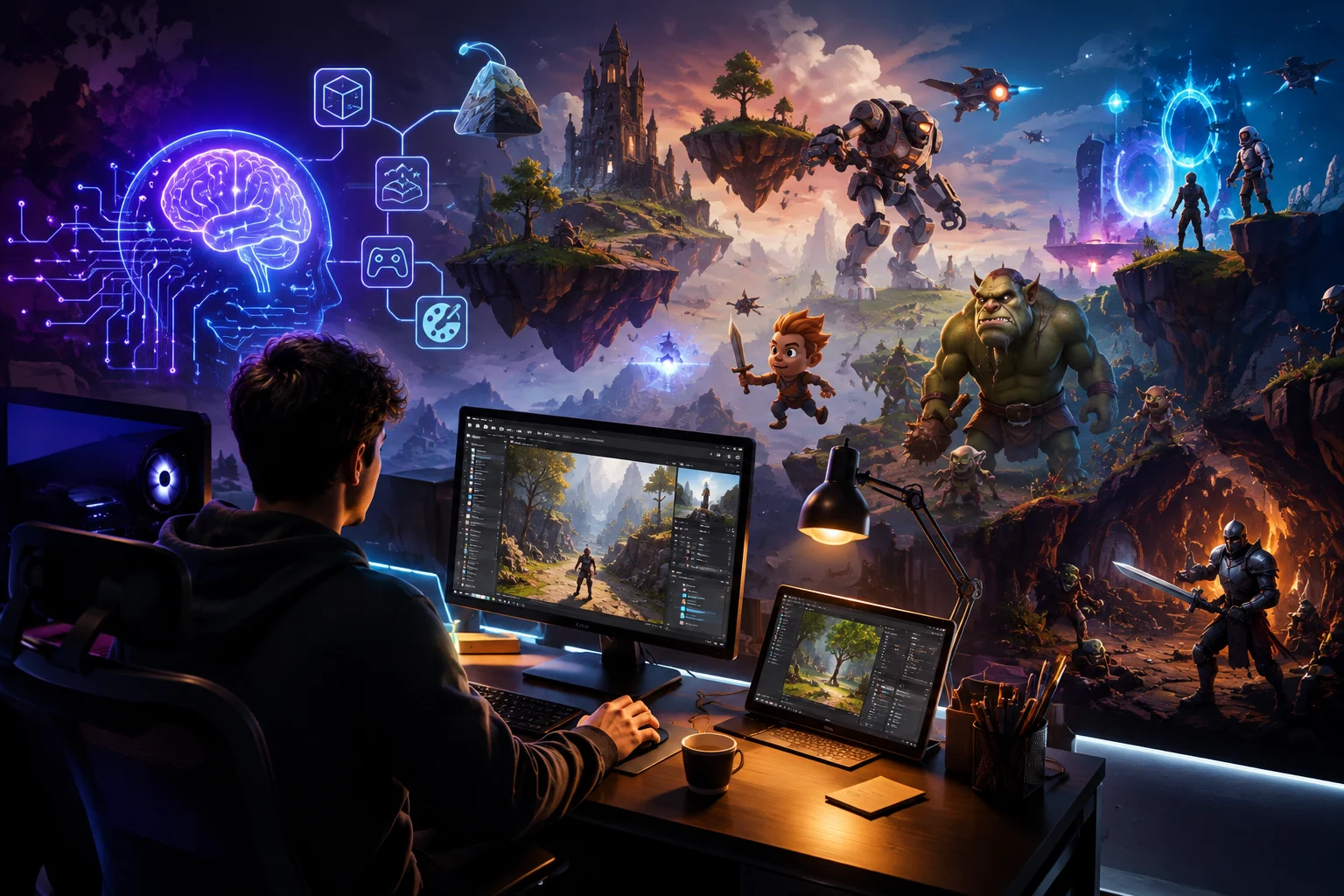

There’s a common assumption that automating parts of a creative process makes the result less creative, as if removing technical friction somehow removes imagination along with it. In practice, the opposite is happening with AI game makers. By taking over the technical execution that used to consume most of a creator’s time and energy, these tools are freeing up far more room for genuine creative experimentation than traditional development ever allowed.
Why Technical Labor Used to Limit Creativity
In traditional development, a huge portion of a creator’s time went toward technical execution, writing code, debugging errors, restructuring systems that didn’t work as intended. That labor left far less room for actual creative exploration, since most of a project’s timeline was consumed by getting basic mechanics to function correctly in the first place. Creativity often had to compete with technical necessity for a creator’s limited time, and technical necessity usually won.
How AI Game Makers Actually Expand Creative Room
Freeing Time for Experimentation Instead of Implementation
When describing an idea replaces manually coding it, the time previously spent on implementation becomes available for actually exploring creative variations. A creator can spend that reclaimed time testing unusual mechanics, unexpected combinations, or genuinely original concepts instead of fighting with syntax errors that have nothing to do with the idea itself.
Making Wild Ideas Cheap Enough to Try
Ambitious or unconventional concepts used to carry real risk, since building them required significant investment before anyone knew whether they’d actually work. AI tools lower that cost dramatically, which means creators can afford to attempt genuinely strange or ambitious ideas that would have felt too risky to pursue under the old model.
Removing the Fear of Wasted Technical Effort
A major, often unspoken barrier to creative risk-taking was the fear of wasting hours of technical labor on an idea that didn’t pan out. When testing an idea costs minutes instead of weeks, that fear largely disappears, freeing creators to chase more unusual directions without worrying about sunk technical cost if the idea doesn’t work.
What This Creative Freedom Actually Produces
More Unconventional Mechanics Getting Tested
Ideas that don’t fit neatly into familiar genres or established patterns are far more likely to get built and tested now, simply because the cost of finding out whether they work has dropped so significantly. This is expanding the range of mechanics actually reaching players, beyond the safer, more predictable concepts that dominated when technical investment was higher.
Faster Exploration of Creative Variations
Rather than committing to a single creative direction early out of necessity, creators can explore several variations of an idea in quick succession, comparing how each one actually feels before settling on a final direction. This kind of rapid creative exploration was rarely realistic under the old, slower development model.
Ideas Evolving Through Play Rather Than Planning Alone
Creative development increasingly happens through direct interaction with a rough, playable version rather than purely through planning on paper. This shift lets an idea grow and shift based on what actually feels compelling once it’s playable, rather than being locked into an early conceptual plan that never gets tested until much later.
A Practical Example of This Creative Freedom
Rooftop Marksman 3D reflects what this expanded creative room tends to produce, a tightly tuned, distinct mechanic with real personality, the kind of focused, well-executed idea that benefits from a creator having the freedom to iterate repeatedly without technical friction slowing that process down.
Creators exploring an AI game maker today are increasingly using that freedom to chase more specific, personal creative visions, rather than defaulting to safer, more familiar mechanics simply because those were easier to execute technically.
What Creativity Still Depends On, Regardless of the Tools
A Genuine Creative Instinct to Begin With
AI tools execute what’s described, they don’t generate the underlying creative spark that makes an idea worth pursuing. That instinct still comes entirely from the person behind the project, and no tool changes how much genuine creative judgment that requires.
Willingness to Follow Through on an Idea
Having more room to experiment doesn’t guarantee a creator will actually use that room well. Following through on a genuinely original idea still takes discipline and patience, regardless of how much technical friction has been removed from the process.
Honest Evaluation of What’s Actually Working
More creative freedom means more ideas get tested, but not every idea that gets tested is actually good. Creators still need the judgment to recognize which experiments are genuinely working and which ones simply felt exciting to try.
Why This Shift Matters Beyond Individual Projects
As more creators use this freedom to explore unconventional ideas, the overall range of games reaching players naturally broadens. Genres and mechanics that might never have justified the technical investment required under the old model are increasingly getting a real chance to prove themselves, which tends to produce a more varied, less predictable landscape of games overall.
Final Thoughts
AI game makers are making game development more creative not by generating ideas on a creator’s behalf, but by removing the technical labor that used to compete directly with creative exploration for a creator’s limited time and attention. With that friction gone, creators are free to chase more ambitious, unconventional, and genuinely personal ideas, and the growing variety of what’s actually getting built reflects exactly that shift.