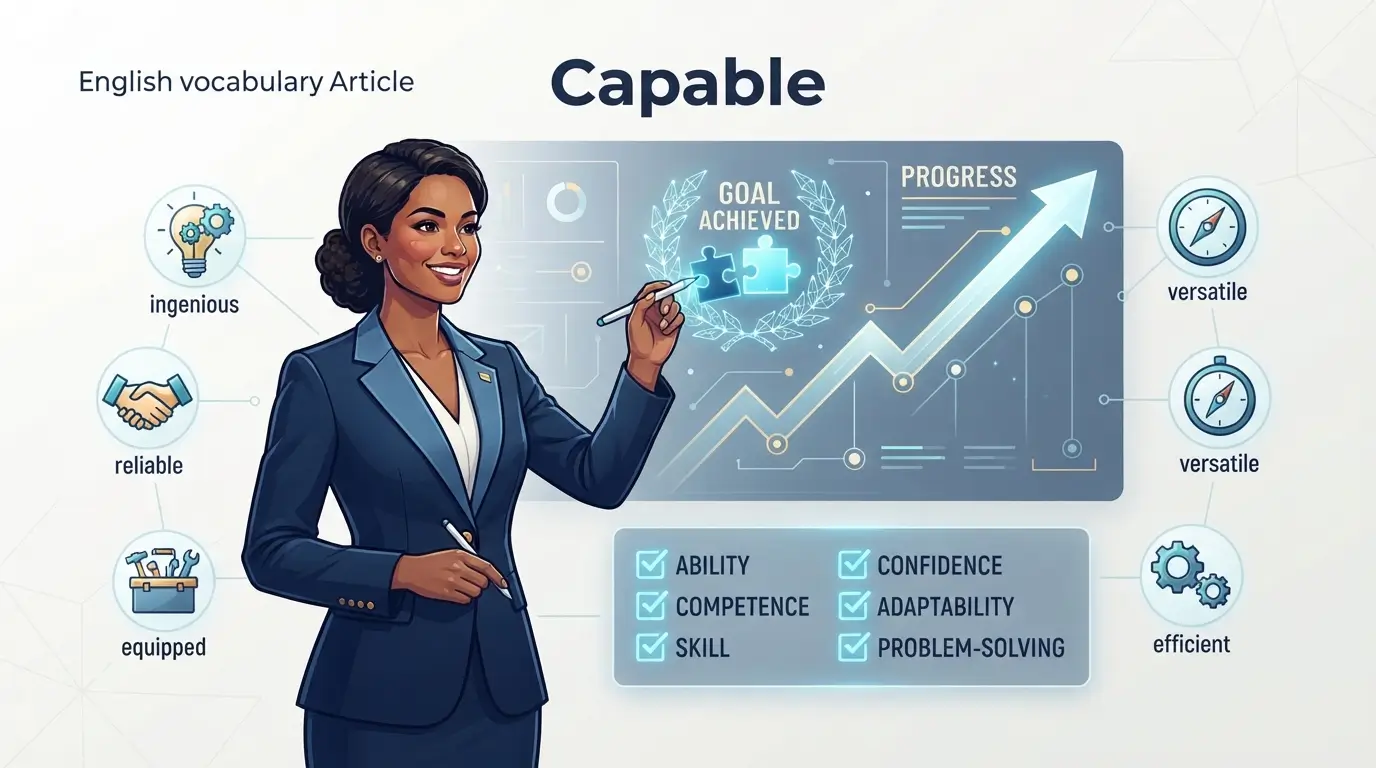

Synonyms for capable become especially useful when you want to describe someone’s ability without repeating the same word. Imagine praising a coworker after she solves a difficult problem alone.
You could simply say, “She is capable,” but skilled, competent, or resourceful may describe her strengths more clearly.
The word capable appears often in everyday English, education, workplaces, and online writing. Learning its alternatives helps you express ability with greater precision.
For students, bloggers, content writers, and daily English users, learning synonyms for capable can make writing more varied and communication more natural.
What Does “Capable” Really Mean?
Capable means having the ability, skill, knowledge, or qualities needed to do something successfully.
In simple English, if someone is capable of doing something, that person has what is needed to do it.
For example:
“Maria is capable of managing the project.”
This means Maria has the ability to manage the project.
The word can describe people, organizations, machines, systems, and even things that have a particular ability.
“He is a capable teacher.”
“The team is capable of handling the workload.”
“This computer is capable of running demanding software.”
Part of Speech
Capable is an adjective.
An adjective describes a person, object, or idea. In this case, it describes the ability or potential of someone or something.
One of the most common structures is:
capable of + noun or -ing form
Examples:
“She is capable of solving difficult problems.”
“The machine is capable of producing thousands of units.”
A common learner mistake is saying “capable to do.” In standard English, “capable of doing” is normally preferred.
The Connotative Meaning of “Capable”
Connotation (the feeling, association, or emotional meaning connected with a word beyond its basic definition) can influence how capable sounds.
Positive Tone
Capable often has a positive meaning because it suggests competence, confidence, independence, and reliability.
“She is a capable leader.”
This sounds like genuine praise.
Neutral Tone
The word can also be completely neutral.
“The device is capable of storing large files.”
Here, the word simply describes a function.
Negative Tone
Capable itself is rarely negative, but the surrounding words can create a negative impression.
“He is capable of making serious mistakes.”
The negative feeling comes from the action, not from the word capable itself.
Etymology and History of “Capable”
The English word capable ultimately comes from Latin capabilis, meaning “able to receive or contain.” It is connected with the Latin verb capere, meaning “to take,” “to seize,” or “to hold.”
The word entered English through French and developed its modern sense of having the ability or qualities needed for a particular task.
Old English: 450–1100
The modern word capable was not part of Old English vocabulary.
Old English used Germanic words to express ideas such as ability, power, strength, skill, and readiness.
Middle English: 1100–1500
After the Norman Conquest, English absorbed many French and Latin words.
The linguistic family behind capable developed through Romance languages during this broader period of linguistic change.
Modern English: 1500–Present
Capable entered English in the late sixteenth century. Its meaning gradually became associated with having the ability, qualities, or potential required to accomplish something.
Today, it is a common adjective in everyday, professional, academic, and technical English.
Pronunciation, Syllables, and Word Formation
US pronunciation: /ˈkeɪpəbəl/
UK pronunciation: /ˈkeɪpəbəl/
Syllables
ca-pa-ble
Affixation Pattern
Root: related to Latin capere, meaning “to take” or “hold”
Prefix: None in modern English
Suffix: -able
The suffix -able often contributes the meaning “able to be” or “having the ability to.”
Examples include:
readable
manageable
dependable
adaptable
Useful Synonyms for “Capable”
No two synonyms are perfect replacements in every sentence. The right choice depends on whether you want to emphasize skill, experience, credentials, natural talent, reliability, flexibility, or results.
Able — Adjective — US /ˈeɪbəl/ | UK /ˈeɪbəl/
Meaning: Able means having the ability or opportunity to do something.
Tone/Register: Neutral, everyday.
Example:
“Are you able to finish the report today?”
“She is able to solve the problem without help.”
Able is one of the closest everyday alternatives to capable. It is simple and extremely common.
Competent — Adjective — US /ˈkɑːmpɪtənt/ | UK /ˈkɒmpɪtənt/
Meaning: Competent means having enough knowledge and skill to perform a task properly.
Tone/Register: Professional, neutral.
Example:
“We need a competent person to supervise the team.”
“She proved to be a competent manager.”
Competent often suggests reliable, acceptable professional performance.
Skilled — Adjective — US /skɪld/ | UK /skɪld/
Meaning: Skilled means having developed a strong ability through training or practice.
Tone/Register: Neutral, professional.
Example:
“He is a skilled carpenter.”
“The company is looking for skilled technicians.”
Use skilled when practice, training, or technical ability matters.
Proficient — Adjective — US /prəˈfɪʃənt/ | UK /prəˈfɪʃənt/
Meaning: Proficient means having a good practical level of skill in a particular area.
Tone/Register: Formal, academic, professional.
Example:
“She is proficient in Spanish.”
“Applicants should be proficient in Excel.”
Proficient is especially useful for languages, software, technical abilities, and measurable skills.
Adept — Adjective — US /əˈdept/ | UK /əˈdept/
Meaning: Adept means very skillful at doing something.
Tone/Register: Formal, positive.
Example:
“He is adept at explaining difficult ideas.”
“She is adept at handling stressful situations.”
Adept usually communicates stronger skill than ordinary capable.
Accomplished — Adjective — US /əˈkɑːmplɪʃt/ | UK /əˈkʌmplɪʃt/
Meaning: Accomplished describes someone who has achieved a high level of success or skill.
Tone/Register: Formal, complimentary.
Example:
“She is an accomplished novelist.”
“He became an accomplished pianist.”
This word connects ability with proven achievement.
Talented — Adjective — US /ˈtæləntɪd/ | UK /ˈtæləntɪd/
Meaning: Talented means naturally good at a particular activity.
Tone/Register: Positive, everyday.
Example:
“My sister is a talented artist.”
“He is talented at making people laugh.”
Unlike capable, talented often suggests natural ability.
Gifted — Adjective — US /ˈɡɪftɪd/ | UK /ˈɡɪftɪd/
Meaning: Gifted means having unusually strong natural ability.
Tone/Register: Positive, academic, complimentary.
Example:
“The school provides special support for gifted students.”
“She is a gifted violinist.”
Gifted is stronger than ordinary capable.
Expert — Adjective/Noun — US /ˈekspɜːrt/ | UK /ˈekspɜːt/
Meaning: Expert describes someone with an exceptionally high level of knowledge or skill.
Tone/Register: Professional, formal.
Example:
“She is an expert researcher.”
“We asked an expert to review the report.”
An expert normally has a much higher level of specialized ability than a generally capable person.
Masterful — Adjective — US /ˈmæstərfəl/ | UK /ˈmɑːstəfəl/
Meaning: Masterful means showing exceptional skill, control, or ability.
Tone/Register: Formal, literary, highly positive.
Example:
“The director delivered a masterful performance.”
“Her masterful speech kept everyone focused.”
This is a powerful word of praise and should not be used for ordinary competence.
Experienced — Adjective — US /ɪkˈspɪriənst/ | UK /ɪkˈspɪəriənst/
Meaning: Experienced means having gained knowledge and ability through previous involvement or work.
Tone/Register: Neutral, professional.
Example:
“We hired an experienced teacher.”
“She is experienced in managing large teams.”
Experienced focuses on time and practice rather than natural talent.
Qualified — Adjective — US /ˈkwɑːlɪfaɪd/ | UK /ˈkwɒlɪfaɪd/
Meaning: Qualified means having the education, training, certification, or requirements needed for a role.
Tone/Register: Professional, formal.
Example:
“She is a qualified accountant.”
“Only qualified candidates will move to the next stage.”
A person can be qualified without being exceptionally talented.
Trained — Adjective — US /treɪnd/ | UK /treɪnd/
Meaning: Trained means having received instruction or practice for a particular task.
Tone/Register: Neutral, professional.
Example:
“All employees are trained to handle emergencies.”
“He is trained in first aid.”
This word emphasizes preparation through instruction.
Knowledgeable — Adjective — US /ˈnɑːlɪdʒəbəl/ | UK /ˈnɒlɪdʒəbəl/
Meaning: Knowledgeable means having a strong understanding of a subject.
Tone/Register: Neutral, professional.
Example:
“She is knowledgeable about web design.”
“The teacher was knowledgeable and patient.”
Knowledge can support capability, but knowing something does not always mean being able to perform it.
Versatile — Adjective — US /ˈvɜːrsətəl/ | UK /ˈvɜːsətaɪl/
Meaning: Versatile means able to perform well in different roles, activities, or situations.
Tone/Register: Positive, professional.
Example:
“He is a versatile writer.”
“She is a versatile employee who can handle several roles.”
This word emphasizes range.
Resourceful — Adjective — US /rɪˈsɔːrsfəl/ | UK /rɪˈsɔːsfəl/
Meaning: Resourceful means good at finding practical solutions when problems arise.
Tone/Register: Positive, professional.
Example:
“She is resourceful when plans change.”
“The resourceful student found another way to complete the assignment.”
This is an excellent alternative when problem-solving ability is the main point.
Effective — Adjective — US /ɪˈfektɪv/ | UK /ɪˈfektɪv/
Meaning: Effective means successful in producing the intended result.
Tone/Register: Professional, academic, neutral.
Example:
“She is an effective team leader.”
“His communication style is highly effective.”
Effective focuses on outcomes rather than potential.
Efficient — Adjective — US /ɪˈfɪʃənt/ | UK /ɪˈfɪʃənt/
Meaning: Efficient means achieving a result while using time, effort, or resources well.
Tone/Register: Professional, business.
Example:
“She is an efficient office manager.”
“The new system makes the process more efficient.”
Use this when productivity and economy matter.
Productive — Adjective — US /prəˈdʌktɪv/ | UK /prəˈdʌktɪv/
Meaning: Productive means achieving useful results through work or activity.
Tone/Register: Neutral, professional.
Example:
“We had a productive meeting.”
“He is most productive in the morning.”
Productive focuses on output rather than general ability.
Enterprising — Adjective — US /ˈentərpraɪzɪŋ/ | UK /ˈentəpraɪzɪŋ/
Meaning: Enterprising describes someone who is energetic, creative, and willing to take useful action.
Tone/Register: Positive, professional.
Example:
“She is an enterprising young professional.”
“His enterprising approach helped solve the problem.”
This word suggests initiative and confidence.
Ingenious — Adjective — US /ɪnˈdʒiːniəs/ | UK /ɪnˈdʒiːniəs/
Meaning: Ingenious means cleverly creative at solving a problem or creating a solution.
Tone/Register: Formal, positive.
Example:
“He designed an ingenious storage system.”
“Her ingenious idea saved the team hours.”
It emphasizes cleverness rather than general competence.
Adaptable — Adjective — US /əˈdæptəbəl/ | UK /əˈdæptəbəl/
Meaning: Adaptable means able to adjust successfully to new conditions.
Tone/Register: Professional, positive.
Example:
“She is adaptable and learns new systems quickly.”
“Adaptable employees often handle change well.”
This is useful when circumstances are constantly changing.
Flexible — Adjective — US /ˈfleksəbəl/ | UK /ˈfleksəbəl/
Meaning: Flexible means able to change plans, methods, or behavior when needed.
Tone/Register: Neutral, professional.
Example:
“He is flexible when deadlines change.”
“We need someone flexible enough to take on new duties.”
It focuses on adjustment rather than expertise.
Dependable — Adjective — US /dɪˈpendəbəl/ | UK /dɪˈpendəbəl/
Meaning: Dependable means reliable enough to be trusted to do what is expected.
Tone/Register: Positive, professional.
Example:
“She is one of our most dependable employees.”
“He has always been dependable.”
This word highlights trustworthiness.
Reliable — Adjective — US /rɪˈlaɪəbəl/ | UK /rɪˈlaɪəbəl/
Meaning: Reliable means consistently performing as expected.
Tone/Register: Neutral, professional.
Example:
“He is a reliable member of the team.”
“We need a reliable person for this responsibility.”
Reliable overlaps with capable when consistent performance is important, but the meanings are not identical.
Dexterous — Adjective — US /ˈdekstrəs/ | UK /ˈdekstrəs/
Meaning: Dexterous means physically skillful, especially when using the hands.
Tone/Register: Formal, descriptive.
Example:
“The surgeon was extremely dexterous.”
“Her dexterous hands repaired the delicate device.”
This is a specialized synonym for physical ability.
Nimble — Adjective — US /ˈnɪmbəl/ | UK /ˈnɪmbəl/
Meaning: Nimble means quick and skillful in movement or thinking.
Tone/Register: Neutral, positive.
Example:
“He has a nimble mind.”
“The nimble athlete changed direction quickly.”
It can describe both physical and mental agility.
Astute — Adjective — US /əˈstuːt/ | UK /əˈstjuːt/
Meaning: Astute means clever and perceptive when making judgments or decisions.
Tone/Register: Formal, professional.
Example:
“She is an astute business leader.”
“His astute observation improved the plan.”
It focuses on judgment rather than general ability.
Savvy — Adjective — US /ˈsævi/ | UK /ˈsævi/
Meaning: Savvy means having practical knowledge and good judgment in a particular area.
Tone/Register: Informal, modern.
Example:
“She is tech-savvy.”
“He is financially savvy.”
It is common in modern conversational and workplace English.
Well-Versed — Adjective Phrase — US /ˌwel ˈvɜːrst/ | UK /ˌwel ˈvɜːst/
Meaning: Well-versed means very familiar with a subject because of knowledge or experience.
Tone/Register: Formal, professional.
Example:
“She is well-versed in employment law.”
“He is well-versed in modern teaching methods.”
It focuses on familiarity rather than physical or practical skill.
Prepared — Adjective — US /prɪˈperd/ | UK /prɪˈpeəd/
Meaning: Prepared means ready because the necessary planning, knowledge, or resources are available.
Tone/Register: Neutral.
Example:
“She was prepared for every question.”
“The team was prepared for the sudden change.”
A prepared person may be capable, but the two words do not mean exactly the same thing.
Equipped — Adjective — US /ɪˈkwɪpt/ | UK /ɪˈkwɪpt/
Meaning: Equipped means having the skills, resources, or qualities needed for a particular task.
Tone/Register: Neutral, professional.
Example:
“She is well equipped to lead the project.”
“The team is equipped to handle difficult cases.”
This is especially useful in professional and academic writing.
Synonyms for “Capable” by Tone
Positive
adept, accomplished, talented, gifted, masterful, resourceful, versatile, ingenious, enterprising, effective
These words add praise or emphasize a particular strength.
Neutral
able, capable, skilled, competent, experienced, trained, prepared, flexible, reliable
These are useful when you want to describe ability without exaggerating it.
Formal or Professional
proficient, qualified, knowledgeable, astute, well-versed, efficient, effective, accomplished
These choices work well in professional reports, academic writing, resumes, and formal descriptions.
Informal
savvy, nimble, skilled, able
These words can sound natural in conversations, especially when describing practical ability.
Why Tone Matters
Consider these two sentences:
“He is capable of managing the team.”
“He is an accomplished leader.”
The first is neutral. The second gives stronger praise and suggests proven achievement.
Choosing the right synonym helps you communicate not only what someone can do, but also how you feel about that ability.
“Capable” vs. Close Alternatives
Capable vs. Able
Able is the simpler and more common everyday word.
“She is able to finish the work.”
Capable often focuses more strongly on having the qualities or ability required.
“She is capable of handling difficult projects.”
Use able for straightforward statements. Use capable when emphasizing ability or potential.
Capable vs. Competent
Competent suggests that someone has enough skill and knowledge to perform a task properly.
“He is a capable manager.”
This gives a broad description.
“He is a competent manager.”
This more directly suggests that he performs his managerial duties effectively.
Capable vs. Skilled
Skilled highlights developed ability.
“She is capable of repairing the machine.”
“She is skilled at repairing machines.”
The second sentence makes training and practice more important.
How “Capable” Changes by Context
Daily Conversation
In everyday conversation, capable is useful when reassuring someone or describing someone’s ability.
“Don’t worry. She’s capable of handling it.”
However, able may sound more casual.
“Can you finish this?”
“Yes, I’m able to.”
For friendly praise, skilled, talented, or good at may sound warmer.
Writing and Blogging
Writers often repeat capable because it is simple and flexible.
Instead of writing:
“A capable writer…”
Consider the exact meaning.
“A skilled writer…”
suggests developed writing ability.
“An experienced writer…”
Demonstrates practice.
“An accomplished writer…”
Suggests achievement.
This approach creates variety without using inaccurate synonyms.
Professional and Academic English
Professional writing benefits from precise vocabulary.
“The candidate is qualified for the position.”
This focuses on formal requirements.
“The candidate is proficient in data analysis.”
This focuses on a specific skill.
“The candidate is experienced in project management.”
This emphasizes previous work.
Precision is more valuable than simply choosing a more complicated word.
Creative and Informal English
Creative writing allows more expressive alternatives.
Words such as nimble, ingenious, astute, gifted, and masterful can create stronger images.
“She had a nimble mind and an unusual way of solving problems.”
This feels more vivid than simply saying:
“She was capable.”
Common Mistakes Learners Make
Mistake 1: Treating Every Synonym as Identical
Not every synonym can replace capable in every sentence.
Qualified focuses on formal requirements.
Experienced focuses on previous involvement.
Talented focuses on natural ability.
Resourceful focuses on solving problems creatively.
The correct synonym depends on context.
Mistake 2: Using the Wrong Grammar After “Capable”
A common mistake is:
“She is capable to solve the problem.”
A more natural standard structure is:
“She is capable of solving the problem.”
Remember:
capable of + noun
or
capable of + -ing form
Mistake 3: Confusing Potential With Achievement
These sentences have different meanings:
“He is capable of becoming a great leader.”
This describes potential.
“He is an accomplished leader.”
This describes demonstrated achievement.
Do not use accomplished when you only mean someone has potential.
Mistake 4: Confusing Talent With Training
Someone may be talented because they have natural ability.
A person may be skilled because they have developed ability through practice.
Someone may be trained because they have received instruction.
These qualities can overlap, but they are not identical.
Mistake 5: Using Strong Words Too Often
Words such as masterful, expert, and gifted carry strong meanings.
Calling every competent employee “masterful” can sound exaggerated.
Choose the mildest accurate word that communicates your intended meaning.
Register Notes
Capable is neutral and widely accepted in spoken and written English.
Able is extremely common and conversational.
Competent sounds professional and measured.
Skilled works well in both everyday and professional contexts.
Proficient is more formal and usually refers to a particular skill.
Adept is formal and complimentary.
Talented is positive and natural.
Gifted suggests unusually strong natural ability.
Masterful is highly complimentary and sometimes literary.
Savvy is informal and modern.
Qualified is strongly associated with credentials and professional requirements.
Experienced focuses on previous practice or involvement.
Real-Life Scenarios Using “Capable” and Its Alternatives
Workplace
Imagine a manager who has successfully handled several complex projects.
You could say:
“She is an experienced manager.”
If her main strength is achieving results:
“She is an effective manager.”
When she finds creative solutions:
“She is a resourceful manager.”
If she has the required professional credentials:
“She is a qualified manager.”
Each sentence communicates a different fact.
Social Situations
Suppose your friend organizes a complicated trip and handles several unexpected problems.
You might say:
“You’re really capable of organizing things.”
To emphasize problem-solving:
“You’re incredibly resourceful.”
When emphasizing flexibility:
“You’re very adaptable.”
To praise reliability:
“You’re always dependable.”
Media and Pop Culture
A performer with natural ability may be described as:
“a gifted performer”
A performer with extensive technical training may be:
“a highly skilled performer”
A performance showing exceptional control may be:
“a masterful performance”
The choice depends on what the writer wants the reader to notice.
Writing and Storytelling
Writers can avoid repetition by identifying the exact quality they want to describe.
Instead of:
“He was capable.”
Try:
“He was resourceful when the plan failed.”
Or:
“He was astute enough to notice the hidden clue.”
Or:
“He was adept at reading people’s reactions.”
Specific vocabulary makes descriptions more vivid.
A Simple Way to Choose the Right Synonym
When you see capable in your writing, ask:
What kind of ability am I describing?
If the answer is general ability, use capable or able.
If it comes from training, consider skilled or proficient.
When experience is important, choose experienced.
When formal credentials matter, choose qualified.
For creative problem-solving, choose resourceful or ingenious.
When natural ability is the focus, choose talented or gifted.
For handling change well, choose adaptable or flexible.
For consistently achieving results, choose effective.
This simple strategy helps you avoid forced synonyms and makes your English more precise.
Interactive Practice Quiz
1. Which word best describes someone who has formal qualifications for a job?
A. Talented
B. Qualified
C. Nimble
D. Gifted
2. Which synonym best describes creative problem-solving ability?
A. Resourceful
B. Experienced
C. Prepared
D. Reliable
3. Which word most strongly suggests natural ability?
A. Trained
B. Qualified
C. Talented
D. Prepared
4. Which alternative sounds most suitable in formal academic writing?
A. Savvy
B. Proficient
C. Handy
D. Good
5. Which word describes someone who handles change well?
A. Adaptable
B. Expert
C. Qualified
D. Accomplished
6. Which word emphasizes saving time, effort, or resources?
A. Gifted
B. Efficient
C. Talented
D. Astute
7. Which sentence sounds most professional?
A. “She is super good at data analysis.”
B. “She is proficient in data analysis.”
C. “She is awesome at data analysis.”
D. “She can totally do data analysis.”
8. Which word suggests unusually strong natural ability?
A. Gifted
B. Trained
C. Prepared
D. Qualified
9. Which word focuses most directly on credentials?
A. Skilled
B. Qualified
C. Ingenious
D. Nimble
10. Which synonym best describes a clever solution?
A. Ingenious
B. Experienced
C. Dependable
D. Prepared
11. Which word is the most informal?
A. Proficient
B. Savvy
C. Competent
D. Qualified
12. Which word emphasizes previous work or practice?
A. Experienced
B. Talented
C. Masterful
D. Gifted
13. Which word emphasizes trust and consistency?
A. Dependable
B. Gifted
C. Ingenious
D. Talented
14. Which word suggests exceptional control and skill?
A. Masterful
B. Prepared
C. Able
D. Trained
15. Which word describes someone who performs a task properly with sufficient skill?
A. Competent
B. Gifted
C. Masterful
D. Ingenious
Answer Key: 1-B | 2-A | 3-C | 4-B | 5-A | 6-B | 7-B | 8-A | 9-B | 10-A | 11-B | 12-A | 13-A | 14-A | 15-A
Reflection Task
Choose three synonyms from this article that describe different types of ability.
Write one original sentence for each word. Then explain why that synonym fits better than simply using capable.
Frequently Asked Questions
What are the best synonyms for capable in professional English?
The strongest professional alternatives include competent, proficient, skilled, qualified, experienced, effective, resourceful, and adept. The best choice depends on the quality being described. Qualified focuses on credentials, proficient focuses on a particular skill, and experienced focuses on previous practice. These differences make professional writing more precise.
What is the difference between capable and competent?
Capable is a broad word for having the ability to do something. Competent usually suggests having enough knowledge and skill to perform a task properly. For example, “She is capable of leading the project” describes ability, while “She is a competent project manager” more directly suggests that she performs the role effectively.
What is a strong synonym for capable on a resume?
The best choice depends on the skill being described. Proficient works well for technical abilities, experienced highlights previous work, qualified emphasizes credentials, and skilled shows developed ability. A specific phrase such as “proficient in data analysis” is usually stronger than simply writing “capable” because it tells the reader exactly what you can do.
Which synonym for capable means highly skilled?
Adept, proficient, skilled, expert, and masterful can all describe strong ability, but they differ in intensity. Adept suggests strong practical skill, proficient suggests a practiced level of competence, expert indicates advanced specialized knowledge, and masterful suggests exceptional control or performance.
Is talented the same as capable?
No. Capable means having the ability to do something, while talented usually suggests natural ability. A person can become capable through education, training, and practice without having exceptional natural talent. Someone can also be naturally talented but still need experience and instruction to become highly capable in a professional setting.
What is the difference between capable and qualified?
Capable describes ability, while qualified usually describes whether someone meets formal requirements for a position or task. A person may be qualified because they have the required degree, certification, or training. That does not automatically mean they are exceptionally skilled. Capable is broader and can describe practical ability without formal credentials.
Which synonyms for capable are best for academic writing?
Useful academic alternatives include proficient, competent, adept, knowledgeable, effective, and qualified, when their meanings fit the context. Academic writing benefits from precision. Use experienced when previous research matters, proficient for developed skills, and knowledgeable when strong subject understanding is the main point.
How can I avoid repeating capable in an English essay?
First, identify the specific quality behind the word. Use skilled for developed ability, experienced for previous practice, qualified for formal credentials, resourceful for creative problem-solving, adaptable for handling change, and effective for successful results. This approach creates natural vocabulary variety without changing your intended meaning.
Conclusion
Synonyms for capable make English more precise because different alternatives highlight different types of ability. The right word depends on the quality you want readers to notice.
Words such as able, competent, skilled, proficient, adept, experienced, qualified, resourceful, and talented each add a different shade of meaning.
Learning these distinctions can improve essays, blog posts, emails, workplace communication, and everyday conversations. Better vocabulary also helps you express praise without exaggerating.
Start with five useful alternatives and practice them in real sentences. Try them in emails, essays, and daily conversations until choosing the right word feels natural.