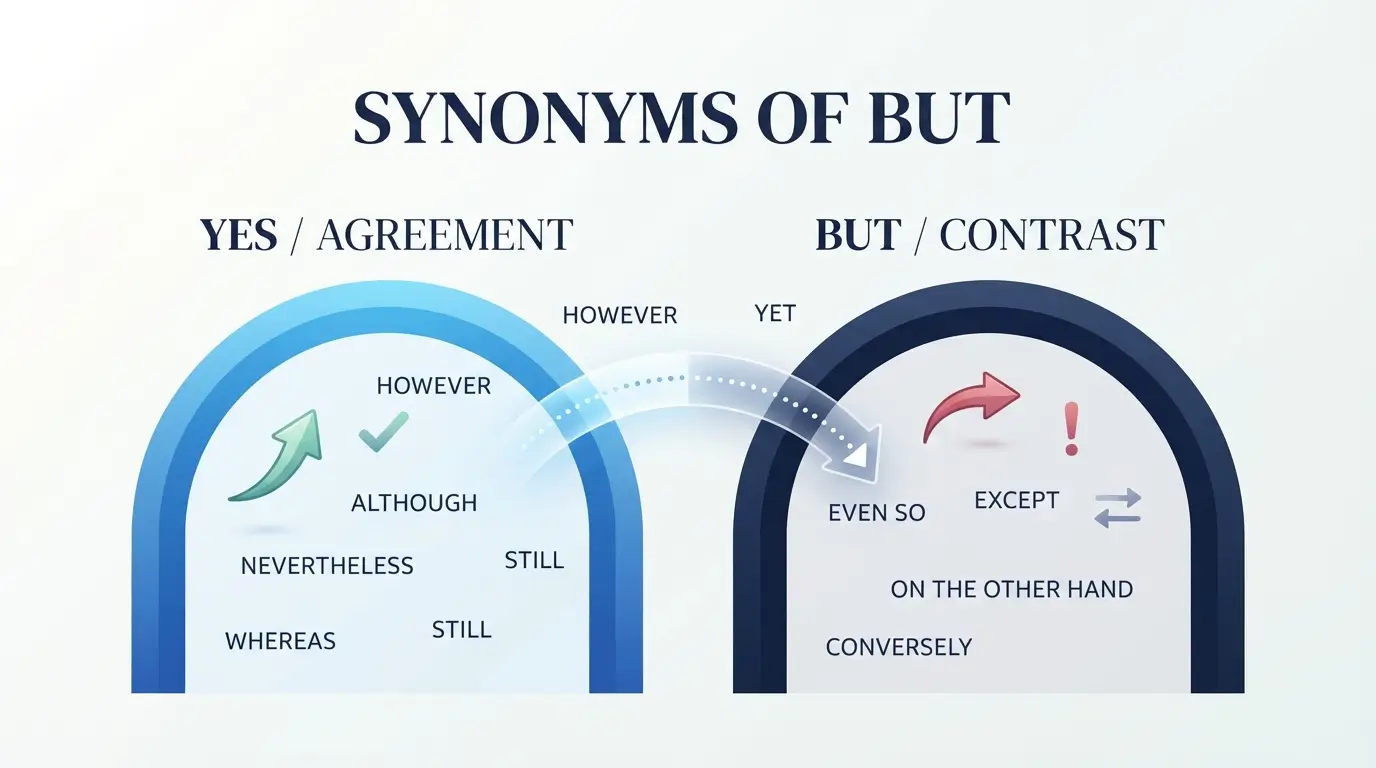

Synonyms of but can make your English more flexible when you want to connect two different ideas. Imagine saying, “I wanted to go, but I was tired.” It sounds natural, but sometimes another word fits better.
The word but appears everywhere. We use it in conversations, emails, essays, articles, reviews, and everyday messages. Its short form makes it one of the easiest ways to show contrast.
Learning synonyms of but does not mean you should stop using but. Instead, it helps you understand how English speakers express contrast, exceptions, alternatives, and different points of view.
For students, bloggers, content writers, and daily English users, this vocabulary can make sentences clearer and more varied. The important skill is knowing which alternative matches the meaning you want.
Understanding the Word “But”
But is mainly used to introduce a contrast between two ideas.
Consider this sentence:
“The restaurant was expensive, but the food was excellent.”
The first part gives one fact. The second part introduces a different or unexpected fact.
In simple English, but can often mean “however,” “in contrast,” or “except,” depending on the sentence.
It is primarily a conjunction when it connects contrasting clauses.
“I wanted to call you, but I was busy.”
However, but can also mean except.
“Everyone but Sarah attended the meeting.”
These two meanings are important because they require different alternatives.
If but means contrast, words such as however, yet, although, and nevertheless may work.
If but means exception, alternatives such as except, apart from, and other than are more appropriate.
The Tone and Connotation of “But”
Connotation (the feeling or association a word creates beyond its basic dictionary meaning) depends on context.
The word but itself is usually neutral.
It can introduce something positive:
“The apartment is small, but it is beautiful.”
It can also introduce something negative:
“The idea sounds good, but it may be difficult to execute.”
Sometimes it simply connects two neutral facts:
“The road was busy, but we arrived on time.”
This means but does not have a fixed positive or negative tone. The surrounding words create the emotional effect.
Its alternatives can have stronger stylistic differences. Though often feels conversational, while nevertheless sounds more formal.
Where “But” Comes From
The history of but goes back to Old English.
It developed from forms such as būtan, which were connected with ideas such as “outside,” “without,” “except,” and “unless.”
During the Old English period (450–1100), related forms were mainly associated with exclusion and exception.
During the Middle English period (1100–1500), the word changed in spelling and pronunciation as English developed. Its use continued to expand.
In Modern English (1500–present), but became an extremely common conjunction for expressing contrast. Its older sense of “except” also survived.
Today, but remains one of the most frequently used words for connecting contrasting ideas.
Pronunciation
US: /bʌt/
UK: /bʌt/
Syllables
but
Word Formation
Root: but
Prefix: none
Suffix: none
The word is a short function word rather than a modern derivative formed with a common English prefix or suffix.
The Most Useful Alternatives to “But”
There is no single word that can replace but in every sentence. Each alternative has its own grammar, tone, and shade of meaning.
The following alternatives cover the most useful ways native speakers express contrast, concession, comparison, exception, and alternatives.
However
However is one of the most useful formal alternatives to but.
US: /haʊˈevər/
UK: /haʊˈevə/
It introduces a contrasting or qualifying idea.
Tone/Register: Formal, professional, academic, neutral.
“The apartment is beautiful. However, it is too small for our family.”
“I understand your concern. However, I disagree with the conclusion.”
However is especially common in essays, reports, articles, and professional writing.
Unlike but, it normally needs punctuation appropriate to its position.
Yet
Yet can introduce a contrast that feels unexpected.
US: /jet/
UK: /jet/
Tone/Register: Neutral, conversational, literary.
“She is young, yet very experienced.”
“The task was difficult, yet he finished it quickly.”
It is especially effective when the second fact seems surprising because of the first.
Although
Although introduces a contrasting condition.
US: /ɔːlˈðoʊ/
UK: /ɔːlˈðəʊ/
Tone/Register: Neutral, formal, academic.
“Although the road was busy, we arrived on time.”
“Although I was nervous, I gave the presentation.”
The grammar is different from but. You can say:
“I was nervous, but I gave the presentation.”
Or:
“Although I was nervous, I gave the presentation.”
Do not normally combine both in the same structure.
Though
Though is closely related to although, but it often sounds more conversational.
US: /ðoʊ/
UK: /ðəʊ/
Tone/Register: Informal, conversational, neutral.
“I liked the movie, though the ending was weak.”
“Though it was late, we kept talking.”
Native speakers also use though at the end of a sentence:
“It was expensive, though.”
This final position is particularly natural in casual conversation.
Even Though
Even though creates a stronger sense of contrast.
US: /ˈiːvən ðoʊ/
UK: /ˈiːvən ðəʊ/
Tone/Register: Neutral, conversational, written.
“Even though it was raining, the children played outside.”
“She went to work even though she felt exhausted.”
Use it when the second action seems surprising given the first fact.
Nevertheless
Nevertheless means that something remains true despite a previous problem, fact, or objection.
US: /ˌnevərðəˈles/
UK: /ˌnevəðəˈles/
Tone/Register: Formal, academic, professional.
“The method has several limitations. Nevertheless, it remains useful.”
“The journey was exhausting. Nevertheless, everyone enjoyed it.”
It is more formal than ordinary but.
Nonetheless
Nonetheless is very close in meaning to nevertheless.
US: /ˌnʌnðəˈles/
UK: /ˌnʌnðəˈles/
Tone/Register: Formal, academic, written.
“The deadline was short. Nonetheless, the team completed the project.”
“The proposal is expensive. Nonetheless, it deserves consideration.”
In many formal contexts, nonetheless and nevertheless can be used interchangeably.
Still
Still can introduce a contrasting thought while keeping the tone natural.
US: /stɪl/
UK: /stɪl/
Tone/Register: Conversational, neutral.
“The book was difficult. Still, I enjoyed reading it.”
“It was cold outside. Still, we decided to walk.”
Compared with nevertheless, still usually feels more relaxed.
Even So
Even so means “despite that.”
US: /ˈiːvən soʊ/
UK: /ˈiːvən səʊ/
Tone/Register: Neutral, conversational, written.
“The tickets were expensive. Even so, we bought them.”
“He made several mistakes. Even so, his presentation was useful.”
It is useful when the second statement goes against the expectation created by the first.
That Said
That said acknowledges a previous point before introducing a qualification.
US: /ðæt sed/
UK: /ðæt sed/
Tone/Register: Professional, neutral, conversational.
“The course is challenging. That said, I learned a lot.”
“The design needs improvement. That said, the concept is strong.”
It is common in modern professional writing and thoughtful discussion.
That Being Said
That being said performs almost the same function as that said.
US: /ðæt ˈbiːɪŋ sed/
UK: /ðæt ˈbiːɪŋ sed/
Tone/Register: Professional, neutral, written.
“The book is quite long. That being said, it is easy to understand.”
“The plan has risks. That being said, it offers several benefits.”
It is useful when you want to acknowledge a point without completely accepting its implications.
On the Other Hand
On the other hand presents another side of an issue.
US: /ɑːn ði ˈʌðər hænd/
UK: /ɒn ði ˈʌðə hænd/
Tone/Register: Neutral, academic, conversational.
“The house is expensive. On the other hand, it is in an excellent location.”
“Working from home is convenient. On the other hand, it can feel isolating.”
This expression is particularly useful when discussing advantages and disadvantages.
In Contrast
In contrast directly highlights a difference.
US: /ɪn ˈkɑːntræst/
UK: /ɪn ˈkɒntrɑːst/
Tone/Register: Formal, academic, professional.
“The first plan is expensive. In contrast, the second option is affordable.”
“The city is noisy. In contrast, the village is peaceful.”
It works particularly well in comparisons and analytical writing.
By Contrast
By contrast has almost the same meaning as in contrast.
US: /baɪ ˈkɑːntræst/
UK: /baɪ ˈkɒntrɑːst/
Tone/Register: Formal, academic, written.
“The old model was heavy. By contrast, the new model is lightweight.”
“Ali enjoys large gatherings. By contrast, Sara prefers quiet evenings.”
It is useful when comparing two clearly different subjects.
Conversely
Conversely introduces an opposite or reversed relationship.
US: /kənˈvɜːrsli/
UK: /kənˈvɜːsli/
Tone/Register: Formal, academic, professional.
“Higher demand can increase prices. Conversely, lower demand may reduce them.”
“Some students prefer visual learning. Conversely, others learn better through reading.”
This word is more common in analytical writing than casual speech.
Whereas
Whereas directly compares two contrasting situations.
US: /werˈæz/
UK: /weərˈæz/
Tone/Register: Formal, academic, neutral.
“Mia enjoys city life, whereas Jack prefers the countryside.”
“The first option is cheaper, whereas the second offers better quality.”
It is especially useful when two subjects have different characteristics.
While
While can introduce a contrasting idea.
US: /waɪl/
UK: /waɪl/
Tone/Register: Neutral, academic, conversational.
“While the plan is affordable, it carries some risks.”
“While I understand your concern, I disagree with the decision.”
Remember that while also refers to time, so context determines its meaning.
Despite
Despite shows that something happened even though there was a condition that might have prevented it.
US: /dɪˈspaɪt/
UK: /dɪˈspaɪt/
Tone/Register: Neutral, formal, academic.
“Despite the rain, we went hiking.”
“Despite being tired, she continued studying.”
A useful grammar rule is that despite is normally followed by a noun, pronoun, or gerund.
In Spite Of
In spite of has almost the same meaning as despite.
US: /ɪn spaɪt əv/
UK: /ɪn spaɪt əv/
Tone/Register: Neutral, conversational, formal.
“In spite of the traffic, we arrived early.”
“He remained calm in spite of the pressure.”
It can often be exchanged with despite without changing the basic meaning.
Except
When but means except, except is the clearest alternative.
US: /ɪkˈsept/
UK: /ɪkˈsept/
Tone/Register: Neutral, everyday.
“Everyone came except Daniel.”
“The shop is open every day except Sunday.”
This is a different meaning from contrastive but.
Except For
Except for identifies something excluded from an otherwise general statement.
US: /ɪkˈsept fɔːr/
UK: /ɪkˈsept fɔː/
Tone/Register: Neutral, everyday.
“The trip was excellent except for the weather.”
“The room was empty except for one chair.”
It is particularly common when one detail differs from the overall situation.
Apart From
Apart from can mean except for.
US: /əˈpɑːrt frəm/
UK: /əˈpɑːt frəm/
Tone/Register: Neutral, especially common in British English.
“Apart from one spelling mistake, the essay was excellent.”
“Apart from Sarah, everyone agreed.”
Be careful because apart from can also mean “in addition to” in some contexts.
Other Than
Other than identifies something different from or excluded from another thing.
US: /ˈʌðər ðæn/
UK: /ˈʌðə ðæn/
Tone/Register: Neutral, formal.
“I have no plans other than studying.”
“No one other than Maya knew about the meeting.”
It is common in both speech and writing.
Excluding
Excluding means leaving someone or something out.
US: /ɪkˈskluːdɪŋ/
UK: /ɪkˈskluːdɪŋ/
Tone/Register: Formal, business, technical.
“The total cost is $80, excluding tax.”
“Everyone attended, excluding two employees.”
This is particularly useful in reports, figures, and formal descriptions.
Save
Save can mean except for, but this usage is formal and literary.
US: /seɪv/
UK: /seɪv/
Tone/Register: Literary, formal, old-fashioned.
“The room was empty save for a wooden chair.”
“Everyone agreed, save one member.”
It would sound unusual in most everyday conversations.
Barring
Barring means unless something prevents an expected event.
US: /ˈbɑːrɪŋ/
UK: /ˈbɑːrɪŋ/
Tone/Register: Formal, written.
“Barring delays, we should arrive by noon.”
“Barring bad weather, the event will continue.”
It is useful for discussing expected future outcomes.
Instead
Instead introduces an alternative rather than direct contrast.
US: /ɪnˈsted/
UK: /ɪnˈsted/
Tone/Register: Neutral, conversational, written.
“I wanted coffee, but I ordered tea instead.”
“We did not drive. Instead, we took the train.”
It often helps writers restructure sentences to avoid repeated but.
Rather
Rather can introduce a correction or preferred alternative.
US: /ˈræðər/
UK: /ˈrɑːðə/
Tone/Register: Neutral, formal, written.
“It was not a failure, but rather a useful lesson.”
“She chose to stay rather than leave.”
It is especially useful when correcting an assumption.
Rather Than
Rather than presents one option as an alternative to another.
US: /ˈræðər ðæn/
UK: /ˈrɑːðə ðæn/
Tone/Register: Neutral, formal, everyday.
“I decided to walk rather than drive.”
“She listened rather than argue.”
It is common when discussing choices and preferences.
At the Same Time
At the same time can introduce a balancing idea.
US: /æt ðə seɪm taɪm/
UK: /ət ðə seɪm taɪm/
Tone/Register: Neutral, conversational, written.
“The job is demanding. At the same time, it is rewarding.”
“I understand your concern. At the same time, we need a practical solution.”
It works well when two truths exist together.
All the Same
All the same means despite what has been said.
US: /ɔːl ðə seɪm/
UK: /ɔːl ðə seɪm/
Tone/Register: Neutral, literary, conversational.
“The journey was long. All the same, we enjoyed it.”
“The plan has risks. All the same, it is worth considering.”
It has a slightly more traditional feel than still.
On the Contrary
On the contrary directly rejects or corrects a previous statement.
US: /ɑːn ðə ˈkɑːntreri/
UK: /ɒn ðə ˈkɒntrəri/
Tone/Register: Formal, emphatic.
“I am not disappointed. On the contrary, I am delighted.”
“The task was not difficult. On the contrary, it was quite simple.”
Do not use it simply whenever two ideas differ. It normally responds to a previous claim.
In Fact
In fact can introduce a correction or stronger piece of information.
US: /ɪn fækt/
UK: /ɪn fækt/
Tone/Register: Neutral, formal, conversational.
“The problem was not serious. In fact, it was easy to fix.”
“She did not avoid the issue. In fact, she discussed it openly.”
It is not a direct synonym of but, but it can create a contrasting correction in suitable contexts.
With That Said
With that said introduces a qualification after acknowledging a previous point.
US: /wɪð ðæt sed/
UK: /wɪð ðæt sed/
Tone/Register: Professional, neutral, written.
“The method has limitations. With that said, it remains useful.”
“The plan needs changes. With that said, I support the main idea.”
It is common in professional discussions and explanatory writing.
In Spite of That
In spite of that refers back to a previous fact and shows that it did not change the outcome.
US: /ɪn spaɪt əv ðæt/
UK: /ɪn spaɪt əv ðæt/
Tone/Register: Neutral, conversational.
“The weather was terrible. In spite of that, they continued.”
“He warned us about the risks. In spite of that, we accepted.”
For All That
For all that means despite everything that has been mentioned.
US: /fɔːr ɔːl ðæt/
UK: /fə ɔːl ðæt/
Tone/Register: Literary, formal.
“The task was difficult. For all that, she remained optimistic.”
“He had little experience. For all that, his work was impressive.”
This expression is uncommon in casual modern speech.
Be That as It May
Be that as it may acknowledges one point before moving to another.
US: /bi ðæt æz ɪt meɪ/
UK: /bi ðæt æz ɪt meɪ/
Tone/Register: Formal, literary, old-fashioned.
“The proposal has weaknesses. Be that as it may, we should discuss it.”
“He may disagree. Be that as it may, the decision is final.”
It can sound overly formal in everyday conversation.
Which Synonym Should You Choose?
The easiest way to choose is to identify the relationship between your ideas.
For simple contrast, use but, however, yet, or though.
For a surprising contrast, yet and even though are useful.
For something that remains true despite another fact, choose nevertheless, nonetheless, still, or even so.
For comparing two sides, use whereas, in contrast, by contrast, or on the other hand.
For exceptions, use except, except for, apart from, other than, or excluding.
For alternatives, use instead or rather than.
This approach is much better than trying to memorize every synonym as if all of them were interchangeable.
But vs. Its Closest Alternatives
But and however are close in meaning, but their grammar differs.
“I was tired, but I continued.”
“I was tired. However, I continued.”
But is a conjunction. However usually functions as an adverb or discourse marker.
But and although also express similar relationships but use different structures.
“I was tired, but I continued.”
“Although I was tired, I continued.”
But and yet are closer grammatically. Both can connect contrasting ideas.
“He is young, but experienced.”
“He is young, yet experienced.”
The second version can make the experience seem more surprising.
The distinction becomes even more important with except.
“I wanted to go, but I was busy.”
Here, but means contrast.
“Everyone but John went.”
Here, but means except.
That single distinction prevents many vocabulary errors.
Using These Alternatives in Different Situations
In daily conversation, simple words usually sound best. But, though, still, yet, and even so are natural choices.
In blogging, variety can improve flow. However, although, that said, on the other hand, and in contrast can help organize ideas.
In professional writing, precision matters. However, nevertheless, nonetheless, whereas, and that said can create a controlled tone.
In academic writing, relationships between claims need to be clear. Words such as although, whereas, nevertheless, conversely, and by contrast can be especially useful.
In creative writing, rhythm and emotion matter. Yet, still, even so, though, and all the same can create different effects.
The goal is not to sound complicated.
The goal is to make the relationship between ideas easy to understand.
Common Mistakes Learners Should Avoid
One common mistake is using however exactly like but.
Incorrect:
“I was tired, however I continued.”
Better:
“I was tired, but I continued.”
Or:
“I was tired; however, I continued.”
Another mistake is using despite with a complete clause.
Incorrect:
“Despite I was tired, I worked.”
Correct:
“Despite being tired, I worked.”
Or:
“Although I was tired, I worked.”
Learners also sometimes write:
“Although I was tired, but I worked.”
In standard English, use one structure:
“Although I was tired, I worked.”
Or:
“I was tired, but I worked.”
Another common problem is using nevertheless in casual situations where still or but would sound more natural.
The word may be grammatically correct but stylistically too formal.
Register Matters
Different alternatives create different impressions.
For casual English, choose:
but, though, still, yet, even so
For general written English, choose:
however, although, while, despite, that said
For formal and academic writing, choose:
nevertheless, nonetheless, whereas, conversely, in contrast, by contrast
For literary or old-fashioned writing, you may encounter:
save, for all that, be that as it may
Good vocabulary means knowing not only what a word means, but also when it sounds natural.
Real-Life Situations
Imagine a workplace discussion.
You want to support a colleague’s idea while mentioning a concern:
“The proposal is promising. That said, we need more evidence.”
Now imagine talking with a friend about a movie:
“The story was predictable, but the acting was great.”
For an academic assignment:
“Although the method is simple, it has several limitations.”
For a review:
“The phone is expensive. Nevertheless, its camera performance is impressive.”
For a story:
“The road was dangerous. Even so, they continued into the night.”
The meaning is related, but the tone changes with each choice.
A Practical Way to Build Your Vocabulary
Instead of memorizing a long list of words, take one familiar sentence and rewrite it.
Start with:
“The restaurant was expensive, but the food was excellent.”
Try:
“The restaurant was expensive. However, the food was excellent.”
Then:
“Although the restaurant was expensive, the food was excellent.”
Then:
“The restaurant was expensive. Even so, the food was excellent.”
Then:
“The restaurant was expensive. Nevertheless, the food was excellent.”
The basic idea remains similar, but the grammar, rhythm, and tone change.
This is a much more effective way to learn synonyms.
Interactive Practice Quiz
1. Which option sounds most natural in everyday conversation?
“I wanted to come, _____ I was busy.”
A. nevertheless
B. but
C. conversely
D. whereas
2. Which word is especially suitable for formal writing?
“The plan has risks. _____, it could produce excellent results.”
A. Though
B. But
C. Nevertheless
D. Except
3. Which word means “except” in this sentence?
“Everyone _____ Ali attended the meeting.”
A. however
B. although
C. but
D. still
4. Which word best introduces a contrasting sentence?
“The house is expensive. _____, it is in a perfect location.”
A. However
B. Except
C. Instead
D. Rather
5. Which sentence is correct?
A. Although it was raining, we went outside.
B. Although it was raining, but we went outside.
C. Although but it was raining, we went outside.
D. Although it rained but we went outside.
6. Which expression presents another side of an issue?
“The job is stressful. _____, the salary is excellent.”
A. On the other hand
B. Except
C. Rather than
D. Barring
7. Which word is best for comparing two people?
“Sarah likes cities, _____ Tom prefers villages.”
A. whereas
B. nevertheless
C. except
D. instead
8. Which phrase means “despite that”?
“The exam was difficult. _____, she passed.”
A. Even so
B. Other than
C. Instead
D. Except
9. Which expression introduces an alternative?
“We decided to walk _____ take a taxi.”
A. however
B. rather than
C. nevertheless
D. whereas
10. Which expression directly corrects a previous statement?
“I am not angry. _____, I am grateful.”
A. On the contrary
B. Apart from
C. Despite
D. Rather than
11. Which option sounds most formal?
“The evidence was limited. _____, the study was valuable.”
A. Still
B. Nevertheless
C. But
D. Though
12. Which phrase is useful for a professional qualification?
“The design needs improvement. _____, the concept is promising.”
A. That said
B. Except for
C. Excluding
D. Other than
13. Which word introduces an opposite relationship?
“Some people enjoy teamwork. _____, others prefer working alone.”
A. Conversely
B. Although
C. Except
D. Despite
14. Which option is more literary or old-fashioned?
“_____ , we must continue.”
A. Be that as it may
B. But
C. Still
D. Yet
15. Which sentence correctly uses “but” to mean “except”?
A. Everyone but James left early.
B. Everyone however James left early.
C. Everyone although James left early.
D. Everyone despite James left early.
Answer Key: 1-B | 2-C | 3-C | 4-A | 5-A | 6-A | 7-A | 8-A | 9-B | 10-A | 11-B | 12-A | 13-A | 14-A | 15-A
Practice Task
Choose any three alternatives from this article and write one original sentence with each. Try to use them in three different situations, such as an email, an essay, and a daily conversation.
Then check whether each word expresses contrast, concession, comparison, exception, or an alternative.
Frequently Asked Questions
What are the best synonyms of but for essays?
The strongest choices for essays include however, although, nevertheless, nonetheless, whereas, in contrast, by contrast, and conversely. The right option depends on the relationship between your ideas. However works for general contrast, while whereas is useful for comparing two subjects. You should not replace every but, because simple wording can often be clearer.
What can I use instead of but in formal writing?
For formal writing, useful alternatives include however, nevertheless, nonetheless, whereas, in contrast, by contrast, and that said. These expressions can make transitions more precise. However, avoid using advanced alternatives simply to sound formal. The best choice is always the word that expresses the intended relationship clearly and naturally.
What is the difference between but and however?
But normally functions as a conjunction and connects two clauses. However generally works as an adverb or discourse marker. For example, “I was tired, but I continued” is direct and natural. “I was tired; however, I continued” is more formal and follows different punctuation rules.
Which synonym of but means except?
When but means except, the closest alternatives are except, except for, apart from, other than, and excluding. For example, “Everyone but Sarah attended” means “Everyone except Sarah attended.” This meaning is different from contrastive but, as in “I wanted to attend, but I was busy.”
Is yet a stronger synonym for but?
Yet can make a contrast feel more unexpected, although it is not always stronger. “He is young, but experienced” states a contrast. “He is young, yet experienced” can emphasize that his experience is surprising because of his age. Both are correct, but yet can create a sharper contrast.
Can although and but be used together?
They should not normally be combined in the same basic contrast structure. Avoid “Although I was tired, but I worked.” Instead, use “Although I was tired, I worked” or “I was tired, but I worked.” Both forms are correct, but they use different grammatical patterns.
What is a good synonym for but in professional emails?
However is one of the safest choices for professional emails. Depending on the context, that said, nevertheless, still, and although can also work. You do not need to remove every but from professional communication. Simple, direct English is often the most effective.
How can I avoid repeating but without making my writing unnatural?
First, decide why you used but. For direct contrast, try however or yet. For concession, use although or nevertheless. For comparison, choose whereas or in contrast. For alternatives, use instead or rather than. This creates meaningful variety rather than forced synonym replacement.
Conclusion
Learning the synonyms of but gives you more control over contrast, comparison, concession, exceptions, and alternatives. The right word can make a sentence clearer without making it harder to read.
Words such as however, yet, although, nevertheless, whereas, still, instead, and except all have useful roles. Their meanings overlap, but their grammar and tone are not always the same.
For students, bloggers, writers, and everyday English users, this kind of vocabulary can improve both written and spoken communication. It helps you express ideas with greater precision and confidence.
You do not need to memorize every alternative at once. Start with a few, use them in your emails, essays, and conversations, and practice choosing the word that best matches your meaning.