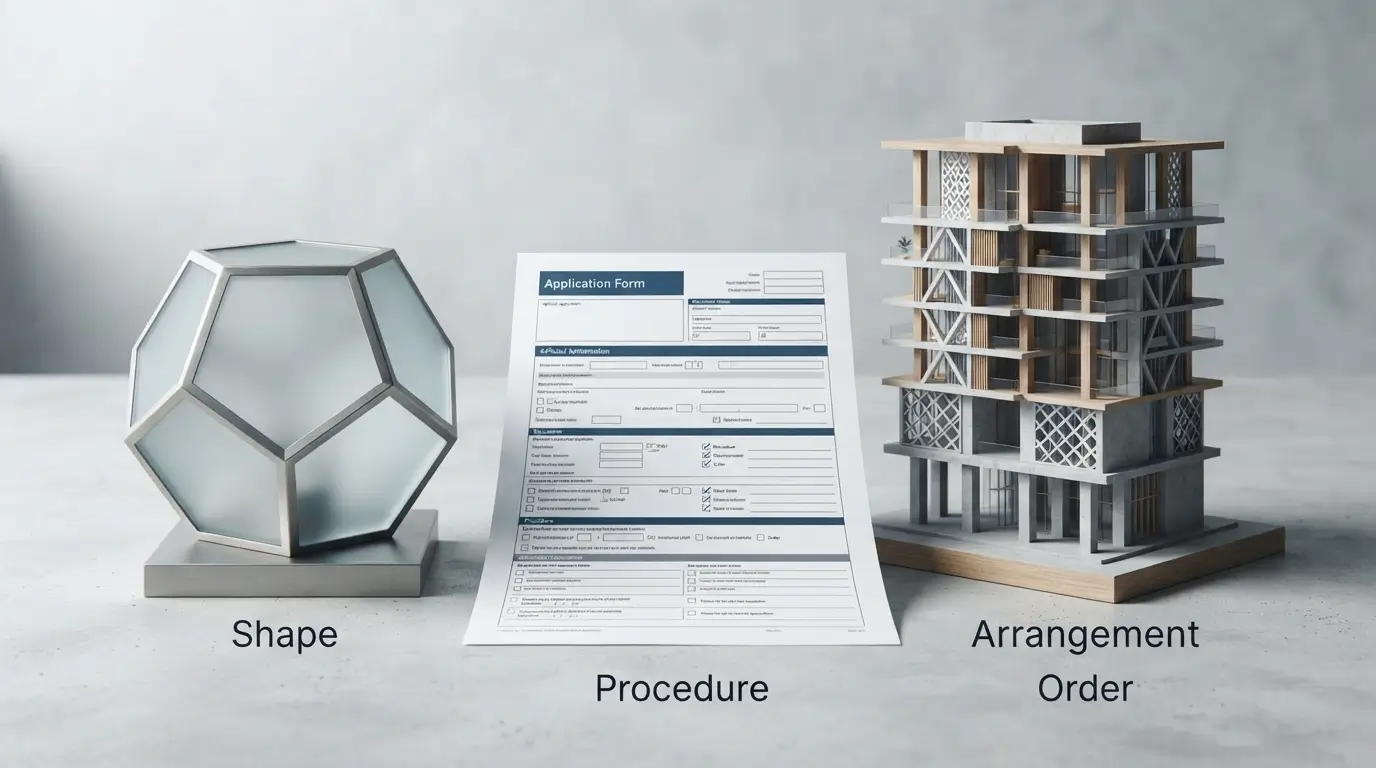

Synonyms for form become useful when you want to describe a shape, type, structure, or way of doing something without repeating the same word.
Imagine filling out a form at school or work, then later describing the form of a building. The same word has different meanings.
That is why synonyms for form can improve vocabulary. Students, bloggers, and writers can choose a more precise word for each context.
The word “form” appears often in everyday English, academic writing, business, art, grammar, and science. Learning synonyms for form helps daily English users communicate clearly.
What Does “Form” Really Mean?
Form has several important meanings in English. Its exact meaning depends on the sentence.
As a noun, “form” can mean the shape or appearance of something.
“The sculpture has an unusual form.”
It can also mean a particular type or kind.
“This form of exercise is popular.”
Another meaning refers to a document that someone completes.
“Please fill out this form.”
“Form” can also mean the structure or arrangement of something.
“The poem has a traditional form.”
As a verb, “form” means to create, shape, develop, or establish something.
“The students formed a discussion group.”
Native speakers understand “form” through context. The word itself does not carry a strong emotional attitude. Its tone usually remains neutral.
Common contexts include:
- Shape and appearance
- Types and categories
- Documents
- Art and literature
- Grammar
- Physical objects
- Organizations
- Ideas and opinions
- Creation and development
- Academic writing
Connotative Meaning
Connotation (the feeling or association a word carries beyond its basic meaning) varies slightly with context.
Positive tone:
“Form” can suggest beauty, structure, order, or artistic quality.
Negative tone:
The word itself is not normally negative. A negative meaning can come from the surrounding words.
Neutral tone:
Most uses of “form” are neutral, especially when it means shape, type, structure, or a document.
For example, “beautiful form” sounds positive, while “standard form” sounds neutral.
Etymology
The word form comes through Old French and Latin. English borrowed it from Old French forme, which came from Latin forma, meaning “shape,” “figure,” “appearance,” or “form.”
The Latin root gave English a word that could describe both physical shape and an abstract structure.
Old English (450–1100)
The modern word “form” was not a major native Old English term. Old English used words such as hiw and related vocabulary to express ideas of shape, appearance, or form.
Middle English (1100–1500)
After the Norman Conquest, French vocabulary strongly influenced English. Forme became established in Middle English and developed several meanings connected with shape, arrangement, and manner.
Modern English (1500–Present)
“Form” expanded into many specialized meanings. Today, it appears in grammar, art, literature, science, education, business, mathematics, and everyday communication.
Its broad range explains why learners often need different synonyms for different contexts.
Pronunciation
US: /fɔrm/
UK: /fɔːm/
Syllables
form
Affixation Pattern of Form
Root: form — meaning shape, figure, or arrangement
Prefix: None
Suffix: None
“Form” is a simple base word. Many English words develop from it, including formal, formation, formative, transform, and reform.
Synonyms List
Because form has several meanings, no single synonym works in every sentence. The following words cover its major senses, including shape, structure, type, style, arrangement, and creation.
Shape
Shape (noun) — US: /ʃeɪp/ | UK: /ʃeɪp/
Meaning: Shape is the visible outline or physical structure of something.
Examples
- The table has a round shape.
- I like the shape of this vase.
Structure
Structure (noun) — US: /ˈstrʌktʃər/ | UK: /ˈstrʌktʃə/
Meaning: Structure is the way parts are arranged to make a whole.
Examples
- The essay has a clear structure.
- Engineers checked the structure carefully.
Type
Type (noun) — US: /taɪp/ | UK: /taɪp/
Meaning: Type means a particular group or kind of thing.
Examples
- What type of music do you enjoy?
- This type of plant needs sunlight.
Kind
Kind (noun) — US: /kaɪnd/ | UK: /kaɪnd/
Meaning: Kind means a group of people or things that share similar qualities.
Examples
- What kind of book are you reading?
- This kind of mistake happens often.
Variety
Variety (noun) — US: /vəˈraɪəti/ | UK: /vəˈraɪəti/
Meaning: Variety means a particular type or version of something.
Examples
- We grow several varieties of tomatoes.
- This variety tastes sweeter.
Figure
Figure (noun) — US: /ˈfɪɡjər/ | UK: /ˈfɪɡə/
Meaning: Figure can mean the visible shape or outline of a person or object.
Examples
- A dark figure appeared in the doorway.
- The statue has an elegant figure.
Outline
Outline (noun) — US: /ˈaʊtlaɪn/ | UK: /ˈaʊtlaɪn/
Meaning: An outline is the outer edge or basic shape of something.
Examples
- I could see the mountain’s outline.
- Draw the outline before adding details.
Appearance
Appearance (noun) — US: /əˈpɪrəns/ | UK: /əˈpɪərəns/
Meaning: Appearance is the way something looks.
Examples
- The paint changed the room’s appearance.
- The product has a modern appearance.
Configuration
Configuration (noun) — US: /kənˌfɪɡjəˈreɪʃən/ | UK: /kənˌfɪɡjəˈreɪʃən/
Meaning: Configuration is the particular arrangement of parts.
Examples
- The computer has a powerful configuration.
- We changed the seating configuration.
Arrangement
Arrangement (noun) — US: /əˈreɪndʒmənt/ | UK: /əˈreɪndʒmənt/
Meaning: Arrangement is the way things are organized or positioned.
Examples
- The flower arrangement looks beautiful.
- The seating arrangement works well.
Design
Design (noun) — US: /dɪˈzaɪn/ | UK: /dɪˈzaɪn/
Meaning: Design is the planned shape, appearance, or structure of something.
Examples
- The building has a simple design.
- I love the design of this chair.
Pattern
Pattern (noun) — US: /ˈpætərn/ | UK: /ˈpætən/
Meaning: Pattern is a repeated or recognizable arrangement or design.
Examples
- The fabric has a colorful pattern.
- We noticed a pattern in the results.
Format
Format (noun) — US: /ˈfɔrmæt/ | UK: /ˈfɔːmæt/
Meaning: Format is the particular arrangement or presentation of information.
Examples
- The teacher requested a digital format.
- The show uses a familiar format.
Mode
Mode (noun) — US: /moʊd/ | UK: /məʊd/
Meaning: Mode is a particular way or manner of doing something.
Examples
- The device has an energy-saving mode.
- Formal mode is appropriate for this setting.
Method
Method (noun) — US: /ˈmɛθəd/ | UK: /ˈmeθəd/
Meaning: Method is a particular way of doing something.
Examples
- This method saves time.
- The teacher explained a new method.
Manner
Manner (noun) — US: /ˈmænər/ | UK: /ˈmænə/
Meaning: Manner is the way something is done or expressed.
Examples
- She spoke in a calm manner.
- He handled the situation professionally.
Style
Style (noun) — US: /staɪl/ | UK: /staɪl/
Meaning: Style is a particular way of designing, expressing, or doing something.
Examples
- Her writing style is easy to understand.
- The artist developed a unique style.
Character
Character (noun) — US: /ˈkærəktər/ | UK: /ˈkærəktə/
Meaning: Character can describe the distinctive qualities or nature of something.
Examples
- The old house has plenty of character.
- The region has a unique character.
Nature
Nature (noun) — US: /ˈneɪtʃər/ | UK: /ˈneɪtʃə/
Meaning: Nature describes the basic qualities or character of something.
Examples
- We discussed the nature of the problem.
- The nature of the work changed.
State
State (noun) — US: /steɪt/ | UK: /steɪt/
Meaning: State is the condition or situation that something is in.
Examples
- The building remains in good state.
- Water exists in different states.
Condition
Condition (noun) — US: /kənˈdɪʃən/ | UK: /kənˈdɪʃən/
Meaning: Condition is the particular state of something at a given time.
Examples
- The car is in excellent condition.
- The book arrived in good condition.
Version
Version (noun) — US: /ˈvɝʒən/ | UK: /ˈvɜːʃən/
Meaning: Version is a particular form or variation of something.
Examples
- I prefer the latest version.
- The director released a longer version.
Model
Model (noun) — US: /ˈmɑdəl/ | UK: /ˈmɒdəl/
Meaning: Model is a particular design, type, or representation of something.
Examples
- This model has better safety features.
- The teacher showed us a model of the bridge.
Template
Template (noun) — US: /ˈtɛmpleɪt/ | UK: /ˈtemplət/
Meaning: A template is a fixed pattern or structure used as a guide.
Examples
- I used a template for the report.
- The form follows a standard template.
Mold
Mold (noun) — US: /moʊld/ | UK: /məʊld/
Meaning: A mold is a shape or container used to give something a particular form.
Examples
- Pour the mixture into the mold.
- The artist used a clay mold.
Embodiment
Embodiment (noun) — US: /ɪmˈbɑdimənt/ | UK: /ɪmˈbɒdimənt/
Meaning: Embodiment is a person or thing that clearly represents an idea or quality.
Examples
- She is the embodiment of patience.
- The building is an embodiment of modern design.
Manifestation
Manifestation (noun) — US: /ˌmænəfəˈsteɪʃən/ | UK: /ˌmænɪfeˈsteɪʃən/
Meaning: Manifestation is a visible or clear expression of something.
Examples
- The painting is a manifestation of his creativity.
- Stress can have many physical manifestations.
Formation
Formation (noun) — US: /fɔrˈmeɪʃən/ | UK: /fɔːˈmeɪʃən/
Meaning: Formation is the process or result of creating a particular structure or arrangement.
Examples
- The formation of the team took time.
- Clouds appeared in unusual formations.
Composition
Composition (noun) — US: /ˌkɑmpəˈzɪʃən/ | UK: /ˌkɒmpəˈzɪʃən/
Meaning: Composition is the way parts combine to make a whole.
Examples
- The composition of the painting is balanced.
- Scientists studied the chemical composition.
Framework
Framework (noun) — US: /ˈfreɪmwɝk/ | UK: /ˈfreɪmwɜːk/
Meaning: Framework is the basic structure that supports something.
Examples
- The plan provides a useful framework.
- The building has a strong framework.
Organization
Organization (noun) — US: /ˌɔrɡənəˈzeɪʃən/ | UK: /ˌɔːɡənaɪˈzeɪʃən/
Meaning: Organization is the way parts or ideas are arranged systematically.
Examples
- The organization of the essay is clear.
- Good organization makes work easier.
Construction
Construction (noun) — US: /kənˈstrʌkʃən/ | UK: /kənˈstrʌkʃən/
Meaning: Construction is the process of building or creating something.
Examples
- Construction began last month.
- The bridge’s construction took two years.
Build
Build (noun) — US: /bɪld/ | UK: /bɪld/
Meaning: Build refers to the shape, size, or physical structure of a person or object.
Examples
- The car has a strong build.
- He has an athletic build.
Create
Create (verb) — US: /kriˈeɪt/ | UK: /kriˈeɪt/
Meaning: Create means to make something new.
Examples
- We need to create a clear plan.
- She created a beautiful painting.
Shape
Shape (verb) — US: /ʃeɪp/ | UK: /ʃeɪp/
Meaning: Shape means to influence or give something a particular form.
Examples
- Experience shaped his personality.
- The artist shaped the clay carefully.
Build
Build (verb) — US: /bɪld/ | UK: /bɪld/
Meaning: Build means to construct or develop something over time.
Examples
- They built a strong community.
- We need to build trust.
Construct
Construct (verb) — US: /kənˈstrʌkt/ | UK: /kənˈstrʌkt/
Meaning: Construct means to build or create something by putting parts together.
Examples
- Workers constructed the new road.
- Students constructed a simple model.
Establish
Establish (verb) — US: /ɪˈstæblɪʃ/ | UK: /ɪˈstæblɪʃ/
Meaning: Establish means to create or set something up so it becomes stable or recognized.
Examples
- The group established new rules.
- They established a local community center.
Develop
Develop (verb) — US: /dɪˈvɛləp/ | UK: /dɪˈveləp/
Meaning: Develop means to grow, create, or improve something over time.
Examples
- She developed a useful study method.
- The team developed a new idea.
Produce
Produce (verb) — US: /prəˈduːs/ | UK: /prəˈdjuːs/
Meaning: Produce means to create, make, or bring something into existence.
Examples
- The factory produces furniture.
- The film produced strong reactions.
Generate
Generate (verb) — US: /ˈdʒɛnəreɪt/ | UK: /ˈdʒenəreɪt/
Meaning: Generate means to create or cause something to exist.
Examples
- The discussion generated new ideas.
- Solar panels generate electricity.
Fashion
Fashion (verb) — US: /ˈfæʃən/ | UK: /ˈfæʃən/
Meaning: Fashion means to make or shape something carefully.
Examples
- The artist fashioned the sculpture by hand.
- They fashioned a solution from simple materials.
Devise
Devise (verb) — US: /dɪˈvaɪz/ | UK: /dɪˈvaɪz/
Meaning: Devise means to create a plan, method, or solution.
Examples
- The team devised a new strategy.
- She devised a simple solution.
Arrange
Arrange (verb) — US: /əˈreɪndʒ/ | UK: /əˈreɪndʒ/
Meaning: Arrange means to put things into a particular order or structure.
Examples
- Please arrange the chairs in rows.
- She arranged the flowers carefully.
Organize
Organize (verb) — US: /ˈɔrɡənaɪz/ | UK: /ˈɔːɡənaɪz/
Meaning: Organize means to arrange things systematically.
Examples
- I need to organize my notes.
- They organized the event successfully.
Frame
Frame (verb) — US: /freɪm/ | UK: /freɪm/
Meaning: Frame means to shape, structure, or present something in a particular way.
Examples
- The article frames the issue clearly.
- They framed the discussion around education.
Constitute
Constitute (verb) — US: /ˈkɑnstətuːt/ | UK: /ˈkɒnstɪtjuːt/
Meaning: Constitute means to make up or form a whole.
Examples
- These parts constitute the final design.
- Several groups constitute the organization.
Found
Found (verb) — US: /faʊnd/ | UK: /faʊnd/
Meaning: Found means to establish an organization, institution, or system.
Examples
- They founded the school in 1995.
- She founded a community group.
Synonyms for “Form” by Tone
The best synonym depends not only on meaning but also on tone and context.
Positive
These words can suggest beauty, improvement, creativity, or strong organization:
- Design
- Development
- Refinement
- Creation
- Advancement
- Composition
- Organization
- Embodiment
For example, design can sound more positive and creative than the general word “form.”
Neutral
These alternatives usually describe something without adding strong emotion:
- Shape
- Structure
- Type
- Kind
- Variety
- Format
- Pattern
- Configuration
- Arrangement
- Version
- State
- Condition
- Method
- Style
Negative or Context-Dependent
Some words can acquire negative associations depending on their context:
- Mold
- Construction
- Manipulation
- Reshaping
- Transformation
These are not inherently negative. The surrounding sentence determines the emotional effect.
Playful / Informal
For casual conversations, speakers often choose simple words:
- Shape
- Type
- Kind
- Style
- Build
- Make
- Create
These sound more natural than highly technical alternatives.
“Form” vs Close Alternatives
Form vs Shape
The term Form is broader than shape.
“Shape” usually focuses on physical appearance or outline.
“Form” can describe physical shape, artistic structure, literary structure, type, or abstract arrangement.
“The shape of the chair is unusual.”
“The form of the poem is unusual.”
Form vs Structure
Structure focuses on how parts are organized.
Form can describe the overall shape or type.
“The structure of the essay is logical.”
“The form of the poem is traditional.”
Form vs Type
Type means a category or kind.
“Form” can sometimes mean the same thing, but it has many other meanings.
“This form of exercise is useful.”
Here, type could replace “form” naturally:
“This type of exercise is useful.”
However, you cannot replace “form” with “type” in:
“The building has an unusual form.”
How “Form” Changes by Context
Daily Conversation
In everyday speech, form commonly appears when talking about documents, shapes, types, and ways of doing things.
For example:
“Did you fill out the form?”
“What form of exercise do you prefer?”
In casual situations, words such as shape, type, and kind often sound more natural.
Writing or Blogging
Bloggers use “form” when discussing writing styles, content structures, trends, and different types of media.
For example:
“This form of storytelling has become popular.”
You can avoid repetition with style, format, type, or structure, depending on your intended meaning.
Professional or Academic Tone
Academic writers often use “form” to describe structures, categories, methods, and expressions.
Examples include:
- A form of communication
- A form of government
- The form of an argument
- The structure of a study
- The format of a report
Choose the alternative carefully because technical contexts may require a precise term.
Creative or Informal Use
Artists and writers often use “form” to discuss artistic structure or physical appearance.
For example:
“The artist focused on form rather than color.”
In this context, shape may work sometimes, but “form” can carry a broader artistic meaning.
Common Mistakes & Native Usage
Mistake 1: Using “Form” Everywhere
Because “form” has many meanings, learners sometimes use it when a more precise word would sound better.
Instead of:
“I like the form of the website.”
You might say:
“I like the design of the website.”
Mistake 2: Confusing Form and Format
Form can mean shape, type, structure, or document.
Format usually focuses on how information is arranged or presented.
“Please complete the form.”
“Please submit the report in PDF format.”
Mistake 3: Confusing Form and Shape
Use shape when physical outline is the main idea.
Use form when you mean broader structure, appearance, type, or artistic organization.
Mistake 4: Treating “Type” and “Form” as Perfect Matches
They overlap when “form” means “kind.”
However, they do not work equally well in every sentence.
“A form of government” sounds natural.
“The form of the sculpture” has a different meaning.
Register Notes
Formal: form, structure, configuration, composition, constitution, manifestation
Neutral: shape, type, kind, version, arrangement, design, format
Informal: shape, kind, style, build, make
Academic: form, structure, composition, configuration, framework, manifestation
Creative: form, shape, design, style, composition
Real-Life Examples Using “Form”
Workplace
A manager may ask an employee to complete a form before starting a new project.
Later, the manager might discuss the structure or format of the project.
Social Situations
A friend might ask:
“What form of exercise do you enjoy?”
You could answer:
“I prefer walking.”
Here, “form” means a particular type or kind.
Media and Pop Culture
A reviewer might discuss the form of a television series.
They could describe its format, style, or structure when explaining how the show works.
Writing and Storytelling
A writer may experiment with different forms of storytelling.
They might choose a traditional narrative, a diary format, or another literary structure.
Why Learning Synonyms for Form Matters
“Form” is one of those English words that looks simple but has a surprisingly wide range of meanings.
Learning its alternatives helps you understand context more accurately.
It also gives you better control over your writing.
Compare:
“The form of the building is interesting.”
with:
“The design of the building is interesting.”
The second sentence may communicate your exact meaning more clearly.
Likewise:
“This form of communication is common.”
could become:
“This type of communication is common.”
The best choice depends on what you want to emphasize.
Students can use these distinctions in essays. Bloggers can make their articles less repetitive. Content writers can select more precise vocabulary. Daily English users can speak with greater confidence.
Exercise: Practice the Best Synonym
Choose the best synonym for form in each situation.
- You want to describe the round appearance of a ball. Which synonym fits best?
- You need to describe the way an essay is organized. Which word is most suitable?
- You want to ask someone what category of music they enjoy. Which synonym fits naturally?
- A website asks you to enter your personal information into a document. Which word should you use?
- An artist discusses the arrangement of visual elements in a painting. Which synonym works best?
- A teacher gives students a fixed structure for writing an essay. Which word describes that guide?
- You want to describe the particular way a person writes. Which synonym fits best?
- A company creates a new department. Which verb means “establish”?
- A team creates a new strategy to solve a problem. Which verb fits best?
- A designer puts several objects into a specific order. Which verb describes this action?
- A scientist describes the condition of matter as solid, liquid, or gas. Which synonym fits best?
- You want to describe the physical structure of a person. Which noun works best?
- A group creates a strong community over several years. Which verb describes this process?
- You want to describe a particular version of a product. Which synonym should you choose?
Reflection Task
Improve Three Sentences
Write three sentences using the word form. Then replace it with a more precise synonym such as shape, structure, type, format, or design. Notice how the meaning changes.
Answer Key: 1. shape | 2. structure | 3. type | 4. form | 5. composition | 6. template | 7. style | 8. establish | 9. devise | 10. arrange | 11. state | 12. build | 13. build | 14. version
Conclusion
The best synonyms for form depend on the meaning you want to express. Shape, structure, type, format, design, and style each highlight a different idea.
Learning these alternatives makes writing more precise. It also helps you avoid repetition in essays, blogs, professional documents, and everyday conversations.
The most important lesson is to consider context before replacing “form.” A synonym should match both the meaning and the tone of your sentence.
Practice these words in emails, essays, blog posts, and daily conversations. The more you use them, the easier it becomes to choose the right word naturally.