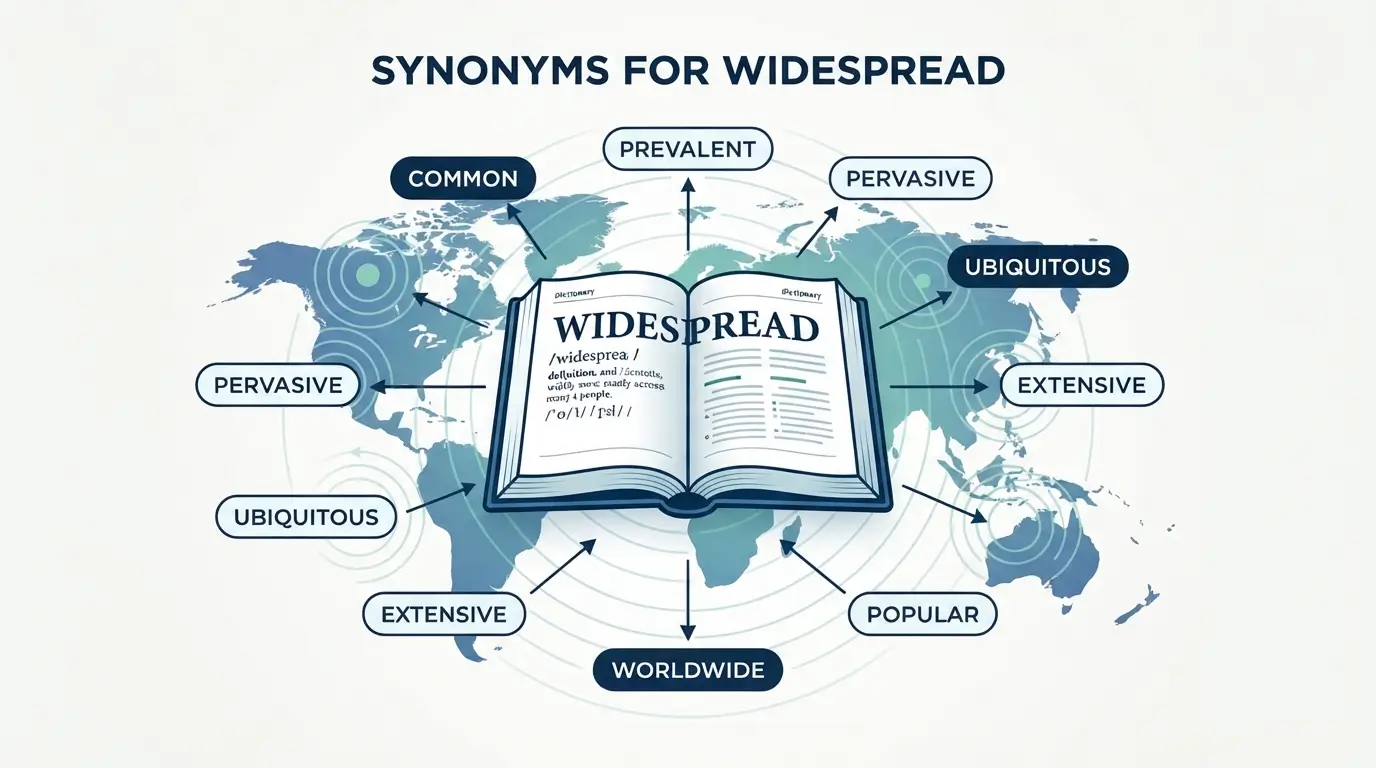

Synonyms for widespread can make your English more precise. Imagine describing a trend that appears in many places, but you want a fresher, sharper word.
A new habit may become widespread within weeks. A useful idea can become commonplace, while a problem may become pervasive across a community.
Learning synonyms for widespread helps you avoid repeating one word. It also lets you choose language that matches your meaning, audience, and writing style.
Students, bloggers, content writers, and everyday English users can all benefit from synonyms for widespread. The right alternative can make a simple sentence clearer and more natural.
What Does “Widespread” Really Mean?
Widespread is an adjective used for something that exists, happens, or is known across a large area or among many people.
Simple Definition
Widespread means existing, happening, or known in many places or among many people.
For example:
Smartphone use is widespread among young adults.
This means many young adults use smartphones.
Another example:
The storm caused widespread damage.
Here, widespread means the damage affected a large area rather than one small location.
Part of Speech
Widespread is an adjective.
It commonly appears before nouns:
- widespread support
- widespread concern
- widespread use
- widespread damage
- widespread belief
- widespread popularity
It can also follow linking verbs:
The practice became widespread.
Native speakers commonly use the word in news reports, academic writing, business communication, social commentary, technology discussions, and everyday descriptions.
Connotative Meaning
Connotation (the feeling or association a word carries beyond its basic dictionary meaning) can influence how a sentence feels.
Positive Tone
Widespread can have a positive association when it describes:
- widespread support
- widespread acceptance
- widespread appreciation
- widespread popularity
Negative Tone
It can describe undesirable situations as well:
- widespread poverty
- widespread corruption
- widespread damage
- widespread misinformation
Neutral Tone
The word is neutral when it simply describes broad distribution:
- widespread internet access
- widespread use of English
- widespread smartphone adoption
So, widespread itself is generally neutral. The noun and surrounding context usually create the positive or negative impression.
Etymology of “Widespread”
The word widespread is a compound formed from wide + spread.
Wide comes from Old English wīd, meaning broad or extensive.
Spread developed from Old English sprǣdan, meaning to stretch out, extend, scatter, or distribute.
Together, these elements create the basic idea of something being spread over a wide area.
Old English: 450–1100
Old English had the separate words and concepts behind the modern compound. Wīd referred to something broad or extensive, while sprǣdan described extending, scattering, or spreading.
Middle English: 1100–1500
Middle English continued the development of words related to wide and spread. Their meanings expanded through descriptions of physical distance, movement, and distribution.
Modern English: 1500–Present
Modern English eventually developed widespread as a compound adjective. Its use expanded beyond physical areas to include beliefs, practices, trends, influence, problems, and social conditions.
Pronunciation of “Widespread”
US: /ˈwaɪdˌsprɛd/
UK: /ˈwaɪdˌspred/
Syllables
wide-spread
Affixation Pattern
Root: wide + spread
Prefix: none
Suffix: none
Word formation: compound adjective
Synonyms List
The following alternatives overlap with widespread, but they are not perfectly interchangeable. Some emphasize frequency, others geographic reach, popularity, acceptance, or deep influence.
Common (Adjective) — US /ˈkɑːmən/ | UK /ˈkɒmən/
Meaning: Existing frequently or among many people.
Tone/Register: Neutral, everyday
Example:
Online banking is now common in many countries.
It is common for students to use digital resources.
Prevalent (Adjective) — US /ˈprɛvələnt/ | UK /ˈprevələnt/
Meaning: Existing or occurring frequently in a particular group, place, or situation.
Tone/Register: Formal, academic
Example:
Stress is prevalent among university students.
The habit remains prevalent in urban areas.
Pervasive (Adjective) — US /pərˈveɪsɪv/ | UK /pəˈveɪsɪv/
Meaning: Present throughout an area, group, or situation.
Tone/Register: Formal, academic
Example:
Social media has a pervasive influence on communication.
The issue became pervasive across the organization.
Extensive (Adjective) — US /ɪkˈstɛnsɪv/ | UK /ɪkˈstensɪv/
Meaning: Covering a large area, range, amount, or scope.
Tone/Register: Formal, professional
Example:
The flood caused extensive damage.
Researchers collected extensive data from several regions.
Universal (Adjective) — US /ˌjuːnəˈvɜːrsəl/ | UK /ˌjuːnɪˈvɜːsəl/
Meaning: Existing or accepted by everyone or nearly everyone.
Tone/Register: Formal, general
Example:
There is no universal agreement on the issue.
The rule has almost universal recognition.
Ubiquitous (Adjective) — US /juːˈbɪkwɪtəs/ | UK /juːˈbɪkwɪtəs/
Meaning: Present or seen almost everywhere.
Tone/Register: Formal, academic
Example:
Smartphones are ubiquitous in modern cities.
Digital payments have become ubiquitous in daily life.
General (Adjective) — US /ˈdʒɛnərəl/ | UK /ˈdʒenərəl/
Meaning: Applying to many people, places, or situations rather than a limited group.
Tone/Register: Neutral
Example:
There was general support for the proposal.
The topic has received general attention.
Far-Reaching (Adjective) — US /ˌfɑːr ˈriːtʃɪŋ/ | UK /ˌfɑː ˈriːtʃɪŋ/
Meaning: Affecting or extending across a large area, group, or range.
Tone/Register: Formal, professional
Example:
The decision could have far-reaching effects.
The reform created far-reaching changes in education.
Broad (Adjective) — US /brɔːd/ | UK /brɔːd/
Meaning: Covering many people, areas, subjects, or aspects.
Tone/Register: Neutral, formal
Example:
The campaign received broad public support.
The article offers a broad overview of the topic.
Global (Adjective) — US /ˈɡloʊbəl/ | UK /ˈɡləʊbəl/
Meaning: Existing, operating, or affecting the whole world.
Tone/Register: Neutral, professional
Example:
Climate change is a global concern.
The brand has a global audience.
Worldwide (Adjective/Adverb) — US /ˌwɜːrldˈwaɪd/ | UK /ˌwɜːldˈwaɪd/
Meaning: Existing or occurring throughout the world.
Tone/Register: Neutral, general
Example:
The film gained worldwide attention.
The announcement was shared worldwide.
Nationwide (Adjective/Adverb) — US /ˌneɪʃənˈwaɪd/ | UK /ˌneɪʃənˈwaɪd/
Meaning: Covering or affecting an entire country.
Tone/Register: Neutral, news, professional
Example:
The campaign received nationwide support.
The service is available nationwide.
Region-Wide (Adjective/Adverb) — US /ˌriːdʒənˈwaɪd/ | UK /ˌriːdʒənˈwaɪd/
Meaning: Covering or affecting an entire region.
Tone/Register: Professional, geographic
Example:
The storm caused region-wide disruption.
Officials announced a region-wide safety campaign.
Broad-Based (Adjective) — US /ˌbrɔːd ˈbeɪst/ | UK /ˌbrɔːd ˈbeɪst/
Meaning: Involving or supported by many different groups or sections.
Tone/Register: Business, formal
Example:
The proposal received broad-based support.
The project needs broad-based community involvement.
Well-Known (Adjective) — US /ˌwɛl ˈnoʊn/ | UK /ˌwel ˈnəʊn/
Meaning: Known by many people.
Tone/Register: Neutral
Example:
She is a well-known author.
The location is well-known among tourists.
Widely Known (Adjective Phrase) — US /ˈwaɪdli noʊn/ | UK /ˈwaɪdli nəʊn/
Meaning: Known by a large number of people.
Tone/Register: Neutral, formal
Example:
The fact is widely known among researchers.
His work is widely known outside the country.
Widely Used (Adjective Phrase) — US /ˈwaɪdli juːzd/ | UK /ˈwaɪdli juːzd/
Meaning: Used by many people or organizations.
Tone/Register: Neutral, professional
Example:
This format is widely used in education.
The method is widely used by professionals.
Widely Accepted (Adjective Phrase) — US /ˈwaɪdli əkˈsɛptɪd/ | UK /ˈwaɪdli əkˈseptɪd/
Meaning: Accepted or believed by many people.
Tone/Register: Academic, formal
Example:
The theory is widely accepted today.
Her explanation became widely accepted.
Widely Recognized (Adjective Phrase) — US /ˈwaɪdli ˈrɛkəɡnaɪzd/ | UK /ˈwaɪdli ˈrekəɡnaɪzd/
Meaning: Recognized or acknowledged by many people.
Tone/Register: Professional, formal
Example:
The university is widely recognized for research.
The problem is widely recognized by experts.
Rampant (Adjective) — US /ˈræmpənt/ | UK /ˈræmpənt/
Meaning: Spreading quickly and existing in an uncontrolled way, usually with a negative sense.
Tone/Register: Strong, negative
Example:
Misinformation became rampant online.
Corruption was rampant in the system.
Frequent (Adjective) — US /ˈfriːkwənt/ | UK /ˈfriːkwənt/
Meaning: Happening or appearing often.
Tone/Register: Neutral
Example:
Frequent power cuts affected the area.
The region experiences frequent storms.
Commonplace (Adjective) — US /ˈkɑːmənpleɪs/ | UK /ˈkɒmənpleɪs/
Meaning: So common that something is no longer unusual or surprising.
Tone/Register: Neutral, formal
Example:
Remote work is now commonplace in many industries.
Online meetings have become commonplace.
Established (Adjective) — US /ɪˈstæblɪʃt/ | UK /ɪˈstæblɪʃt/
Meaning: Firmly accepted, recognized, or practiced over time.
Tone/Register: Formal, professional
Example:
The practice is now well established.
The company follows an established process.
Mainstream (Adjective) — US /ˈmeɪnstriːm/ | UK /ˈmeɪnstriːm/
Meaning: Accepted, popular, or followed by the majority.
Tone/Register: Neutral, media, informal
Example:
The idea has entered the mainstream.
Streaming has become a mainstream form of entertainment.
Popular (Adjective) — US /ˈpɑːpjələr/ | UK /ˈpɒpjʊlə/
Meaning: Liked, used, or supported by many people.
Tone/Register: Neutral
Example:
The app became popular among teenagers.
The style remains popular today.
Prevailing (Adjective) — US /prɪˈveɪlɪŋ/ | UK /prɪˈveɪlɪŋ/
Meaning: Existing as the most common or accepted condition, opinion, or practice.
Tone/Register: Formal, academic
Example:
The prevailing view favors further research.
These were the prevailing attitudes at the time.
Dominant (Adjective) — US /ˈdɑːmənənt/ | UK /ˈdɒmɪnənt/
Meaning: More powerful, influential, or common than competing alternatives.
Tone/Register: Formal, analytical
Example:
English is a dominant language in international business.
One brand has a dominant position in the market.
Penetrating (Adjective) — US /ˈpɛnətreɪtɪŋ/ | UK /ˈpenətreɪtɪŋ/
Meaning: Reaching deeply into an area, group, or system.
Tone/Register: Formal, analytical
Example:
The technology has a penetrating influence on modern life.
The report offers a penetrating analysis of the issue.
Omnipresent (Adjective) — US /ˌɑːmnɪˈprɛzənt/ | UK /ˌɒmnɪˈprezənt/
Meaning: Seeming to be present everywhere at the same time.
Tone/Register: Formal, literary
Example:
Screens are almost omnipresent in modern homes.
Music was omnipresent throughout the festival.
All-Pervading (Adjective) — US /ˌɔːl pərˈveɪdɪŋ/ | UK /ˌɔːl pəˈveɪdɪŋ/
Meaning: Affecting or spreading through every part of something.
Tone/Register: Formal, literary
Example:
There was an all-pervading sense of excitement.
Technology has an all-pervading influence on communication.
Far-Flung (Adjective) — US /ˈfɑːr flʌŋ/ | UK /ˈfɑː flʌŋ/
Meaning: Located across widely separated places.
Tone/Register: Descriptive, literary
Example:
The organization operates in far-flung regions.
She has friends in far-flung parts of the world.
Scattered (Adjective) — US /ˈskætərd/ | UK /ˈskætəd/
Meaning: Distributed across different places rather than concentrated in one location.
Tone/Register: Neutral
Example:
Scattered communities remained after the migration.
The village has scattered houses across the valley.
Distributed (Adjective) — US /dɪˈstrɪbjətɪd/ | UK /dɪˈstrɪbjʊtɪd/
Meaning: Spread across different locations, groups, or parts.
Tone/Register: Technical, professional
Example:
The company has a distributed workforce.
Resources were distributed across several regions.
Dispersed (Adjective) — US /dɪˈspɜːrst/ | UK /dɪˈspɜːst/
Meaning: Spread out over a relatively wide area.
Tone/Register: Formal, geographic
Example:
The population is dispersed across several islands.
The group became dispersed after the event.
Diffuse (Adjective) — US /dɪˈfjuːs/ | UK /dɪˈfjuːs/
Meaning: Spread widely and often gradually through an area or group.
Tone/Register: Formal, academic
Example:
The movement has a diffuse organizational structure.
Influence became diffuse across the region.
Extensive (Adjective) — US /ɪkˈstɛnsɪv/ | UK /ɪkˈstensɪv/
Meaning: Large in amount, scope, or range.
Tone/Register: Academic, business
Example:
The museum has an extensive collection.
The researchers reviewed extensive evidence.
Broadly Accepted (Adjective Phrase) — US /ˈbrɔːdli əkˈsɛptɪd/ | UK /ˈbrɔːdli əkˈseptɪd/
Meaning: Accepted by many people or groups rather than by only a small minority.
Tone/Register: Academic, professional
Example:
The explanation is broadly accepted by historians.
The principle is broadly accepted in modern education.
Broadly Recognized (Adjective Phrase) — US /ˈbrɔːdli ˈrɛkəɡnaɪzd/ | UK /ˈbrɔːdli ˈrekəɡnaɪzd/
Meaning: Recognized across a wide group, field, or community.
Tone/Register: Formal, professional
Example:
The researcher is broadly recognized in her field.
The method is broadly recognized as effective.
Synonyms by Tone
Positive
Use these when broad presence or acceptance has a favorable meaning:
- popular
- widely accepted
- widely recognized
- mainstream
- established
- broad-based
- well-known
Neutral
These are useful when you simply want to describe broad distribution:
- widespread
- common
- broad
- extensive
- global
- worldwide
- distributed
- dispersed
- nationwide
Negative
These can suggest an undesirable or uncontrolled spread:
- rampant
- pervasive
- all-pervading
- prevalent
Playful or Informal
For relaxed communication, simpler choices usually sound more natural:
- common
- popular
- everywhere
- mainstream
- well-known
Tone matters because two words can have similar meanings while creating different impressions. Choosing the right synonym makes your writing more accurate and natural.
Widespread vs. Close Alternatives
Widespread vs. Common
Common emphasizes frequency or ordinary occurrence.
Widespread emphasizes distribution across many places or people.
The disease is widespread across the region.
The condition is common among older adults.
Widespread vs. Pervasive
Pervasive suggests that something has spread throughout an environment or system.
Widespread describes broad presence.
Internet access is widespread.
Digital advertising is pervasive.
Widespread vs. Ubiquitous
Ubiquitous suggests that something is nearly everywhere.
Widespread means found in many places.
Smartphones are widespread.
Smartphones seem ubiquitous in modern cities.
How Widespread Changes by Context
Daily Conversation
In everyday English, common, popular, well-known, and everywhere may sound more natural than highly formal alternatives.
Instead of:
The trend is pervasive.
A casual speaker might say:
The trend is everywhere.
Writing or Blogging
Bloggers can use widespread, common, popular, widely used, and mainstream depending on the exact meaning.
For example:
Remote work has become widespread.
This emphasizes broad adoption.
By contrast:
Remote work has become popular.
This emphasizes people liking or choosing it.
Professional or Academic Tone
Formal writing often benefits from words such as prevalent, pervasive, extensive, prevailing, and far-reaching.
For example:
The study examines prevalent attitudes toward online education.
The word prevalent sounds more analytical than the everyday word common.
Creative or Informal Use
Creative writing may use far-flung, omnipresent, or all-pervading when the writer wants a stronger image.
For example:
Music seemed omnipresent throughout the old city.
This creates a more vivid impression than simply saying:
Music was widespread.
Common Mistakes and Native Usage
Mistake 1: Treating Every Synonym as Interchangeable
Words such as global, nationwide, and widespread describe different scopes.
A global trend affects the world. A nationwide trend affects an entire country. A widespread trend may cover many places without reaching the whole world.
Mistake 2: Using “Ubiquitous” for Everything
Ubiquitous is stronger than widespread. It suggests something is almost everywhere.
Smartphones are widespread.
This does not necessarily mean smartphones are present in every location.
Mistake 3: Confusing “Popular” With “Widespread”
Popular focuses on approval, demand, or liking.
Widespread focuses on distribution.
Something can be widespread without being popular.
For example, misinformation may be widespread without being desirable.
Mistake 4: Using Highly Formal Words in Casual Speech
Words such as pervasive, omnipresent, and all-pervading can sound overly formal in ordinary conversation.
In casual English, common, popular, or everywhere may be better.
Register Notes
Widespread is flexible and works well in both spoken and written English.
Common, popular, and well-known are especially natural in everyday communication.
Prevalent, pervasive, prevailing, and far-reaching are more common in academic, professional, journalistic, and analytical writing.
Ubiquitous and omnipresent are stronger and more sophisticated choices. Use them only when their precise meanings fit the context.
Real-Life Mini Scenarios
Workplace
A company introduces remote meetings across all departments.
You could say:
Remote meetings have become widespread.
For a formal report:
Remote collaboration has become prevalent across the organization.
Social Situations
A new expression starts appearing in everyday conversations.
You might say:
The expression has become popular.
If people use it across many communities:
The expression has become widespread.
Media and Pop Culture
A new streaming series becomes known internationally.
You could write:
The series gained worldwide popularity.
If you want to emphasize recognition:
The series became widely known.
Writing and Storytelling
A writer describes a belief found throughout a fictional kingdom.
The belief was widespread among the villagers.
For a more literary effect:
The belief was all-pervading throughout the kingdom.
How to Choose the Right Synonym
Ask yourself four simple questions before replacing widespread.
Am I talking about frequency?
Choose common, frequent, or prevalent.
Am I talking about geographic reach?
Choose widespread, worldwide, global, nationwide, or far-flung.
Am I talking about social acceptance?
Choose popular, mainstream, widely accepted, or established.
Am I describing something that has spread deeply?
Choose pervasive, omnipresent, or all-pervading when appropriate.
This simple method helps you avoid using an impressive-looking synonym that does not actually fit your sentence.
Interactive Practice Quiz
Choose the best answer for each situation.
1. Which word best describes something found almost everywhere?
A. Frequent
B. Ubiquitous
C. Popular
D. Established
2. Which synonym is most suitable for academic writing about a common social issue?
A. Prevalent
B. Cute
C. Famous
D. Fun
3. A trend affects an entire country. Which term fits best?
A. Nationwide
B. Scattered
C. Local
D. Narrow
4. Which word suggests that something is common and no longer unusual?
A. Commonplace
B. Dispersed
C. Far-flung
D. Narrow
5. Which word best describes an uncontrolled negative spread?
A. Mainstream
B. Rampant
C. Established
D. Broad
6. Which synonym focuses on something being liked by many people?
A. Popular
B. Dispersed
C. Extensive
D. Diffuse
7. Which word describes something spread across widely separated locations?
A. Far-flung
B. Frequent
C. Universal
D. Mainstream
8. Which term is strongest when something seems impossible to avoid because it is everywhere?
A. Common
B. Ubiquitous
C. General
D. Popular
9. Which word best describes a practice firmly accepted over time?
A. Established
B. Scattered
C. Rampant
D. Diffuse
10. Which phrase means “known by many people”?
A. Widely known
B. Far-flung
C. Region-wide
D. Dispersed
11. Which word best describes influence throughout an entire system?
A. Pervasive
B. Popular
C. Commonplace
D. Frequent
12. Which word is most suitable for something covering a large range or scope?
A. Extensive
B. Famous
C. Tiny
D. Local
13. Which word describes something accepted by the majority?
A. Mainstream
B. Dispersed
C. Scattered
D. Diffuse
14. Which word describes something spread over a wide area rather than concentrated?
A. Dispersed
B. Popular
C. Dominant
D. Frequent
15. Application Task
Write one original sentence using widespread, prevalent, pervasive, commonplace, or ubiquitous. Then replace your chosen word with another suitable synonym and compare the difference in tone.
Answer key: 1-B | 2-A | 3-A | 4-A | 5-B | 6-A | 7-A | 8-B | 9-A | 10-A | 11-A | 12-A | 13-A | 14-A
Frequently Asked Questions
1. What is the best synonym for widespread in academic writing?
Prevalent and pervasive are strong academic alternatives, but they are not identical. Prevalent usually means frequently found or occurring, while pervasive suggests that something spreads throughout an environment or system. Widespread remains a safe choice when you simply mean that something exists across many places or among many people.
2. What is a stronger word than widespread?
Ubiquitous is often stronger than widespread because it suggests that something is present almost everywhere. Omnipresent can create an even stronger impression of being everywhere. However, these words should not replace widespread automatically. Use them only when the context supports their stronger meaning.
3. Is “common” the same as “widespread”?
Not exactly. Common usually emphasizes frequency or how often something occurs. Widespread emphasizes distribution across many places or people. A behavior can be common in one small community without being widespread. A widespread behavior exists across a much broader area or population.
4. What is the difference between widespread and ubiquitous?
Widespread means something is found across many places or among many people. Ubiquitous means something seems to be everywhere or nearly impossible to avoid. Therefore, ubiquitous generally carries a stronger sense of universal presence than widespread.
5. Which synonym for widespread is best for business writing?
The best choice depends on your meaning. Extensive, broad-based, widely used, widely recognized, prevalent, and mainstream can all work in business writing. For example, “widely recognized brand” focuses on recognition, while “extensive network” focuses on broad coverage.
6. What is the opposite of widespread?
Common opposites include limited, localized, restricted, isolated, rare, and uncommon. The correct opposite depends on the sentence. Localized works when something affects only a small geographic area, while rare focuses on low frequency rather than geographic reach.
7. Can widespread describe negative things?
Yes. Widespread is neutral and can describe both positive and negative situations. Examples include “widespread support,” “widespread damage,” “widespread poverty,” and “widespread misinformation.” The noun following widespread usually determines the emotional direction of the sentence.
8. What is the most natural synonym for widespread in everyday English?
Common is often the easiest everyday alternative, but it does not always preserve the exact meaning. Popular, everywhere, and widely used can also sound natural depending on context. In careful writing, widespread is often preferable when you specifically mean broad distribution.
Conclusion
Learning synonyms for widespread is not simply about memorizing vocabulary. It is about choosing the word that expresses your exact idea with the right tone.
Words such as common, popular, prevalent, and pervasive overlap with widespread, but each carries a different shade of meaning and usage.
The right synonym can make an essay clearer, a blog post more engaging, and a conversation more precise. It can also help you sound confident without forcing difficult vocabulary.
Start practicing today. Use these alternatives in emails, essays, blog posts, and daily conversations, and notice how your English becomes more flexible and natural.