
Synonyms for summary can make your writing more precise. Imagine finishing a long report and needing one clear phrase to describe its short version.
A student may write a brief overview before an exam. A manager may need a quick recap of a meeting. Both situations need clear language.
Learning synonyms for summary helps you avoid repeating the same word. It also lets you choose words that match formal, academic, casual, or creative writing.
For students, bloggers, writers, and daily English users, synonyms for summary offer a simple way to make communication clearer, smoother, and more natural.
📚 What Does “Summary” Really Mean?
A summary is a short statement or piece of writing that gives the main points of something longer. It removes unnecessary details while keeping the central ideas.
For example, a five-page article might be reduced to one paragraph that explains its key argument. That shorter version is a summary.
Native speakers commonly use summary in education, business, journalism, meetings, books, reports, presentations, and everyday conversation.
The word is mainly a noun.
Simple definition: A summary is a short account that presents the main ideas or important points of something longer.
🧠 Connotative Meaning
Connotation (the feeling, association, or idea a word suggests beyond its basic dictionary meaning) can affect how a synonym sounds.
Positive tone: Words such as overview or synopsis can sound organized, professional, and helpful.
Negative tone: Terms such as abridgment can sometimes suggest that something has been shortened by removing material.
Neutral tone: Summary, outline, recap, and digest are usually neutral, although their exact tone depends on context.
The word summary itself is generally neutral and practical. It does not normally express a strong emotional attitude.
📖 Etymology of “Summary”
The word summary ultimately comes from Latin summarius, meaning “of or belonging to the sum.” It is connected with Latin summa, meaning “the highest point,” “total,” or “main substance.”
The idea is important because a summary brings the main substance of something together.
Old English: 450–1100
The modern English word summary was not an established Old English vocabulary item. Old English used other expressions to communicate ideas related to a short account or main point.
Therefore, it would be inaccurate to claim that summary directly developed from an Old English form.
Middle English: 1100–1500
The word entered English through forms influenced by Latin and French. Medieval scholarly and religious writing helped preserve vocabulary derived from Latin.
The idea of presenting the main substance of a longer work became increasingly useful in learned writing.
Modern English: 1500–Present
By the Early Modern English period, summary had become established as a noun and adjective.
Today, the noun is widely used for shortened versions of articles, books, reports, meetings, research, stories, and presentations.
🔊 Pronunciation
US: /ˈsʌməri/
UK: /ˈsʌməri/
Syllables
sum-ma-ry
Affixation Pattern of “Summary”
Root: summ- / Latin summa
Prefix: None
Suffix: -ary
The root is connected to the idea of a sum, total, or main substance.
📖 List of Synonyms
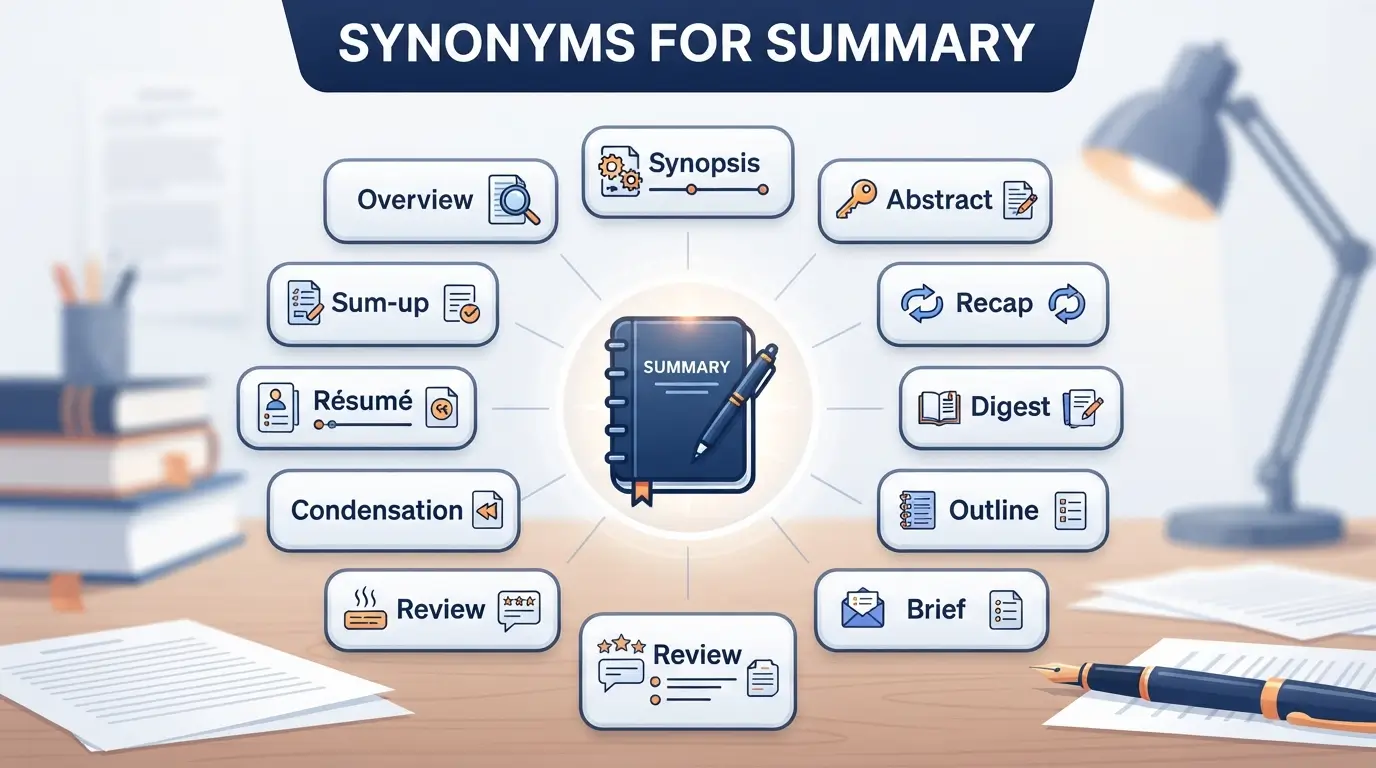
There is an important vocabulary point here: not every word below is a perfect substitute for summary. Some are near-synonyms used in specific contexts.
A recap, for example, often reviews events, while a synopsis usually summarizes a work such as a book, film, or story. Good vocabulary learning means understanding these differences rather than treating every word as identical.
📝 Abstract (Noun) — US /ˈæbstrækt/ | UK /ˈæbstrækt/
Meaning: An abstract is a concise account of the main purpose, methods, findings, and conclusions of a scholarly work.
Tone/Register: Academic, formal
Example:
- Read the abstract before choosing the research paper.
- The abstract explains the study in just a few paragraphs.
📝 Abridgment (Noun) — US /ˈæbrɪdʒmənt/ | UK /ˈəbrɪdʒmənt/
Meaning: An abridgment is a shortened version of a longer work that keeps its essential content.
Tone/Register: Formal, literary
Example:
- I read an abridgment of the classic novel.
- The abridgment removed several long descriptions.
📝 Account (Noun) — US /əˈkaʊnt/ | UK /əˈkaʊnt/
Meaning: An account is a description or report of events, experiences, or information.
Tone/Register: Neutral, formal
Example:
- She gave an account of what happened.
- His account covered the main events of the trip.
📝 Analysis (Noun) — US /əˈnæləsɪs/ | UK /əˈnæləsɪs/
Meaning: An analysis examines information in detail and may include a condensed presentation of important findings.
Tone/Register: Academic, professional
Example:
- The report includes an analysis of customer behavior.
- His analysis highlighted three important trends.
📝 Abstract Summary (Noun Phrase) — US /ˈæbstrækt ˈsʌməri/ | UK /ˈæbstrækt ˈsʌməri/
Meaning: An abstract summary is a highly condensed presentation of the essential content of a longer academic work.
Tone/Register: Academic
Example:
- The professor requested an abstract summary.
- Keep the abstract summary focused on the findings.
📝 Brief (Noun) — US /briːf/ | UK /briːf/
Meaning: A brief is a concise statement of essential information, often prepared for a professional purpose.
Tone/Register: Professional, formal
Example:
- Send me a brief before the meeting.
- The legal team prepared a short brief.
📝 Briefing (Noun) — US /ˈbriːfɪŋ/ | UK /ˈbriːfɪŋ/
Meaning: A briefing is a short presentation or explanation that gives people the essential information they need.
Tone/Register: Professional, business
Example:
- The team attended a morning briefing.
- The briefing covered the project’s latest updates.
📝 Capsule (Noun) — US /ˈkæpsəl/ | UK /ˈkæpsjuːl/
Meaning: A capsule is a very short form of information that contains only the essential points.
Tone/Register: Informal, journalistic
Example:
- Here is a capsule of the story.
- The article gives a capsule history of the company.
📝 Condensation (Noun) — US /ˌkɑːndenˈseɪʃən/ | UK /ˌkɒndenˈseɪʃən/
Meaning: A condensation is a shortened version created by removing less important material.
Tone/Register: Formal, literary
Example:
- The editor prepared a condensation of the original report.
- This condensation is easier to read.
📝 Condensed Version (Noun Phrase) — US /kənˈdenst ˈvɜːrʒən/ | UK /kənˈdenst ˈvɜːʃən/
Meaning: A condensed version presents the essential content of something in a shorter form.
Tone/Register: Neutral, formal
Example:
- The website offers a condensed version of the report.
- I chose the condensed version for quick reading.
📝 Digest (Noun) — US /ˈdaɪdʒest/ | UK /ˈdaɪdʒest/
Meaning: A digest is a short collection or version of important information from a larger source.
Tone/Register: Neutral, journalistic
Example:
- I read the weekly news digest.
- The digest highlights the most important stories.
📝 Digest Version (Noun Phrase) — US /ˈdaɪdʒest ˈvɜːrʒən/ | UK /ˈdaɪdʒest ˈvɜːʃən/
Meaning: A digest version presents selected key information from a larger source.
Tone/Register: Neutral
Example:
- The newsletter provides a digest version of the report.
- I prefer the digest version when I am busy.
📝 Epitome (Noun) — US /ɪˈpɪtəmi/ | UK /ɪˈpɪtəmi/
Meaning: An epitome can represent the essential qualities or central features of something.
Tone/Register: Formal, literary
Example:
- The short essay was an epitome of his argument.
- The speech became an epitome of her leadership style.
Native usage note: Epitome is not a direct replacement for summary in every sentence.
📝 Extract (Noun) — US /ˈɛkstrækt/ | UK /ˈekstrækt/
Meaning: An extract is a selected part taken from a longer text rather than necessarily a summary of it.
Tone/Register: Neutral, academic
Example:
- The teacher gave us an extract from the novel.
- Read the extract before answering the questions.
📝 Gist (Noun) — US /dʒɪst/ | UK /dʒɪst/
Meaning: The gist is the main idea or general meaning of something.
Tone/Register: Informal, everyday
Example:
- I did not read the whole email, but I got the gist.
- Can you give me the gist of the conversation?
📝 Outline (Noun) — US /ˈaʊtlaɪn/ | UK /ˈaʊtlaɪn/
Meaning: An outline presents the main points of a subject in an organized structure.
Tone/Register: Academic, professional
Example:
- Make an outline before writing the essay.
- The presentation outline covers four main topics.
📝 Overview (Noun) — US /ˈoʊvərvjuː/ | UK /ˈəʊvəvjuː/
Meaning: An overview gives a general picture of the main features of a subject.
Tone/Register: Neutral, professional
Example:
- The introduction gives an overview of the project.
- I need a quick overview before I start reading.
📝 Recap (Noun) — US /ˈriːkæp/ | UK /ˈriːkæp/
Meaning: A recap briefly reviews events, information, or points that have already been discussed.
Tone/Register: Informal, conversational
Example:
- Let me give you a quick recap.
- The host gave a recap of yesterday’s episode.
📝 Resume (Noun) — US /rəˈzuːmeɪ/ | UK /reɪˈzjuːmeɪ/
Meaning: A resume can mean a concise summary of information, although this use is less common than the employment document meaning in American English.
Tone/Register: Formal
Example:
- The document provided a resume of the argument.
- He included a brief resume of the evidence.
📝 Synopsis (Noun) — US /sɪˈnɑːpsɪs/ | UK /sɪˈnɒpsɪs/
Meaning: A synopsis is a concise account of the main events or ideas in a work.
Tone/Register: Formal, literary, academic
Example:
- The publisher asked for a synopsis of the novel.
- The film synopsis revealed the basic storyline.
📝 Summation (Noun) — US /sʌˈmeɪʃən/ | UK /sʌˈmeɪʃən/
Meaning: A summation is a final statement that brings together the main points of an argument or discussion.
Tone/Register: Formal, academic
Example:
- The final paragraph offers a summation of the findings.
- Her summation was brief but powerful.
📝 Recapitulation (Noun) — US /riˌkæpɪtʃəˈleɪʃən/ | UK /riˌkæpɪtjʊˈleɪʃən/
Meaning: Recapitulation is a formal restatement or review of the main points already presented.
Tone/Register: Formal, academic
Example:
- The final section provides a recapitulation of the argument.
- His recapitulation helped the audience remember the key ideas.
📝 Review (Noun) — US /rɪˈvjuː/ | UK /rɪˈvjuː/
Meaning: A review examines or discusses something and may include a summary of its content.
Tone/Register: Neutral, academic, professional
Example:
- I wrote a review of the book.
- The review explains the main ideas before giving an opinion.
📝 Report (Noun) — US /rɪˈpɔːrt/ | UK /rɪˈpɔːt/
Meaning: A report is a structured account of information, events, findings, or activities.
Tone/Register: Professional, academic
Example:
- The report explains what happened.
- Please send me a report after the meeting.
📝 Statement (Noun) — US /ˈsteɪtmənt/ | UK /ˈsteɪtmənt/
Meaning: A statement expresses information or an idea clearly and directly.
Tone/Register: Neutral, formal
Example:
- Her statement captured the main concern.
- The company released a short statement.
📝 Recital (Noun) — US /rɪˈsaɪtəl/ | UK /rɪˈsaɪtəl/
Meaning: A recital can be a formal account or detailed statement of facts.
Tone/Register: Formal, legal
Example:
- The agreement contains a recital of the relevant facts.
- The recital explains the background to the decision.
📝 Synopsis Summary (Noun Phrase) — US /sɪˈnɑːpsɪs ˈsʌməri/ | UK /sɪˈnɒpsɪs ˈsʌməri/
Meaning: A synopsis summary is a concise account focused mainly on the central content of a work.
Tone/Register: Literary, professional
Example:
- The editor requested a synopsis summary.
- Her synopsis summary explained the plot clearly.
📝 Sketch (Noun) — US /skɛtʃ/ | UK /sketʃ/
Meaning: A sketch is a brief description that gives only the main features of something.
Tone/Register: Neutral, creative
Example:
- He gave us a quick sketch of the plan.
- The article provides a sketch of the historical background.
📝 Digestive Summary (Noun Phrase) — US /daɪˈdʒestɪv ˈsʌməri/ | UK /daɪˈdʒestɪv ˈsʌməri/
Meaning: A digestive summary presents information in a simplified form that is easier to absorb.
Tone/Register: Educational
Example:
- The lesson includes a digestive summary for beginners.
- Students used the summary to review the chapter.
📝 Recap Account (Noun Phrase) — US /ˈriːkæp əˈkaʊnt/ | UK /ˈriːkæp əˈkaʊnt/
Meaning: A recap account briefly describes events or information that has already been covered.
Tone/Register: Conversational
Example:
- The presenter gave a recap account of the event.
- Her recap account was easy to follow.
📝 Synopsis (Noun) — US /sɪˈnɑːpsɪs/ | UK /sɪˈnɒpsɪs/
Meaning: A synopsis condenses the central plot, argument, or content of a longer work.
Tone/Register: Formal, literary
Example:
- The author prepared a synopsis for the publisher.
- The synopsis explains the story without every detail.
📝 Résumé (Noun) — US /ˈrezəmeɪ/ | UK /ˈrezjʊmeɪ/
Meaning: In formal writing, résumé can refer to a brief summary or recapitulation, although its modern everyday meaning is usually a job document.
Tone/Register: Formal
Example:
- The article ends with a résumé of the argument.
- The author included a brief résumé of the evidence.
📝 Digestif Overview (Noun Phrase) — US /daɪˈdʒestɪv ˈoʊvərvjuː/ | UK /daɪˈdʒestɪv ˈəʊvəvjuː/
Meaning: A digestif overview presents the most useful information in a compact and accessible form.
Tone/Register: Educational
Example:
- The guide starts with a digestif overview.
- The overview helped new readers understand the topic.
📝 Recap Summary (Noun Phrase) — US /ˈriːkæp ˈsʌməri/ | UK /ˈriːkæp ˈsʌməri/
Meaning: A recap summary briefly reviews information that has already been discussed.
Tone/Register: Informal, conversational
Example:
- Here is a quick recap summary of the lesson.
- The recap summary covered the three main points.
📝 Synopsis Account (Noun Phrase) — US /sɪˈnɑːpsɪs əˈkaʊnt/ | UK /sɪˈnɒpsɪs əˈkaʊnt/
Meaning: A synopsis account gives a compact description of the main content or events in a longer work.
Tone/Register: Formal, literary
Example:
- The publisher requested a synopsis account.
- The account described the novel’s central conflict.
📝 Short Version (Noun Phrase) — US /ʃɔːrt ˈvɜːrʒən/ | UK /ʃɔːt ˈvɜːʃən/
Meaning: The short version is an informal way to refer to a condensed explanation of something.
Tone/Register: Informal
Example:
- Give me the short version.
- Here is the short version of what happened.
📝 Main Points (Noun Phrase) — US /meɪn pɔɪnts/ | UK /meɪn pɔɪnts/
Meaning: Main points are the most important ideas or facts in a larger discussion or text.
Tone/Register: Neutral, everyday
Example:
- What are the main points of the article?
- Write down the main points before the test.
📝 Key Points (Noun Phrase) — US /kiː pɔɪnts/ | UK /kiː pɔɪnts/
Meaning: Key points are the most important pieces of information that a reader or listener should remember.
Tone/Register: Professional, academic
Example:
- The speaker listed the key points at the end.
- Highlight the key points in your notes.
📝 Highlights (Noun) — US /ˈhaɪlaɪts/ | UK /ˈhaɪlaɪts/
Meaning: Highlights are the most important, interesting, or memorable parts of something.
Tone/Register: Neutral, informal
Example:
- The newsletter includes the highlights from the conference.
- She shared the highlights of her trip.
📝 Essentials (Noun) — US /ɪˈsenʃəlz/ | UK /ɪˈsenʃəlz/
Meaning: Essentials are the most necessary facts, ideas, or details.
Tone/Register: Neutral
Example:
- The guide covers the essentials.
- Give me the essentials before the meeting.
📝 Core (Noun) — US /kɔːr/ | UK /kɔː/
Meaning: The core is the central or most important part of an idea, argument, or subject.
Tone/Register: Neutral, academic
Example:
- The core of the argument is easy to understand.
- Focus on the core of the message.
📝 Substance (Noun) — US /ˈsʌbstəns/ | UK /ˈsʌbstəns/
Meaning: Substance refers to the essential meaning, ideas, or important content of something.
Tone/Register: Formal, academic
Example:
- The paragraph captures the substance of the report.
- His speech had plenty of substance.
📝 Essence (Noun) — US /ˈesəns/ | UK /ˈesəns/
Meaning: Essence is the most basic or important quality or meaning of something.
Tone/Register: Formal, literary
Example:
- The final paragraph captures the essence of the story.
- She explained the essence of the proposal clearly.
📝 Pith (Noun) — US /pɪθ/ | UK /pɪθ/
Meaning: Pith means the central or essential part of an idea, especially when expressed concisely.
Tone/Register: Formal, literary
Example:
- The writer captured the pith of the argument.
- Give us the pith of the proposal.
📝 Quintessence (Noun) — US /kwɪnˈtesəns/ | UK /kwɪnˈtesəns/
Meaning: Quintessence means the purest or most essential example or form of something.
Tone/Register: Literary, formal
Example:
- The paragraph is the quintessence of his argument.
- Her speech captured the quintessence of the movement.
Native usage note: This is not a direct everyday synonym for summary. It is better understood as a related word for the essential nature of something.
🔍 Synonyms by Tone
Not every alternative should be used in every situation. Tone and register help you choose the natural word.
🟢 Positive or Helpful
- Overview
- Briefing
- Digest
- Key points
- Highlights
- Essentials
- Outline
These words often make information sound organized and accessible.
⚪ Neutral
- Summary
- Recap
- Account
- Report
- Statement
- Main points
- Short version
- Review
These work well in ordinary communication.
🔵 Formal or Academic
- Abstract
- Synopsis
- Summation
- Recapitulation
- Abridgment
- Condensation
- Analysis
- Substance
- Essence
These are useful when precision and formality matter.
🟣 Informal
- Recap
- Gist
- Short version
- Highlights
For example, “Give me the gist” sounds much more conversational than “Please provide a synopsis.”
✍️ Literary or Creative
- Sketch
- Synopsis
- Essence
- Pith
- Quintessence
These can work well in creative or descriptive writing, but some are uncommon in everyday speech.
⚖️ “Summary” vs. Close Alternatives
Summary vs. Overview
A summary usually condenses the main information.
An overview gives a general picture without necessarily condensing every major point.
Example:
The report summary explains the findings.
The introduction provides an overview of the research.
Use summary when you want a condensed account. Use overview when you want broad orientation.
Summary vs. Synopsis
A synopsis is especially common for books, films, stories, plays, and other works.
A summary has a much broader range.
I wrote a summary of the lecture.
The publisher requested a synopsis of the novel.
Summary vs. Recap
A recap usually reviews something that has already happened or been discussed.
A summary can present the content of a text, argument, event, or subject.
Let’s recap what we discussed yesterday.
Please write a summary of the article.
🧠 How “Summary” Changes by Context
Daily Conversation
In everyday English, people often use recap, gist, short version, or main points instead of summary.
If someone asks, “What’s the gist?” they want the basic meaning, not every detail.
Similarly, “Give me the short version” is friendly and informal.
Writing and Blogging
Bloggers commonly use summary, overview, key points, and highlights.
A summary can quickly tell readers what an article covers. This is useful when readers want to understand the main idea before reading the full piece.
Professional and Academic English
Professional and academic writing often favors summary, abstract, overview, briefing, and synopsis.
An academic abstract has a more specific function than an ordinary summary. It often presents the purpose, method, findings, and conclusions of a study.
Creative and Informal Writing
Creative writers may use synopsis, sketch, essence, or gist, depending on the purpose.
A novelist might prepare a synopsis for a publisher. A storyteller might give a quick recap to friends.
⚠️ Common Mistakes & Native Usage
Treating every synonym as identical
This is one of the biggest vocabulary mistakes.
A summary is not always an analysis. An analysis examines something in detail, while a summary mainly condenses information.
Using “abstract” for everything
An abstract is strongly associated with academic and scholarly writing.
You would normally say:
“Write a summary of the movie.”
Not:
“Write an abstract of the movie.”
Confusing “review” with “summary”
A review often includes evaluation or opinion.
A summary focuses mainly on what something contains or says.
Using “gist” in formal writing
Gist is natural in conversation but can sound too informal in a formal academic paper.
Use main idea, overview, or summary instead.
Overusing “summary”
Repeating summary throughout an article can make the writing feel mechanical.
Instead, select a suitable alternative based on the exact meaning you need.
Internal linking idea: A related article about synonyms for overview can naturally support readers who want to explore more vocabulary.
📋 Register Guide
Formal: abstract, synopsis, summation, recapitulation, abridgment
Professional: briefing, overview, report, executive summary, key points
Academic: abstract, outline, analysis, summary, synopsis
Neutral: summary, account, review, main points
Informal: recap, gist, short version, highlights
Literary: essence, pith, quintessence, sketch
🧩 Real-Life Mini Scenarios
Workplace
After a long meeting, a manager may ask an employee for a briefing or summary of the decisions.
Social Situations
A friend who missed a movie might ask, “Can you give me the gist?”
Media and Pop Culture
A website may publish a recap after a television episode or sporting event.
Writing and Storytelling
An author may create a synopsis to explain a novel’s plot to an editor or publisher.
Academic Life
A student may prepare an abstract for a research paper or create an outline before writing an essay.
News
A news website might present the highlights or key points of a major event for readers who have limited time.
📝 Interactive Practice Quiz
Choose the best word for each situation.
1. Your professor asks for a short version of your research paper’s purpose and findings. Which word fits best?
A) Gist
B) Abstract
C) Recap
D) Highlights
2. Your friend missed yesterday’s episode and wants to know what happened.
A) Recap
B) Abstract
C) Abridgment
D) Summation
3. A manager wants a quick presentation of important information before a meeting.
A) Briefing
B) Essence
C) Pith
D) Extract
4. You want to explain the general picture of a complicated subject.
A) Overview
B) Recap
C) Gist
D) Extract
5. A publisher asks an author to describe the main events of a novel.
A) Report
B) Synopsis
C) Statement
D) Briefing
6. Someone asks for the basic meaning of a long conversation.
A) Gist
B) Abstract
C) Abridgment
D) Outline
7. A student organizes the main ideas before writing an essay.
A) Outline
B) Digest
C) Recap
D) Account
8. A newsletter presents the most important stories from the week.
A) Highlights
B) Recapitulation
C) Abridgment
D) Statement
9. A formal paper presents a final statement bringing together its main arguments.
A) Summation
B) Gist
C) Capsule
D) Recap
10. A lawyer provides a formal account of relevant facts.
A) Recital
B) Gist
C) Highlights
D) Short version
11. You want a casual way to ask someone to explain something briefly.
A) Give me the short version
B) Provide a recapitulation
C) Submit an abstract
D) Prepare an abridgment
12. A teacher asks students to identify the most important ideas in a chapter.
A) Key points
B) Extracts
C) Recitals
D) Sketches
13. A reader wants a shortened version of a long classic book.
A) Abridgment
B) Gist
C) Briefing
D) Statement
14. A researcher gives a concise account of a study’s purpose, methods, and findings.
A) Abstract
B) Recap
C) Highlights
D) Short version
15. A writer gives a very brief description of the main features of an idea.
A) Sketch
B) Recap
C) Briefing
D) Gist
Answer Key: 1-B | 2-A | 3-A | 4-A | 5-B | 6-A | 7-A | 8-A | 9-A | 10-A | 11-A | 12-A | 13-A | 14-A | 15-A
✍️ Reflection Task
Choose one synonym from this article and write your own sentence with it. Then replace it with summary and decide whether the meaning and tone remain natural.
❓ Frequently Asked Questions
1. What is the best synonym for summary in academic writing?
Abstract is often the best choice when referring to a concise description of a research paper, thesis, or scholarly study. However, summary remains the broader term. An abstract usually follows a specific academic structure and may include the research purpose, methods, findings, and conclusions. For a general academic text, overview or summary may be more appropriate.
2. What is a casual synonym for summary?
Recap, gist, and short version are common casual alternatives. Recap is useful when reviewing events or previous discussion, while gist means the basic idea or general meaning. “Give me the short version” is especially natural in conversation when someone wants a quick explanation without unnecessary details.
3. What is the difference between a summary and an overview?
A summary usually condenses the important content of something longer. An overview gives a broad picture of a subject. A summary may include several key details, while an overview often helps readers understand the general structure or direction of a topic before they examine it more closely.
4. Which synonym for summary is best for a book or movie?
Synopsis is usually the strongest choice when describing the main plot or content of a book, movie, play, or other creative work. A summary also works, especially in general writing. However, synopsis sounds more specialized and is common when writers present a story to publishers, editors, or other professionals.
5. Is “recap” the same as “summary”?
They overlap, but they are not always interchangeable. A recap usually reviews something that has already happened or been discussed. A summary can condense a text, argument, report, lesson, event, or subject. “Let’s recap the meeting” sounds natural, while “Write a summary of the article” is more appropriate for academic work.
6. What is a formal word for summary?
Several formal alternatives exist, including abstract, synopsis, summation, recapitulation, abridgment, and condensation. The best choice depends on context. For academic research, abstract is especially appropriate. In a novel, synopsis is often better. For a final statement of an argument, summation can be suitable.
7. Can “gist” replace “summary” in formal writing?
Usually, it is better to avoid gist in highly formal or academic writing. Gist is common in everyday speech and means the main idea or general meaning. In formal writing, summary, overview, main point, or central idea usually sounds more natural and precise.
8. What synonym for summary is best for a business meeting?
Briefing, overview, recap, key points, and summary can all work, depending on the purpose. A briefing gives important information before or during a professional situation. A recap reviews what has already happened. A summary condenses the meeting’s main information, decisions, or outcomes.
🌟 Conclusion
Learning synonyms for summary is not simply about collecting more words. It is about understanding how small differences in meaning, tone, and context improve communication.
A student may need an abstract or outline, while a manager may prefer a briefing. A friend may simply ask for the gist or a quick recap.
These distinctions make writing more natural. They also help bloggers, students, professionals, and everyday English users express ideas with greater precision and confidence.
Start practicing by replacing summary with one suitable alternative in your emails, essays, notes, and conversations. The more you use these words, the more naturally they become part of your vocabulary.