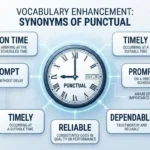

Synonyms of punctual can make a simple idea sound more precise. Imagine arriving at work exactly at 9:00 every day. Your manager might call you punctual, reliable, or prompt.
A student who reaches every class before it starts is showing punctuality. Knowing related words helps you describe this habit without repeating the same word.
Synonyms of punctual are useful because “punctual” is common in school, work, travel, appointments, and everyday English. Different alternatives add useful shades.
For students, bloggers, writers, and daily English users, synonyms of punctual can make speaking and writing more natural, varied, and accurate.
📚 What Does “Punctual” Really Mean?
Punctual is an adjective that means arriving, happening, or being completed at the expected or agreed time.
In simple English, a punctual person does not arrive late. If a meeting begins at 10:00 and you arrive at 9:58, you are punctual.
Native speakers usually use punctual for people, arrivals, appointments, meetings, payments, deliveries, and events.
For example:
- “She is always punctual for work.”
- “The train was punctual today.”
- “Thank you for being punctual.”
The word usually has a positive and neutral tone. Calling someone punctual often suggests discipline, responsibility, respect, and good time management.
🧠 Connotative Meaning
Connotation (the feeling or association a word creates beyond its basic dictionary meaning) can affect how a synonym sounds.
Positive tone: Punctual can suggest reliability, discipline, professionalism, and respect.
Negative tone: The word itself is rarely negative, although excessive emphasis on punctuality can sometimes sound strict or demanding.
Neutral tone: In factual statements, punctual simply describes whether someone or something happens at the expected time.
📖 Etymology of “Punctual”
Punctual comes from the Latin punctualis, meaning “belonging to a point.” It is related to punctum, meaning “point.”
The connection is easy to understand. A “point” can represent an exact moment in time. Over time, the English word developed its modern connection with exact timing.
Old English: 450–1100
The modern word punctual was not part of Old English vocabulary in its present form. Old English used other expressions to describe being timely or arriving at an expected moment.
Middle English: 1100–1500
After the Norman Conquest, English absorbed many French and Latin-based words. The linguistic family behind punctual became increasingly available in learned and formal vocabulary.
Modern English: 1500–Present
Punctual developed into its familiar modern sense of being exact or reliable about time. Today, it is especially common in professional, educational, and formal contexts.
🔊 Pronunciation
US: /ˈpʌŋk.tʃu.əl/
UK: /ˈpʌŋk.tʃu.əl/
🔤 Syllables
punc-tu-al
Affixation Pattern
Root: punct- / punc-
Prefix: None in the modern English formation
Suffix: -ual
The root is connected with the Latin idea of a point.
📖 40 Synonyms of Punctual
The alternatives below are not all perfect replacements in every sentence. Some describe arriving on time, while others emphasize promptness, reliability, scheduling, or exact timing.
⏱️ On Time (Adjective Phrase) — US /ɑːn taɪm/ | UK /ɒn taɪm/
Meaning: Arriving or happening at the expected time.
Tone/Register: Neutral, everyday.
Examples:
- I arrived on time for the interview.
- The bus was on time this morning.
⚡ Prompt (Adjective) — US /prɑːmpt/ | UK /prɒmpt/
Meaning: Happening or being done without delay.
Tone/Register: Neutral, professional.
Examples:
- Thank you for your prompt response.
- She gave a prompt reply to the email.
🕐 Timely (Adjective) — US /ˈtaɪm.li/ | UK /ˈtaɪm.li/
Meaning: Happening at a suitable or useful time.
Tone/Register: Formal, professional.
Examples:
- Your timely advice prevented a problem.
- The team received a timely warning.
📅 On Schedule (Adjective Phrase) — US /ɑːn ˈskedʒ.uːl/ | UK /ɒn ˈʃed.juːl/
Meaning: Happening according to the planned timetable.
Tone/Register: Neutral, professional.
Examples:
- The project is still on schedule.
- The train arrived on schedule.
🎯 Timekeeping (Noun) — US /ˈtaɪmˌkiː.pɪŋ/ | UK /ˈtaɪmˌkiː.pɪŋ/
Meaning: The practice of keeping accurate track of time or arriving at expected times.
Tone/Register: Formal, professional.
Examples:
- Good timekeeping is important at work.
- His excellent timekeeping impressed the manager.
🧭 Timely-Minded (Adjective) — US /ˈtaɪm.li ˌmaɪn.dɪd/ | UK /ˈtaɪm.li ˌmaɪn.dɪd/
Meaning: Careful about completing things at the appropriate time.
Tone/Register: Uncommon, descriptive.
Examples:
- She is very timely-minded about deadlines.
- A timely-minded employee watches important schedules closely.
🚆 Schedule-Conscious (Adjective) — US /ˈskedʒ.uːl ˌkɑːn.ʃəs/ | UK /ˈʃed.juːl ˌkɒn.ʃəs/
Meaning: Very aware of schedules and expected times.
Tone/Register: Neutral, descriptive.
Examples:
- He is schedule-conscious before every meeting.
- Schedule-conscious travelers usually arrive early.
⏳ Promptly (Adverb) — US /ˈprɑːmpt.li/ | UK /ˈprɒmpt.li/
Meaning: At the expected time or without delay.
Tone/Register: Formal, professional.
Examples:
- The meeting started promptly at nine.
- Please reply promptly.
🏁 Timely Manner (Phrase) — US /ˈtaɪm.li ˈmæn.ɚ/ | UK /ˈtaɪm.li ˈmæn.ə/
Meaning: In a way that happens within the needed or expected time.
Tone/Register: Formal, business.
Examples:
- The complaint was handled in a timely manner.
- Please complete the form in a timely manner.
📍 Exact (Adjective) — US /ɪɡˈzækt/ | UK /ɪɡˈzækt/
Meaning: Happening at precisely the stated time.
Tone/Register: Neutral, formal.
Examples:
- She arrived at the exact time agreed.
- The ceremony began at the exact hour.
🕰️ Time-Accurate (Adjective) — US /ˈtaɪm ˌæk.jɚ.ət/ | UK /ˈtaɪm ˌæk.jər.ət/
Meaning: Closely matching the correct or expected time.
Tone/Register: Technical, descriptive.
Examples:
- The system provides time-accurate records.
- We need time-accurate information for the experiment.
📌 Regular (Adjective) — US /ˈreɡ.jə.lɚ/ | UK /ˈreɡ.jə.lə/
Meaning: Happening consistently according to an expected pattern or schedule.
Tone/Register: Neutral.
Examples:
- He is a regular attendee at the morning meetings.
- Her regular attendance makes planning easier.
🔔 Consistent (Adjective) — US /kənˈsɪs.tənt/ | UK /kənˈsɪs.tənt/
Meaning: Behaving or performing in the same reliable way over time.
Tone/Register: Neutral, professional.
Examples:
- She is consistent about arriving before nine.
- His consistent attendance helped the team.
🤝 Reliable (Adjective) — US /rɪˈlaɪ.ə.bəl/ | UK /rɪˈlaɪ.ə.bəl/
Meaning: Dependable and likely to do what is expected.
Tone/Register: Neutral, professional.
Examples:
- Maria is reliable and rarely arrives late.
- We need a reliable person for this role.
🧑💼 Dependable (Adjective) — US /dɪˈpen.də.bəl/ | UK /dɪˈpen.də.bəl/
Meaning: Able to be trusted to arrive or act as expected.
Tone/Register: Professional, positive.
Examples:
- Our receptionist is extremely dependable.
- He has always been dependable about meetings.
🌟 Trustworthy (Adjective) — US /ˈtrʌstˌwɝː.ði/ | UK /ˈtrʌstˌwɜː.ði/
Meaning: Deserving trust because of reliable behavior.
Tone/Register: Neutral, positive.
Examples:
- She is trustworthy and always respects appointments.
- His punctual habits make him seem trustworthy.
🧱 Steady (Adjective) — US /ˈsted.i/ | UK /ˈsted.i/
Meaning: Consistent and dependable over time.
Tone/Register: Neutral.
Examples:
- He has a steady record of attendance.
- Her steady work habits earned respect.
📋 Organized (Adjective) — US /ˈɔːr.ɡə.naɪzd/ | UK /ˈɔːr.ɡə.naɪzd/
Meaning: Good at planning time and activities efficiently.
Tone/Register: Neutral, professional.
Examples:
- She is organized and rarely misses appointments.
- An organized student usually prepares early.
🧠 Disciplined (Adjective) — US /ˈdɪs.ə.plɪnd/ | UK /ˈdɪs.ə.plɪnd/
Meaning: Able to control behavior and follow plans or schedules.
Tone/Register: Formal, positive.
Examples:
- He is disciplined about arriving before class.
- Her disciplined routine keeps her on schedule.
🏃 Early (Adjective/Adverb) — US /ˈɝː.li/ | UK /ˈɜː.li/
Meaning: Arriving before the expected time.
Tone/Register: Everyday.
Examples:
- I got to the office early.
- She was early for her appointment.
⏰ Ahead of Time (Phrase) — US /əˈhed əv taɪm/ | UK /əˈhed əv taɪm/
Meaning: Before the expected or scheduled time.
Tone/Register: Everyday, professional.
Examples:
- We arrived ahead of time.
- Please submit the assignment ahead of time.
🚪 In Good Time (Phrase) — US /ɪn ɡʊd taɪm/ | UK /ɪn ɡʊd taɪm/
Meaning: Early enough to avoid being late.
Tone/Register: Neutral, especially common in British English.
Examples:
- We reached the station in good time.
- Please arrive in good time for boarding.
🗓️ According to Schedule (Phrase) — US /əˈkɔːr.dɪŋ tə ˈskedʒ.uːl/ | UK /əˈkɔː.dɪŋ tə ˈʃed.juːl/
Meaning: Happening exactly as the planned schedule says.
Tone/Register: Formal, professional.
Examples:
- Construction is proceeding according to schedule.
- The flight departed according to schedule.
📈 On Track (Phrase) — US /ɑːn træk/ | UK /ɒn træk/
Meaning: Progressing according to the planned timing.
Tone/Register: Professional, informal.
Examples:
- The project is on track for Friday.
- We are on track to finish today.
🧾 Due (Adjective) — US /duː/ | UK /djuː/
Meaning: Expected or scheduled to happen at a particular time.
Tone/Register: Neutral, formal.
Examples:
- The payment is due tomorrow.
- The train is due at six.
📬 Forthcoming (Adjective) — US /ˈfɔːrθˌkʌm.ɪŋ/ | UK /ˈfɔːθˌkʌm.ɪŋ/
Meaning: Expected to happen or appear soon at an anticipated time.
Tone/Register: Formal.
Examples:
- The forthcoming report is due next week.
- Details will be included in the forthcoming announcement.
⌛ Immediate (Adjective) — US /ɪˈmiː.di.ət/ | UK /ɪˈmiː.di.ət/
Meaning: Happening without waiting or delay.
Tone/Register: Formal, professional.
Examples:
- The problem requires immediate attention.
- She gave an immediate response.
⚡ Swift (Adjective) — US /swɪft/ | UK /swɪft/
Meaning: Happening very quickly.
Tone/Register: Neutral, literary.
Examples:
- The manager took swift action.
- We received a swift response.
🏃♂️ Speedy (Adjective) — US /ˈspiː.di/ | UK /ˈspiː.di/
Meaning: Happening or completed quickly.
Tone/Register: Informal, friendly.
Examples:
- Thanks for the speedy reply.
- We hope for a speedy delivery.
🚀 Rapid (Adjective) — US /ˈræp.ɪd/ | UK /ˈræp.ɪd/
Meaning: Happening very quickly.
Tone/Register: Neutral, formal.
Examples:
- The team made rapid progress.
- We saw a rapid improvement.
Note: Rapid is not a direct synonym for punctual. It describes speed, not arrival at an expected time.
⚙️ Efficient (Adjective) — US /ɪˈfɪʃ.ənt/ | UK /ɪˈfɪʃ.ənt/
Meaning: Working effectively without wasting time.
Tone/Register: Professional.
Examples:
- She is efficient with her morning routine.
- An efficient team respects deadlines.
📝 Diligent (Adjective) — US /ˈdɪl.ə.dʒənt/ | UK /ˈdɪl.ə.dʒənt/
Meaning: Careful and hardworking about completing responsibilities.
Tone/Register: Formal, academic.
Examples:
- He is diligent about meeting deadlines.
- Her diligent preparation kept the project on time.
🎓 Conscientious (Adjective) — US /ˌkɑːn.ʃiˈen.ʃəs/ | UK /ˌkɒn.ʃiˈen.ʃəs/
Meaning: Careful to do duties properly and responsibly.
Tone/Register: Formal, professional.
Examples:
- She is conscientious about her appointments.
- His conscientious approach prevents delays.
🛡️ Responsible (Adjective) — US /rɪˈspɑːn.sə.bəl/ | UK /rɪˈspɒn.sə.bəl/
Meaning: Reliable in fulfilling duties and commitments.
Tone/Register: Neutral, professional.
Examples:
- Responsible employees respect working hours.
- He is responsible about meeting deadlines.
📆 Scheduled (Adjective) — US /ˈskedʒ.uːld/ | UK /ˈʃed.juːld/
Meaning: Planned to happen at a particular time.
Tone/Register: Neutral, professional.
Examples:
- The meeting is scheduled for ten.
- Her interview is scheduled for Monday.
🕊️ Well-Timed (Adjective) — US /ˌwel ˈtaɪmd/ | UK /ˌwel ˈtaɪmd/
Meaning: Happening at a particularly suitable moment.
Tone/Register: Neutral, formal.
Examples:
- His well-timed question changed the discussion.
- The well-timed announcement attracted attention.
🎯 Time-Conscious (Adjective) — US /ˈtaɪm ˌkɑːn.ʃəs/ | UK /ˈtaɪm ˌkɒn.ʃəs/
Meaning: Very aware of the importance of using and respecting time.
Tone/Register: Neutral, professional.
Examples:
- She is highly time-conscious at work.
- Time-conscious travelers check their departure times carefully.
⌚ Punctilious (Adjective) — US /pʌŋkˈtɪl.i.əs/ | UK /pʌŋkˈtɪl.i.əs/
Meaning: Extremely careful about rules, details, and proper behavior, including timing.
Tone/Register: Formal, literary.
Examples:
- He was punctilious about following the meeting schedule.
- Her punctilious attention to deadlines impressed the committee.
🏛️ Strictly Timed (Adjective Phrase) — US /ˈstrɪkt.li taɪmd/ | UK /ˈstrɪkt.li taɪmd/
Meaning: Controlled so that something happens at a precise time.
Tone/Register: Formal, professional.
Examples:
- The examination is strictly timed.
- The broadcast follows a strictly timed schedule.
🕰️ Time-Faithful (Adjective) — US /ˈtaɪm ˌfeɪθ.fəl/ | UK /ˈtaɪm ˌfeɪθ.fəl/
Meaning: Faithfully following an established timing or schedule.
Tone/Register: Uncommon, descriptive.
Examples:
- The team remained time-faithful throughout the event.
- The production was time-faithful to the original plan.
🔍 Synonyms of Punctual by Tone
😊 Positive
These words emphasize admirable qualities rather than simple timing:
Reliable, dependable, trustworthy, disciplined, conscientious, responsible, organized, diligent, consistent
They work well when describing a person’s character.
⚖️ Neutral
These alternatives simply describe timing or scheduling:
On time, prompt, timely, scheduled, due, on schedule, according to schedule, early, ahead of time, in good time
These are especially useful in everyday English.
🏢 Formal or Professional
These choices fit reports, academic writing, workplace communication, and official contexts:
Timely, prompt, principally schedule-related expressions, conscientious, diligent, punctilious, strictly timed, time-conscious
For example, “The matter was handled promptly” sounds more professional than “The matter was handled quickly.”
😄 Informal
For relaxed conversation, speakers often choose:
On time, early, ahead of time, speedy, on track
The best synonym depends on what you actually want to emphasize.
⚖️ “Punctual” vs. Close Alternatives
Punctual vs. Prompt
Punctual focuses on being at the expected time.
Prompt focuses more strongly on avoiding delay.
Compare:
- “She is punctual for meetings.” → She arrives at the agreed time.
- “She gave a prompt reply.” → She responded quickly.
Punctual vs. Timely
Punctual usually describes a person or event meeting an expected time.
Timely often means that something happens at a suitable or useful moment.
- “He is punctual for class.”
- “Your advice was timely.”
Punctual vs. Reliable
Punctual specifically concerns time.
Reliable has a broader meaning. A reliable person can be trusted to do many things correctly, including arriving on time.
🧠 How “Punctual” Changes by Context
Daily Conversation
In everyday speech, on time, early, and prompt are often more natural than formal alternatives.
You might say, “I was on time for dinner,” rather than “I was punctual for dinner.”
Writing and Blogging
Writers can use punctual, timely, reliable, and prompt depending on the exact idea.
For example, a blog about workplace habits might discuss punctual employees, while a technology article might describe a timely response to a security issue.
Professional and Academic English
Professional writing often benefits from precise vocabulary.
“Employees are expected to be punctual” sounds direct and formal.
“Responses should be provided promptly” emphasizes speed.
“Reports must be submitted in a timely manner” emphasizes appropriate timing.
Creative or Informal English
Creative writing can use phrases such as right on time, ahead of time, or just in time.
These expressions create a more conversational feel.
⚠️ Common Mistakes and Native Usage
Mistake 1: Treating “punctual” as “fast”
A punctual person is not necessarily fast.
Someone can walk slowly and still arrive exactly on time.
Mistake 2: Using “timely” everywhere
“Timely” and “punctual” overlap, but they are not identical.
A timely decision is appropriate at the right moment. A punctual employee arrives when expected.
Mistake 3: Confusing “early” with “punctual”
Early means before the expected time.
Punctual means at the expected time.
If class starts at 8:00 and you arrive at 7:40, you are early. If you arrive at 8:00, you are punctual.
Mistake 4: Assuming “reliable” only means punctual
Reliable is broader.
A reliable employee may arrive on time, finish tasks, communicate clearly, and keep promises.
Mistake 5: Overusing “punctual”
Repeating the same adjective can make writing feel flat.
Instead, choose the word that matches your intended meaning: prompt for quick action, timely for suitable timing, and reliable for dependability.
📝 Register Notes
Formal: punctual, prompt, timely, conscientious, diligent, punctilious
Neutral: on time, reliable, dependable, scheduled, early
Informal: ahead of time, right on time, speedy
For related vocabulary, an internal guide on synonyms of timely can also help you compare subtle differences in time-related language.
Real-Life Mini Scenarios Using “Punctual” and Its Alternatives
Workplace
A manager notices that Sara arrives at 8:55 for her 9:00 shift every day. She is punctual and reliable.
Social Situation
You have dinner reservations at 7:00. Your friend arrives at 6:55. You might simply say, “You’re on time.”
Travel
A passenger reaches the airport two hours before departure. They arrived ahead of time and avoided unnecessary stress.
Media and Pop Culture
A television program begins at the advertised hour. Viewers may describe it as starting on schedule.
Storytelling
A detective arrives just in time to stop an important event. This phrase creates more drama than simply saying the detective was punctual.
Exercise
Choose the best answer for each situation.
1. Emma arrives at exactly 9:00 for work every day. Which word fits best?
A) Rapid
B) Punctual
C) Swift
D) Immediate
2. You want to describe a reply that came without delay. Which word is best?
A) Prompt
B) Early
C) Scheduled
D) Regular
3. The train arrived according to its planned timetable. Which phrase fits?
A) Ahead of time
B) On schedule
C) Rapid
D) Diligent
4. A student arrives 20 minutes before class. Which phrase is most accurate?
A) Timely
B) Punctual
C) Ahead of time
D) Due
5. A manager can always trust an employee to fulfill commitments. Which word fits best?
A) Reliable
B) Swift
C) Immediate
D) Exact
6. Advice arrives at exactly the moment it is needed. Which adjective is best?
A) Timely
B) Scheduled
C) Early
D) Rapid
7. A project is progressing according to its planned deadline. Which phrase works best?
A) On track
B) Speedy
C) Punctual
D) Early
8. A response is completed very quickly. Which word is most natural?
A) Prompt
B) Scheduled
C) Punctual
D) Due
9. A person carefully follows rules and deadlines. Which formal adjective fits?
A) Punctilious
B) Speedy
C) Early
D) Swift
10. A person manages time carefully and pays close attention to schedules. Which phrase fits?
A) Time-conscious
B) Rapid
C) Immediate
D) Forthcoming
11. A payment must be made tomorrow. Which word describes its status?
A) Due
B) Reliable
C) Diligent
D) Swift
12. A company wants to describe an employee who consistently performs duties responsibly. Which word is strongest?
A) Dependable
B) Rapid
C) Early
D) Scheduled
13. A meeting begins exactly at the advertised hour. Which phrase is natural?
A) On time
B) Swift
C) Diligent
D) Responsible
14. A report arrives at a useful moment and helps solve a problem. Which word fits best?
A) Timely
B) Punctual
C) Early
D) Scheduled
15. A task is completed efficiently without wasting time. Which word fits best?
A) Efficient
B) Punctual
C) Due
D) Forthcoming
Answer Key: 1-B | 2-A | 3-B | 4-C | 5-A | 6-A | 7-A | 8-A | 9-A | 10-A | 11-A | 12-A | 13-A | 14-A | 15-A
Reflection Task
Choose one synonym you learned today. Write one sentence about your own work, school, travel, or daily routine. Then replace it with punctual and notice how the meaning changes.
Frequently Asked Questions
1. What is the best synonym for punctual in professional English?
Prompt, timely, and reliable are strong professional alternatives, but each has a slightly different meaning. Prompt emphasizes quick action, timely emphasizes appropriate timing, and reliable emphasizes dependability. For an employee who consistently arrives at the expected time, punctual remains the most precise choice.
2. What is a good synonym for punctual when describing an employee?
Reliable and dependable are useful when describing an employee because they cover more than timekeeping. If the specific point is that the employee always arrives at the agreed time, punctual is more precise. You can also say the employee is always on time in natural everyday English.
3. Is “timely” the same as “punctual”?
Not exactly. Punctual usually means happening at the expected or scheduled time. Timely means happening at a suitable or useful moment. A person can be punctual for a meeting, while advice, information, or action can be timely because it arrives when it is needed.
4. What is the difference between punctual and prompt?
Punctual focuses on meeting a specific expected time. Prompt often focuses on acting or responding without delay. For example, “She was punctual for the meeting” means she arrived at the agreed time. “She gave a prompt response” means she responded quickly.
5. What is the opposite of punctual?
Common opposites include late, tardy, and unpunctual. Late is the most common everyday choice. Tardy is often used in school or formal attendance contexts. Unpunctual is understandable and correct but is less common in everyday conversation.
6. How can I say “punctual” naturally in casual English?
In casual English, on time is usually the most natural alternative. You can say, “I was on time for the movie,” or “She is always on time for work.” Ahead of time means earlier than necessary, so it should not be treated as an exact replacement for punctual.
7. Which synonyms of punctual are best for academic writing?
For academic writing, choose words according to the exact meaning. Timely, prompt, consistent, reliable, and conscientious can work in suitable contexts. Avoid replacing punctual with a more complicated word simply to sound formal. Precision is more important than vocabulary complexity.
Conclusion
Learning synonyms of punctual helps you describe time, reliability, and responsibility with greater precision. The right alternative makes your English sound clearer and more natural.
Words such as on time, prompt, timely, and reliable are especially useful because they highlight different sides of good time management and dependable behavior.
For students and writers, these alternatives reduce repetition. For speakers, they make everyday conversations more flexible and expressive.
Start by using one new synonym in an email, essay, or daily conversation today. Small vocabulary choices can gradually make your English more confident, precise, and natural.