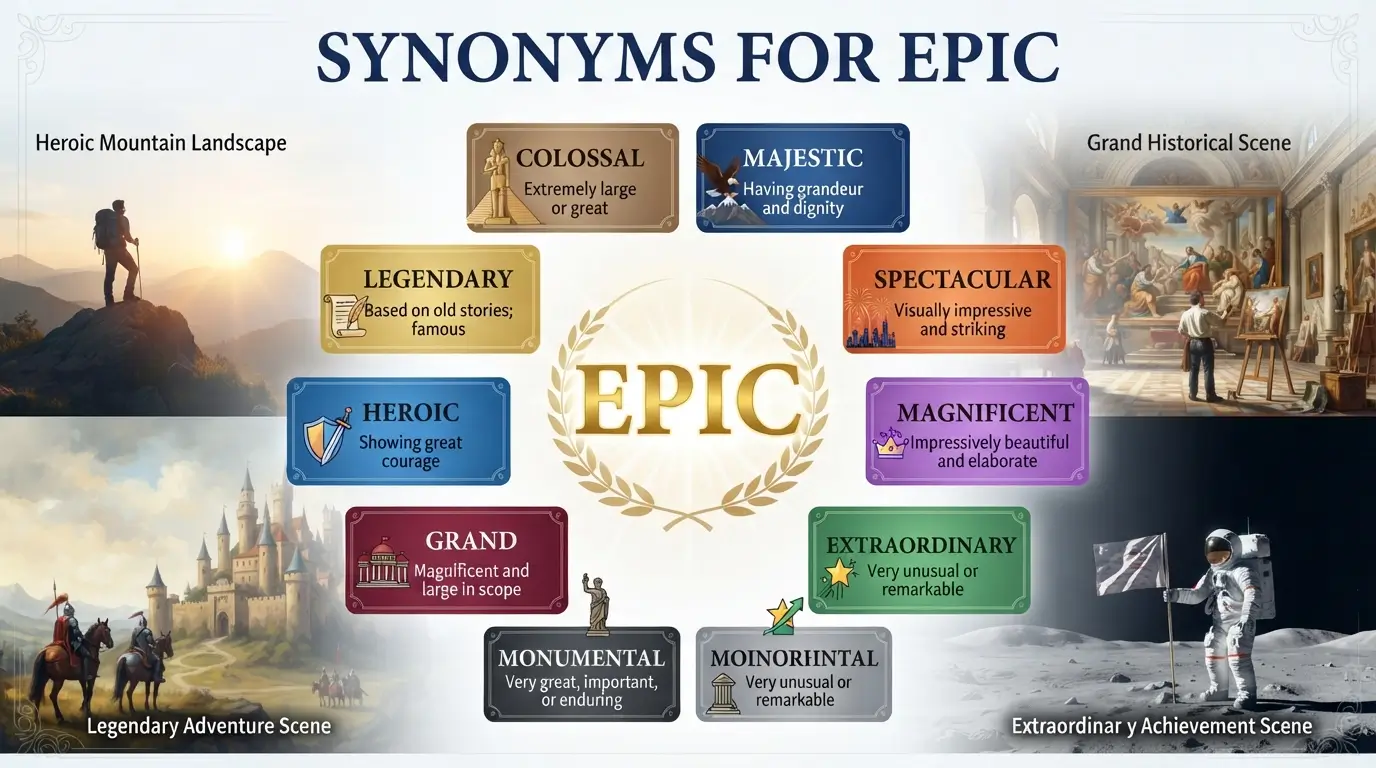

Synonyms for epic become useful when you want to describe something extraordinary, dramatic, impressive, or unusually large. A great adventure may feel truly epic.
Imagine watching a movie with a huge battle, emotional characters, and a breathtaking ending. You might call it epic, but words like legendary or monumental can add more detail.
Synonyms for epic help you avoid repeating one exciting word. They also let you show whether something is grand, heroic, impressive, dramatic, or simply amazing.
For students, bloggers, content writers, and daily English users, synonyms for epic make descriptions stronger. They help you choose words that match the exact feeling you want.
📚 What Does “Epic” Really Mean?
Epic has several related meanings.
As an adjective, epic can describe something extremely impressive, grand, heroic, dramatic, or large in scale.
For example:
- “The team made an epic comeback.”
- “They went on an epic journey.”
- “The concert was epic.”
In literature, an epic is a long narrative poem or story about heroic characters, major events, adventures, or the fate of a people.
The modern informal use is broader. Native speakers often use epic to mean excellent, amazing, memorable, or spectacular.
🧠 Connotative Meaning
Connotation (the emotional feeling or association connected with a word beyond its basic meaning) is especially important with epic.
Positive tone: Epic often suggests greatness, excitement, courage, achievement, or admiration.
Negative tone: In some contexts, “epic” can sound exaggerated or overly dramatic, especially when used for something ordinary.
Neutral tone: In literary or historical contexts, epic can simply describe a particular type of long heroic narrative.
📖 Etymology of “Epic”
Epic ultimately comes from the Greek epikos, meaning “pertaining to a story or word.” It is related to epos, meaning “word,” “speech,” or “story.”
The word entered English through Latin and French forms connected with epic poetry.
Old English: 450–1100
The modern word epic was not part of everyday Old English vocabulary. Old English had heroic poetry, however, including long narrative works centered on warriors, battles, loyalty, and legendary events.
Middle English: 1100–1500
During Middle English, French and Latin strongly influenced English literary vocabulary. Terms connected with classical literature gradually became more established in English.
Modern English: 1500–Present
Epic became firmly associated with long heroic poetry and literature. In modern English, its meaning expanded beyond literature.
Today, it can describe a massive event, heroic achievement, dramatic story, exciting experience, or—in informal speech—something exceptionally good.
🔊 Pronunciation
US: /ˈepɪk/
UK: /ˈepɪk/
🔤 Syllables
ep-ic
🧩 Affixation Pattern
Root: ep- / epic-
Prefix: None in modern English
Suffix: -ic
The -ic ending forms an adjective meaning “related to” or “connected with.”
📖 Synonyms for Epic
The following 40 alternatives cover the main meanings of epic. They are not interchangeable in every sentence because epic can describe size, greatness, heroism, drama, literature, or informal excitement.
Grand (Adjective) — US /ɡrænd/ | UK /ɡrænd/
Meaning: Very impressive because of its size, importance, or style.
Tone/Register: Formal, neutral, descriptive.
Examples:
- The palace looked grand under the evening lights.
- They planned a grand celebration for the anniversary.
Monumental (Adjective) — US /ˌmɑː.njəˈmen.təl/ | UK /ˌmɒn.jəˈmen.təl/
Meaning: Extremely important, impressive, or significant in scale.
Tone/Register: Formal, academic.
Examples:
- The scientist made a monumental contribution to medicine.
- Building the bridge was a monumental task.
Legendary (Adjective) — US /ˈledʒ.ən.der.i/ | UK /ˈledʒ.ən.dri/
Meaning: So famous or impressive that it has become the subject of stories or admiration.
Tone/Register: Neutral, expressive.
Examples:
- Her performance became legendary.
- That final match is now legendary among fans.
Heroic (Adjective) — US /hɪˈroʊ.ɪk/ | UK /hɪˈrəʊ.ɪk/
Meaning: Showing great courage, bravery, or noble behavior.
Tone/Register: Formal, literary.
Examples:
- The firefighter made a heroic rescue.
- His heroic effort saved the team.
Magnificent (Adjective) — US /mæɡˈnɪf.ə.sənt/ | UK /mæɡˈnɪf.ɪ.sənt/
Meaning: Extremely beautiful, impressive, or excellent.
Tone/Register: Formal, expressive.
Examples:
- We watched a magnificent sunset.
- The building has a magnificent entrance.
Spectacular (Adjective) — US /spekˈtæk.jə.lɚ/ | UK /spekˈtæk.jə.lə/
Meaning: Extremely impressive or exciting to watch.
Tone/Register: Neutral, expressive.
Examples:
- The fireworks were spectacular.
- The team staged a spectacular comeback.
Extraordinary (Adjective) — US /ɪkˈstrɔːr.də.ner.i/ | UK /ɪkˈstrɔː.dɪn.ər.i/
Meaning: Far beyond what is usual or expected.
Tone/Register: Neutral, formal.
Examples:
- She showed extraordinary determination.
- The results were extraordinary.
Amazing (Adjective) — US /əˈmeɪ.zɪŋ/ | UK /əˈmeɪ.zɪŋ/
Meaning: Causing strong surprise, admiration, or excitement.
Tone/Register: Informal, everyday.
Examples:
- The view from the mountain was amazing.
- You did an amazing job.
Incredible (Adjective) — US /ɪnˈkred.ə.bəl/ | UK /ɪnˈkred.ə.bəl/
Meaning: Extremely impressive or difficult to believe.
Tone/Register: Neutral, informal.
Examples:
- She made an incredible comeback.
- The story has an incredible ending.
Astonishing (Adjective) — US /əˈstɑː.nɪ.ʃɪŋ/ | UK /əˈstɒn.ɪ.ʃɪŋ/
Meaning: Extremely surprising or impressive.
Tone/Register: Formal, expressive.
Examples:
- The athlete showed astonishing speed.
- The discovery produced astonishing results.
Breathtaking (Adjective) — US /ˈbreθˌteɪ.kɪŋ/ | UK /ˈbreθˌteɪ.kɪŋ/
Meaning: So beautiful or impressive that it creates a powerful emotional reaction.
Tone/Register: Expressive, literary.
Examples:
- We saw a breathtaking mountain view.
- The final scene was breathtaking.
Awe-Inspiring (Adjective) — US /ˈɔː ɪnˌspaɪr.ɪŋ/ | UK /ˈɔː ɪnˌspaɪə.rɪŋ/
Meaning: Creating a strong feeling of admiration and wonder.
Tone/Register: Formal, expressive.
Examples:
- The cathedral was awe-inspiring.
- Her dedication was awe-inspiring.
Impressive (Adjective) — US /ɪmˈpres.ɪv/ | UK /ɪmˈpres.ɪv/
Meaning: Causing admiration because of quality, ability, or achievement.
Tone/Register: Neutral, professional.
Examples:
- His presentation was impressive.
- The company achieved impressive growth.
Remarkable (Adjective) — US /rɪˈmɑːr.kə.bəl/ | UK /rɪˈmɑː.kə.bəl/
Meaning: Unusual or impressive enough to deserve attention.
Tone/Register: Neutral, formal.
Examples:
- She made a remarkable recovery.
- The project achieved remarkable results.
Exceptional (Adjective) — US /ɪkˈsep.ʃə.nəl/ | UK /ɪkˈsep.ʃə.nəl/
Meaning: Much better or greater than what is normal.
Tone/Register: Formal, professional.
Examples:
- He delivered an exceptional performance.
- The restaurant provides exceptional service.
Phenomenal (Adjective) — US /fəˈnɑː.mə.nəl/ | UK /fəˈnɒm.ɪ.nəl/
Meaning: Extremely impressive, successful, or remarkable.
Tone/Register: Informal, professional.
Examples:
- Her progress has been phenomenal.
- The singer enjoyed phenomenal success.
Astounding (Adjective) — US /əˈstaʊn.dɪŋ/ | UK /əˈstaʊn.dɪŋ/
Meaning: Extremely surprising or impressive.
Tone/Register: Expressive, formal.
Examples:
- The team achieved astounding results.
- His memory is astounding.
Staggering (Adjective) — US /ˈstæɡ.ər.ɪŋ/ | UK /ˈstæɡ.ər.ɪŋ/
Meaning: So great that it is difficult to understand or believe.
Tone/Register: Formal, expressive.
Examples:
- The project required a staggering amount of work.
- The city experienced a staggering increase in visitors.
Vast (Adjective) — US /væst/ | UK /vɑːst/
Meaning: Extremely large in size, area, or amount.
Tone/Register: Neutral, formal.
Examples:
- They crossed a vast desert.
- The library contains a vast collection of books.
Massive (Adjective) — US /ˈmæs.ɪv/ | UK /ˈmæs.ɪv/
Meaning: Extremely large, heavy, or extensive.
Tone/Register: Informal, neutral.
Examples:
- The festival attracted a massive crowd.
- They faced a massive challenge.
Monumental (Adjective) — US /ˌmɑː.njəˈmen.təl/ | UK /ˌmɒn.jəˈmen.təl/
Meaning: Exceptionally significant or large in importance or scale.
Tone/Register: Formal, academic.
Examples:
- The invention was a monumental achievement.
- The team overcame a monumental obstacle.
Colossal (Adjective) — US /kəˈlɑː.səl/ | UK /kəˈlɒs.əl/
Meaning: Extremely large or impressive.
Tone/Register: Dramatic, expressive.
Examples:
- The statue is colossal.
- They faced a colossal challenge.
Gigantic (Adjective) — US /dʒaɪˈɡæn.tɪk/ | UK /dʒaɪˈɡæn.tɪk/
Meaning: Extremely large in physical size.
Tone/Register: Informal, descriptive.
Examples:
- A gigantic wave hit the shore.
- The stadium has a gigantic screen.
Momentous (Adjective) — US /moʊˈmen.təs/ | UK /məʊˈmen.təs/
Meaning: Very important because it may have major future effects.
Tone/Register: Formal, academic.
Examples:
- It was a momentous decision.
- The country entered a momentous period.
Historic (Adjective) — US /hɪˈstɔːr.ɪk/ | UK /hɪˈstɒr.ɪk/
Meaning: Important enough to be remembered as part of history.
Tone/Register: Formal, journalistic.
Examples:
- The team achieved a historic victory.
- Leaders signed a historic agreement.
Monumental (Adjective) — US /ˌmɑː.njəˈmen.təl/ | UK /ˌmɒn.jəˈmen.təl/
Meaning: Extremely important, difficult, or significant.
Tone/Register: Formal.
Examples:
- Completing the mission was a monumental achievement.
- The discovery had monumental importance.
Epic-Scale (Adjective) — US /ˈepɪk skeɪl/ | UK /ˈepɪk skeɪl/
Meaning: Extremely large, ambitious, or dramatic in scale.
Tone/Register: Informal, descriptive.
Examples:
- The director created an epic-scale battle scene.
- The project has epic-scale ambitions.
Grandiose (Adjective) — US /ɡræn.diˈoʊs/ | UK /ˈɡræn.di.əʊs/
Meaning: Impressively large or ambitious, sometimes in an exaggerated way.
Tone/Register: Formal, often negative.
Examples:
- The plan sounded grandiose.
- His grandiose promises worried the team.
Dramatic (Adjective) — US /drəˈmæt̬.ɪk/ | UK /drəˈmæt.ɪk/
Meaning: Full of excitement, strong emotion, or striking change.
Tone/Register: Neutral, expressive.
Examples:
- The movie has a dramatic final scene.
- There was a dramatic change in the weather.
Thrilling (Adjective) — US /ˈθrɪl.ɪŋ/ | UK /ˈθrɪl.ɪŋ/
Meaning: Causing strong excitement or suspense.
Tone/Register: Informal, expressive.
Examples:
- The race had a thrilling finish.
- We watched a thrilling adventure film.
Exciting (Adjective) — US /ɪkˈsaɪ.tɪŋ/ | UK /ɪkˈsaɪ.tɪŋ/
Meaning: Creating strong interest, enthusiasm, or enjoyment.
Tone/Register: Everyday, informal.
Examples:
- We had an exciting weekend.
- The final match was exciting.
Unforgettable (Adjective) — US /ˌʌn.fɚˈɡet̬.ə.bəl/ | UK /ˌʌn.fəˈɡet.ə.bəl/
Meaning: So memorable that it is difficult to forget.
Tone/Register: Neutral, expressive.
Examples:
- It was an unforgettable evening.
- Her performance was unforgettable.
Memorable (Adjective) — US /ˈmem.ər.ə.bəl/ | UK /ˈmem.ər.ə.bəl/
Meaning: Worth remembering because it is unusual, enjoyable, or important.
Tone/Register: Neutral.
Examples:
- We had a memorable trip.
- The speech was memorable.
Epic-like (Adjective) — US /ˈepɪk laɪk/ | UK /ˈepɪk laɪk/
Meaning: Resembling something grand, heroic, dramatic, or legendary.
Tone/Register: Informal, descriptive.
Examples:
- The landscape had an epic-like quality.
- The final sequence felt epic-like.
Superlative (Adjective) — US /suːˈpɝː.lə.tɪv/ | UK /suːˈpɜː.lə.tɪv/
Meaning: Extremely excellent or of the highest quality.
Tone/Register: Formal, literary.
Examples:
- She gave a superlative performance.
- The restaurant received superlative reviews.
Supreme (Adjective) — US /suːˈpriːm/ | UK /suːˈpriːm/
Meaning: Greater or better than all others.
Tone/Register: Formal, elevated.
Examples:
- The athlete demonstrated supreme confidence.
- They showed supreme dedication.
Glorious (Adjective) — US /ˈɡlɔːr.i.əs/ | UK /ˈɡlɔː.ri.əs/
Meaning: Wonderful, beautiful, or deserving great admiration.
Tone/Register: Literary, expressive.
Examples:
- The team celebrated a glorious victory.
- We enjoyed a glorious summer afternoon.
Majestic (Adjective) — US /məˈdʒes.tɪk/ | UK /məˈdʒes.tɪk/
Meaning: Showing impressive beauty, dignity, or greatness.
Tone/Register: Formal, literary.
Examples:
- The mountains looked majestic.
- A majestic eagle flew overhead.
Heroic-Scale (Adjective) — US /hɪˈroʊ.ɪk skeɪl/ | UK /hɪˈrəʊ.ɪk skeɪl/
Meaning: Extremely large or dramatic in a way associated with heroic stories.
Tone/Register: Literary, descriptive.
Examples:
- The novel tells a heroic-scale adventure.
- The film uses heroic-scale imagery.
Legendary-Scale (Adjective) — US /ˈledʒ.ən.der.i skeɪl/ | UK /ˈledʒ.ən.dri skeɪl/
Meaning: So large or impressive that it resembles something from legend.
Tone/Register: Expressive, literary.
Examples:
- The concert reached legendary-scale popularity.
- The athlete achieved legendary-scale success.
Jaw-Dropping (Adjective) — US /ˈdʒɔː ˌdrɑː.pɪŋ/ | UK /ˈdʒɔː ˌdrɒp.ɪŋ/
Meaning: Extremely surprising or impressive.
Tone/Register: Informal, conversational.
Examples:
- The special effects were jaw-dropping.
- She gave a jaw-dropping performance.
🔍 Synonyms for Epic by Tone
🌟 Positive
These words strongly communicate admiration:
Magnificent, spectacular, extraordinary, incredible, amazing, phenomenal, breathtaking, awe-inspiring, remarkable, exceptional, glorious, majestic, legendary, impressive
They work well when you want readers to feel admiration.
⚖️ Neutral
These describe scale, importance, or dramatic quality without necessarily expressing strong emotion:
Grand, vast, massive, gigantic, dramatic, memorable, historic, momentous
These are useful in informative writing.
🏛️ Formal or Academic
For formal contexts, choose:
Monumental, momentous, extraordinary, exceptional, remarkable, superlative, supreme, historic
These are better suited to essays, reports, reviews, and serious descriptions.
😄 Playful or Informal
Modern conversational English often uses:
Amazing, incredible, exciting, thrilling, jaw-dropping, massive, epic-scale
The casual use of epic itself is especially common in conversations, social media, entertainment reviews, and pop culture.
⚠️ Negative or Critical
Some alternatives can introduce criticism:
Grandiose can suggest that something is unnecessarily ambitious or exaggerated.
This is an important distinction. Calling a plan epic may praise it. Calling the same plan grandiose may imply that it is unrealistic.
⚖️ “Epic” vs. Close Alternatives
Epic vs. Legendary
Epic describes something grand, dramatic, heroic, or extraordinary.
Legendary suggests lasting fame. Something legendary is remembered because of its reputation or historical importance.
- “It was an epic adventure.” → The adventure was huge and exciting.
- “It became a legendary adventure.” → People continued to remember and talk about it.
Epic vs. Spectacular
Epic often suggests scale, story, adventure, or greatness.
Spectacular focuses more on something visually impressive or exciting to experience.
A movie can have an epic story and spectacular visuals.
Epic vs. Extraordinary
Extraordinary means far outside the ordinary.
Epic adds a stronger sense of scale, drama, heroism, or memorable impact.
An unusual scientific discovery can be extraordinary, while a huge adventure involving danger and heroic action may be epic.
🧠 How “Epic” Changes by Context
Daily Conversation
In casual English, epic often means really amazing or impressive.
Someone might say:
“That party was epic!”
Here, the speaker is not talking about classical literature. They are expressing enthusiasm.
Writing and Blogging
Bloggers can use epic to make descriptions vivid, but repetition can weaken its effect.
Instead of writing “an epic trip” several times, use alternatives such as unforgettable journey, spectacular adventure, or extraordinary experience.
Professional and Academic English
In formal writing, epic should be used carefully.
Words such as monumental, historic, momentous, or extraordinary may be more precise when discussing major achievements or events.
For example:
“The discovery represented a monumental advance in the field.”
This sounds more academic than:
“The discovery was epic.”
Creative and Informal English
Creative writing gives epic more freedom.
It can describe:
- Epic battles
- Epic journeys
- Epic quests
- Epic victories
- Epic adventures
- Epic storytelling
In informal speech, it can also describe a funny, exciting, or unforgettable experience.
⚠️ Common Mistakes and Native Usage
Mistake 1: Assuming “epic” always means huge
Not necessarily.
In modern informal English, epic can simply mean excellent or amazing.
“That song is epic” may refer to its emotional impact rather than its physical scale.
Mistake 2: Using every synonym as a direct replacement
Gigantic means very large.
Legendary emphasizes fame.
Heroic emphasizes courage.
Spectacular emphasizes impressive appearance or experience.
Timely and grandiose would not normally replace epic in the same sentence.
Mistake 3: Using “grandiose” as a compliment
Be careful with grandiose.
It often carries a negative suggestion that something is overly ambitious, unrealistic, or self-important.
Mistake 4: Overusing “epic”
Because epic is popular in casual English, writers sometimes use it too often.
Instead of:
“We had an epic meal at an epic restaurant during an epic trip.”
Try:
“We had an unforgettable meal at a spectacular restaurant during an extraordinary trip.”
The second version gives each description a clearer purpose.
📝 Register Notes
Formal: monumental, momentous, extraordinary, exceptional, superlative
Neutral: impressive, remarkable, spectacular, historic, grand
Informal: amazing, incredible, exciting, thrilling, jaw-dropping
Literary: heroic, glorious, majestic, legendary
For deeper vocabulary development, comparing synonyms of magnificent can also help you distinguish words that express admiration and grandeur.
🧩 Real-Life Mini Scenarios
💼 Workplace
Your company completes a difficult project months ahead of schedule.
You could call it a remarkable achievement, an extraordinary success, or a monumental accomplishment.
👥 Social Situation
Your friends organize a surprise birthday party.
You might say:
“That was epic!”
For a more descriptive version:
“That was an unforgettable celebration.”
🎬 Media and Pop Culture
A movie features enormous battles, emotional characters, and a sweeping storyline.
A reviewer might describe it as an epic film, a spectacular production, or a grand cinematic adventure.
📖 Writing and Storytelling
A fantasy novel follows a hero across kingdoms, battles, and dangerous landscapes.
The story may be described as heroic, legendary, grand, or epic.
Exercise
Choose the best answer for each situation.
1. You want to describe a movie with huge battles and a sweeping story. Which word fits best?
A) Epic
B) Tiny
C) Ordinary
D) Quiet
2. A mountain view is so beautiful that it leaves you amazed. Which word works best?
A) Breathtaking
B) Regular
C) Minor
D) Simple
3. A historical agreement changes the future of a country. Which adjective is most appropriate?
A) Momentous
B) Speedy
C) Casual
D) Tiny
4. A plan sounds extremely ambitious and slightly unrealistic. Which word may carry that criticism?
A) Grandiose
B) Memorable
C) Reliable
D) Gentle
5. A firefighter shows extraordinary courage while rescuing people. Which word fits best?
A) Heroic
B) Vast
C) Scheduled
D) Ordinary
6. A performance is extremely impressive and exciting to watch. Which word fits best?
A) Spectacular
B) Regular
C) Average
D) Minor
7. A famous athlete achieves something people will remember for years. Which word fits best?
A) Legendary
B) Routine
C) Small
D) Ordinary
8. A result is far beyond what anyone expected. Which word fits best?
A) Extraordinary
B) Common
C) Typical
D) Standard
9. A building looks dignified, beautiful, and powerful. Which word is suitable?
A) Majestic
B) Speedy
C) Casual
D) Tiny
10. You want a casual way to say something was extremely impressive.
A) Jaw-dropping
B) Momentous
C) Monumental
D) Historic
11. A project is extremely large in physical size. Which word is most precise?
A) Massive
B) Heroic
C) Literary
D) Memorable
12. An event is remembered because it was unusually important.
A) Historic
B) Speedy
C) Casual
D) Ordinary
13. A story creates intense excitement and suspense.
A) Thrilling
B) Regular
C) Typical
D) Quiet
14. Something is worth remembering because of a special experience.
A) Memorable
B) Vast
C) Grandiose
D) Massive
15. A result is much better than normal quality standards.
A) Exceptional
B) Routine
C) Average
D) Ordinary
Answer Key: 1-A | 2-A | 3-A | 4-A | 5-A | 6-A | 7-A | 8-A | 9-A | 10-A | 11-A | 12-A | 13-A | 14-A | 15-A
✍️ Reflection Task
Choose one synonym from this guide and write a sentence about a movie, trip, achievement, person, or event you remember.
Then replace that synonym with epic. Ask yourself: Does the meaning stay exactly the same, or does the new word change the tone?
Frequently Asked Questions
1. What are the best synonyms for epic when describing an amazing experience?
The strongest choices depend on the experience. Spectacular, extraordinary, unforgettable, incredible, thrilling, and breathtaking are useful for impressive experiences. For casual conversation, “amazing” or “incredible” sounds natural. For more vivid writing, “unforgettable” or “spectacular” can communicate a more specific type of admiration.
2. What is a formal synonym for epic in academic writing?
Monumental, momentous, extraordinary, remarkable, and exceptional are useful formal alternatives. The best choice depends on the context. Use momentous for an important event or decision, monumental for a major achievement or challenge, and extraordinary when something is far beyond normal expectations.
3. What is the difference between epic and legendary?
Epic usually emphasizes grandeur, drama, adventure, or exceptional scale. Legendary emphasizes fame and lasting reputation. An adventure can be epic because it is enormous and dramatic. It becomes legendary when people continue to remember and admire it over time. The two words can overlap when describing famous heroic events.
4. What is a good synonym for epic in casual English?
For casual English, amazing, incredible, awesome, spectacular, thrilling, and jaw-dropping can work depending on the context. “Epic” itself is already highly informal in many modern conversations. If you want to sound natural with friends, “That was incredible!” or “That was amazing!” is often more conversational.
5. Can spectacular and epic be used interchangeably?
Sometimes, but not always. Spectacular mainly emphasizes something visually impressive, exciting, or striking. Epic can emphasize scale, adventure, heroism, importance, or overall impact. A fireworks display can be spectacular, while a long heroic journey can be epic. A movie can be both epic and spectacular.
6. What is the opposite of epic?
There is no single opposite in every context. Depending on the meaning, possible contrasts include ordinary, ordinary-scale, minor, small-scale, mundane, unremarkable, or forgettable. If epic means “extraordinary,” then ordinary is a natural opposite. If it means “very large,” small-scale is more precise.
7. Is epic a positive word?
Usually, yes, especially in modern informal English. Calling something “epic” often expresses excitement, admiration, or enthusiasm. However, the word can sound exaggerated when used for ordinary situations. In literary contexts, epic is more neutral because it can simply identify a genre or describe a heroic narrative tradition.
8. How can I avoid repeating the word epic in an article?
First decide what epic means in each sentence. If you mean “very large,” use massive, vast, or colossal. When you mean “amazing,” use extraordinary, incredible, or spectacular. If you mean “heroic,” choose heroic or legendary. Matching the synonym to the exact meaning makes writing stronger than simply replacing words randomly.
🌟 Conclusion
Learning synonyms for epic gives you more than a longer vocabulary list. It helps you describe greatness, scale, excitement, heroism, beauty, and importance with greater accuracy.
Words such as spectacular, legendary, monumental, extraordinary, and breathtaking each create a slightly different image. That difference makes your writing more vivid.
For students, bloggers, content writers, and everyday speakers, choosing the right synonym can make a sentence sound more natural and expressive. Strong vocabulary is not about using difficult words.
Start practicing these alternatives in your emails, essays, reviews, stories, and conversations. Choose one new word today and use it in a sentence that genuinely fits its meaning.