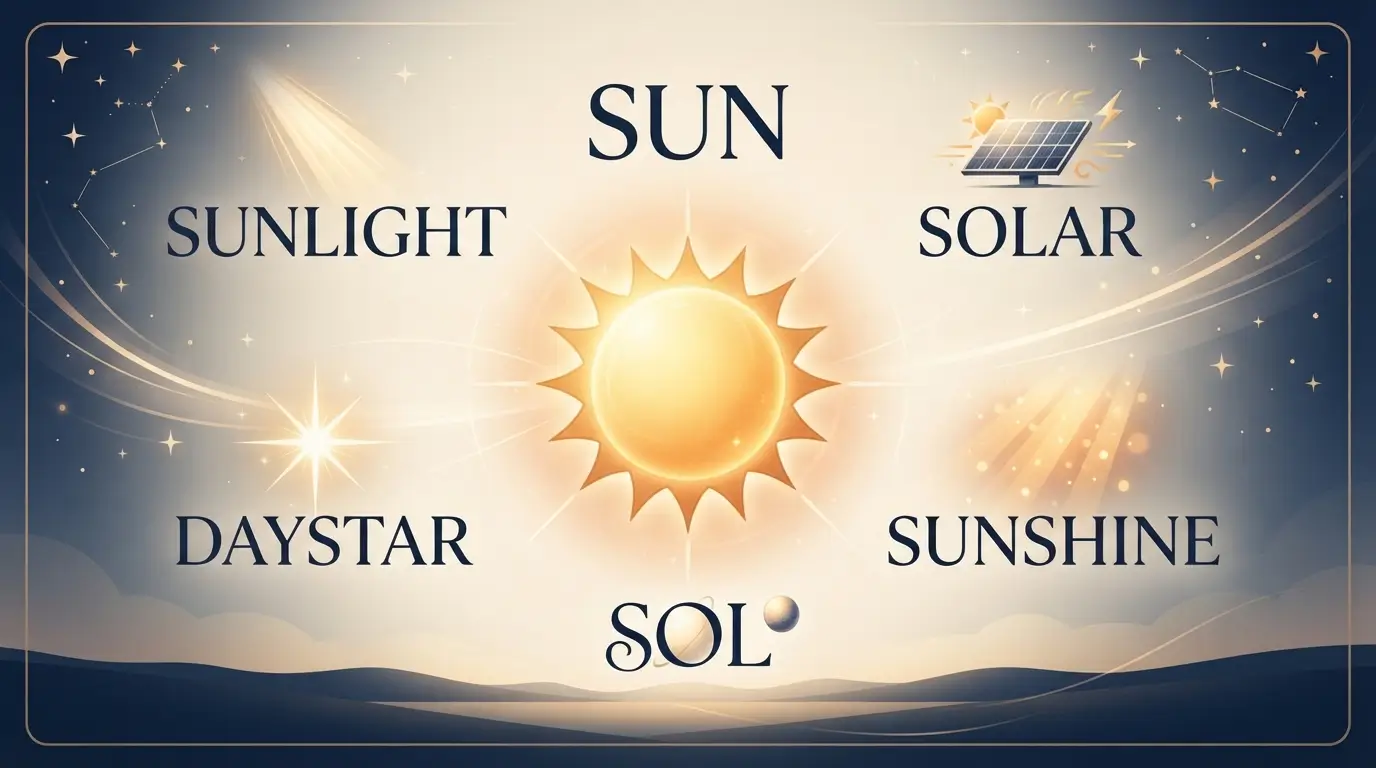

Synonyms of sun can brighten your vocabulary when “sun” feels too simple for the idea you want to express in writing, poetry, or everyday English.
Picture a summer morning. Instead of saying “the sun was bright,” you might describe the daystar, solar orb, or warm luminary above you.
Learning synonyms of sun helps students, bloggers, writers, and English learners choose words that match tone, context, and meaning more precisely.
Because synonyms of sun include poetic, scientific, and descriptive terms, learning their differences can make your English more vivid without making it sound unnatural.
What Does “Sun” Really Mean?
The word sun usually refers to the star at the center of our solar system. It provides Earth with light and heat and strongly influences our planet’s climate and natural cycles.
In everyday English, sun is a noun. It is one of the most familiar words in English because people use it when talking about weather, daylight, heat, nature, astronomy, travel, seasons, and daily routines.
Simple definition: The sun is the star that gives Earth light and heat.
Native speakers normally use sun in ordinary situations:
- “The sun is shining.”
- “It is too hot in the sun.”
- “We watched the sunset.”
- “The morning sun filled the room.”
The word can also have figurative meanings. Someone may call a loved one “the sun of my life” to suggest warmth, happiness, or importance.
🧠 Connotative Meaning
Connotation (the feeling or association a word creates beyond its basic dictionary meaning) can change depending on how sun is used.
Positive tone:
The sun can suggest warmth, happiness, hope, energy, life, and renewal.
Negative tone:
In some contexts, the sun can suggest excessive heat, dryness, exhaustion, or harsh conditions.
Neutral tone:
In science and ordinary conversation, sun is usually neutral and factual.
This distinction matters when choosing alternatives. Luminary sounds literary, while star is more scientific. Daystar feels poetic or old-fashioned.
📖 Etymology of “Sun”
The English word sun has a very old Germanic history.
It comes from Old English sunne, which developed from Proto-Germanic *sunnōn. The word is related to similar forms in other Germanic languages, including German Sonne and Dutch zon.
The deeper Indo-European history connects it with an ancient Indo-European root associated with the sun and solar deity concepts.
Old English: 450–1100
Old English used sunne for the sun or the heavenly body that gives daylight. The word was already an everyday part of the language.
Middle English: 1100–1500
During Middle English, forms such as sunne, sonne, and related spellings appeared. Spelling was not yet standardized.
Modern English: 1500–Present
The modern spelling sun gradually became established. Today, it is both an everyday word and an important scientific term.
🔊 Pronunciation of “Sun”
US IPA: /sʌn/
UK IPA: /sʌn/
Syllables: sun
Affixation Pattern
Root: sun
Prefix: none
Suffix: none
The word is a simple native English noun rather than a modern prefixed or suffixed formation.
🌅 Synonyms List
A useful linguistic point comes first: English does not have 40 perfect one-word synonyms for “sun.” The most accurate alternatives include direct lexical equivalents, poetic names, scientific descriptions, and context-dependent expressions.
Using unrelated words simply to reach a number would create poor vocabulary advice. The list below therefore distinguishes between close synonyms, technical terms, poetic alternatives, and descriptive equivalents.
Sol (Noun) — US /soʊl/ | UK /səʊl/
Meaning: Sol is the astronomical name for our Sun, especially when distinguishing it from other stars.
Tone/Register: Scientific, astronomical
Examples:
- Scientists often use Sol when discussing our planetary system.
- The planet orbits Sol at a great distance.
Star (Noun) — US /stɑr/ | UK /stɑː/
Meaning: A star is a self-luminous celestial body, and our Sun is the star at the center of the solar system.
Tone/Register: Scientific, neutral
Examples:
- The Sun is an ordinary star in astronomical terms.
- Every clear night reminds us how many stars exist beyond our own.
Luminary (Noun) — US /ˈluːməˌneri/ | UK /ˈluːmɪnəri/
Meaning: A luminary is a body that gives off or appears to give light, traditionally referring to the Sun or Moon.
Tone/Register: Literary, formal
Examples:
- The ancient poem praises the luminary of the morning.
- The luminary rose above the distant hills.
Daystar (Noun) — US /ˈdeɪˌstɑr/ | UK /ˈdeɪˌstɑː/
Meaning: Daystar is a poetic or archaic name for the sun as the bright object of daytime.
Tone/Register: Poetic, literary
Examples:
- The daystar appeared above the eastern horizon.
- The poet welcomed the rising daystar.
Solar Orb (Noun Phrase) — US /ˈsoʊlər ɔrb/ | UK /ˈsəʊlə ɔːb/
Meaning: Solar orb is a descriptive expression for the Sun viewed as a rounded heavenly body.
Tone/Register: Literary, descriptive
Examples:
- The golden solar orb sank behind the mountains.
- Clouds partly covered the solar orb.
Solar Disk (Noun Phrase) — US /ˈsoʊlər dɪsk/ | UK /ˈsəʊlə dɪsk/
Meaning: Solar disk describes the apparent circular face of the Sun seen from Earth.
Tone/Register: Scientific, descriptive
Examples:
- The solar disk appeared through the thin clouds.
- The telescope captured details across the solar disk.
Solar Sphere (Noun Phrase) — US /ˈsoʊlər sfɪr/ | UK /ˈsəʊlə sfɪə/
Meaning: Solar sphere describes the Sun as a roughly spherical astronomical body.
Tone/Register: Scientific, descriptive
Examples:
- The solar sphere contains enormous amounts of plasma.
- Researchers study the movement of material across the solar sphere.
Solar Body (Noun Phrase) — US /ˈsoʊlər ˈbɑdi/ | UK /ˈsəʊlə ˈbɒdi/
Meaning: Solar body is a technical description of the Sun as a celestial object.
Tone/Register: Scientific
Examples:
- The solar body produces energy through nuclear fusion.
- The researchers measured activity on the solar body.
Central Star (Noun Phrase) — US /ˈsɛntrəl stɑr/ | UK /ˈsentrəl stɑː/
Meaning: Central star identifies the Sun by its position at the center of our solar system.
Tone/Register: Scientific
Examples:
- Earth receives energy from its central star.
- The planets orbit the system’s central star.
Central Luminary (Noun Phrase) — US /ˈsɛntrəl ˈluːməˌneri/ | UK /ˈsentrəl ˈluːmɪnəri/
Meaning: Central luminary is a literary or descriptive way to identify the Sun as the main source of light in our planetary system.
Tone/Register: Literary, formal
Examples:
- The central luminary dominates the daytime sky.
- Ancient writers often celebrated the central luminary.
Solar Star (Noun Phrase) — US /ˈsoʊlər stɑr/ | UK /ˈsəʊlə stɑː/
Meaning: Solar star describes the Sun as a star belonging to or associated with our solar system.
Tone/Register: Scientific, descriptive
Examples:
- Our solar star is relatively ordinary compared with many stars.
- The solar star drives Earth’s climate system.
Heavenly Body (Noun Phrase) — US /ˈhɛvənli ˈbɑdi/ | UK /ˈhevənli ˈbɒdi/
Meaning: A heavenly body is a natural object in space, and the term can include the Sun.
Tone/Register: General, scientific
Examples:
- The Sun is the brightest heavenly body in our daytime sky.
- Ancient people carefully observed this heavenly body.
Celestial Body (Noun Phrase) — US /səˈlɛstʃəl ˈbɑdi/ | UK /sɪˈlestiəl ˈbɒdi/
Meaning: A celestial body is a natural object in space, including stars such as the Sun.
Tone/Register: Academic, scientific
Examples:
- The Sun is a massive celestial body.
- Students learn about this celestial body in astronomy.
Celestial Luminary (Noun Phrase) — US /səˈlɛstʃəl ˈluːməˌneri/ | UK /sɪˈlestiəl ˈluːmɪnəri/
Meaning: Celestial luminary is a literary expression for a bright heavenly object such as the Sun.
Tone/Register: Literary, formal
Examples:
- The celestial luminary brightened the ancient landscape.
- The writer compared the king to a celestial luminary.
Heavenly Luminary (Noun Phrase) — US /ˈhɛvənli ˈluːməˌneri/ | UK /ˈhevənli ˈluːmɪnəri/
Meaning: Heavenly luminary is a poetic description of the Sun as a source of heavenly light.
Tone/Register: Poetic, literary
Examples:
- The heavenly luminary climbed above the horizon.
- The poem celebrates the warmth of the heavenly luminary.
Bright Orb (Noun Phrase) — US /braɪt ɔrb/ | UK /braɪt ɔːb/
Meaning: Bright orb is a descriptive expression for the Sun’s rounded appearance in the sky.
Tone/Register: Literary, descriptive
Examples:
- The bright orb appeared after the storm.
- She watched the bright orb disappear behind the sea.
Golden Orb (Noun Phrase) — US /ˈɡoʊldən ɔrb/ | UK /ˈɡəʊldən ɔːb/
Meaning: Golden orb poetically describes the Sun when it appears yellow, orange, or golden.
Tone/Register: Poetic, informal
Examples:
- The golden orb hovered above the fields.
- The evening golden orb gave the clouds a warm glow.
Fiery Orb (Noun Phrase) — US /ˈfaɪəri ɔrb/ | UK /ˈfaɪəri ɔːb/
Meaning: Fiery orb emphasizes the Sun’s intense heat and bright appearance.
Tone/Register: Poetic, dramatic
Examples:
- The fiery orb rose over the desert.
- The story begins beneath a blazing fiery orb.
Burning Orb (Noun Phrase) — US /ˈbɜrnɪŋ ɔrb/ | UK /ˈbɜːnɪŋ ɔːb/
Meaning: Burning orb is a dramatic description emphasizing the Sun’s heat and brightness.
Tone/Register: Literary, dramatic
Examples:
- The burning orb made the road shimmer.
- Travelers sought shade beneath the harsh burning orb.
Orb of Day (Noun Phrase) — US /ɔrb əv deɪ/ | UK /ɔːb əv deɪ/
Meaning: Orb of day is a poetic expression for the Sun as the rounded source of daytime light.
Tone/Register: Poetic, literary
Examples:
- The orb of day rose above the valley.
- The poem describes the fading orb of day.
Light of Day (Noun Phrase) — US /laɪt əv deɪ/ | UK /laɪt əv deɪ/
Meaning: Light of day refers to natural daylight and can sometimes poetically evoke the Sun.
Tone/Register: General, poetic
Examples:
- We waited for the light of day before leaving.
- The village looked different in the light of day.
Daylight Source (Noun Phrase) — US /ˈdeɪlaɪt sɔrs/ | UK /ˈdeɪlaɪt sɔːs/
Meaning: Daylight source describes the Sun according to the light it provides during daytime.
Tone/Register: Technical, explanatory
Examples:
- The daylight source affects the room’s temperature.
- The Sun is Earth’s primary natural daylight source.
Natural Light Source (Noun Phrase) — US /ˈnætʃərəl laɪt sɔrs/ | UK /ˈnætʃərəl laɪt sɔːs/
Meaning: Natural light source describes the Sun as a naturally occurring source of illumination.
Tone/Register: General, educational
Examples:
- Designers often use the Sun as a natural light source.
- A window can bring this natural light source indoors.
Source of Daylight (Noun Phrase) — US /sɔrs əv ˈdeɪlaɪt/ | UK /sɔːs əv ˈdeɪlaɪt/
Meaning: Source of daylight describes the Sun according to its role in producing the daylight we experience.
Tone/Register: Educational
Examples:
- The Sun is our primary source of daylight.
- The ancient culture worshipped its source of daylight.
Source of Solar Energy (Noun Phrase) — US /sɔrs əv ˈsoʊlər ˈɛnərdʒi/ | UK /sɔːs əv ˈsəʊlə ˈenədʒi/
Meaning: This phrase describes the Sun according to the energy it supplies to the solar system.
Tone/Register: Scientific, academic
Examples:
- The Sun is the main source of solar energy for Earth.
- Plants ultimately depend on this source of solar energy.
Solar Power Source (Noun Phrase) — US /ˈsoʊlər ˈpaʊər sɔrs/ | UK /ˈsəʊlə ˈpaʊə sɔːs/
Meaning: Solar power source identifies the Sun as the natural origin of solar energy.
Tone/Register: Technical
Examples:
- The Sun acts as the planet’s largest natural solar power source.
- Engineers study how efficiently we can use this solar power source.
G-Type Main-Sequence Star (Noun Phrase) — US /ˈdʒi taɪp meɪn ˈsiːkwəns stɑr/ | UK /ˈdʒiː taɪp meɪn ˈsiːkwəns stɑː/
Meaning: This is the scientific classification of the Sun as a G-type main-sequence star.
Tone/Register: Technical, astronomical
Examples:
- The Sun is classified as a G-type main-sequence star.
- Astronomers compare other stars with our G-type main-sequence star.
Yellow Dwarf (Noun) — US /ˈjɛloʊ drɔf/ | UK /ˈjeləʊ drɔːf/
Meaning: Yellow dwarf is a traditional astronomical term for stars similar to the Sun.
Tone/Register: Scientific, educational
Examples:
- The Sun is often described as a yellow dwarf.
- The textbook explains how a yellow dwarf evolves.
Sol Star (Noun Phrase) — US /soʊl stɑr/ | UK /səʊl stɑː/
Meaning: Sol star is a descriptive astronomical expression identifying the star named Sol.
Tone/Register: Scientific, specialized
Examples:
- The Sol star is central to our planetary system.
- Researchers monitor activity around the Sol star.
Solar Primary (Noun Phrase) — US /ˈsoʊlər ˈpraɪmɛri/ | UK /ˈsəʊlə ˈpraɪməri/
Meaning: Solar primary is a technical expression identifying the primary star around which the planets of our solar system orbit.
Tone/Register: Technical, astronomical
Examples:
- Earth revolves around the solar primary.
- The planets are gravitationally bound to the solar primary.
Primary Star (Noun Phrase) — US /ˈpraɪmɛri stɑr/ | UK /ˈpraɪməri stɑː/
Meaning: Primary star identifies the main star in a planetary system.
Tone/Register: Scientific
Examples:
- The planet receives energy from its primary star.
- Scientists measured radiation from the primary star.
Solar Source (Noun Phrase) — US /ˈsoʊlər sɔrs/ | UK /ˈsəʊlə sɔːs/
Meaning: Solar source describes the Sun as the origin of solar radiation and energy.
Tone/Register: Technical
Examples:
- The solar source produces enormous amounts of radiation.
- The spacecraft measured changes from the solar source.
Solar Luminary (Noun Phrase) — US /ˈsoʊlər ˈluːməˌneri/ | UK /ˈsəʊlə ˈluːmɪnəri/
Meaning: Solar luminary is a literary description of the Sun as a luminous celestial object.
Tone/Register: Literary, formal
Examples:
- The poet described the solar luminary in glowing language.
- The solar luminary dominated the morning sky.
Daylight Luminary (Noun Phrase) — US /ˈdeɪlaɪt ˈluːməˌneri/ | UK /ˈdeɪlaɪt ˈluːmɪnəri/
Meaning: Daylight luminary is a poetic description of the Sun as the dominant source of daylight.
Tone/Register: Poetic
Examples:
- The daylight luminary appeared above the rooftops.
- The writer praised the daylight luminary for its warmth.
Radiant Orb (Noun Phrase) — US /ˈreɪdiənt ɔrb/ | UK /ˈreɪdiənt ɔːb/
Meaning: Radiant orb emphasizes the Sun’s bright, glowing appearance.
Tone/Register: Literary, descriptive
Examples:
- The radiant orb broke through the clouds.
- A radiant orb warmed the quiet landscape.
Great Luminary (Noun Phrase) — US /ɡreɪt ˈluːməˌneri/ | UK /ɡreɪt ˈluːmɪnəri/
Meaning: Great luminary is an elevated literary expression for a dominant source of light such as the Sun.
Tone/Register: Poetic, formal
Examples:
- The poem calls the Sun the great luminary.
- The great luminary marked the beginning of another day.
Solar Fire (Noun Phrase) — US /ˈsoʊlər faɪər/ | UK /ˈsəʊlə ˈfaɪə/
Meaning: Solar fire is a poetic expression emphasizing the Sun’s intense energy and heat.
Tone/Register: Poetic, dramatic
Examples:
- The desert shimmered beneath the solar fire.
- The writer described the afternoon as filled with solar fire.
Celestial Fire (Noun Phrase) — US /səˈlɛstʃəl faɪər/ | UK /sɪˈlestiəl ˈfaɪə/
Meaning: Celestial fire is a poetic expression that presents the Sun as a brilliant fire in the heavens.
Tone/Register: Literary, poetic
Examples:
- Ancient poems often imagined the Sun as celestial fire.
- The mountain peaks glowed beneath the celestial fire.
Sunlight (Noun) — US /ˈsʌnlaɪt/ | UK /ˈsʌnlaɪt/
Meaning: Sunlight is the light that comes from the Sun rather than the Sun itself.
Tone/Register: Everyday, neutral
Examples:
- The plants need enough sunlight to grow.
- Warm sunlight entered through the window.
Sunshine (Noun) — US /ˈsʌnʃaɪn/ | UK /ˈsʌnʃaɪn/
Meaning: Sunshine refers to the bright light or warmth produced by the Sun.
Tone/Register: Everyday, positive
Examples:
- The sunshine made the morning feel cheerful.
- We enjoyed the warm sunshine at the park.
Sunbeam (Noun) — US /ˈsʌnˌbiːm/ | UK /ˈsʌnˌbiːm/
Meaning: A sunbeam is a narrow visible stream of sunlight, not the Sun itself.
Tone/Register: Everyday, descriptive
Examples:
- A sunbeam crossed the bedroom floor.
- Dust floated through a bright sunbeam.
Important: Sunlight, sunshine, and sunbeam are related terms rather than exact synonyms of sun. They are included because they are common semantic alternatives in vocabulary writing, but replacing sun with them in every sentence would be incorrect.
🎭 Synonyms of Sun by Tone
Positive and Warm
These expressions create feelings of beauty, warmth, hope, or energy:
- Sunshine
- Golden orb
- Radiant orb
- Daystar
- Luminary
- Heavenly luminary
- Solar luminary
They work especially well in creative writing, poetry, descriptions, and personal reflections.
Neutral
These are safer for ordinary communication:
- Sun
- Star
- Sol
- Celestial body
- Heavenly body
- Solar body
- Primary star
Use these when clarity matters more than style.
Scientific and Academic
For scientific contexts, choose:
- Sol
- G-type main-sequence star
- Yellow dwarf
- Solar body
- Solar disk
- Solar sphere
- Central star
- Solar primary
These expressions are more precise than poetic alternatives.
Poetic and Dramatic
For creative writing:
- Daystar
- Solar orb
- Golden orb
- Fiery orb
- Burning orb
- Orb of day
- Solar fire
- Celestial fire
These words create imagery rather than simply naming the astronomical object.
⚖️ “Sun” vs Close Alternatives
Sun vs Star
Sun specifically identifies the star in our solar system.
Star is broader. It can describe any similar astronomical object.
“The Sun is a star.”
You cannot replace sun with star in every everyday sentence without changing the meaning.
Sun vs Sol
Sun is the ordinary English word.
Sol is the astronomical proper name used to distinguish our Sun from other stars.
For general conversation, sun sounds natural. In astronomy, Sol can provide greater precision.
Sun vs Daystar
Sun is neutral and common.
Daystar is poetic or archaic. It can create a more imaginative tone but sounds unusual in casual conversation.
🧠 How “Sun” Changes by Context
Daily Conversation
In daily English, sun is almost always the best choice.
People naturally say:
- “The sun is very bright.”
- “Stay out of the sun.”
- “The sun came out.”
- “I love the morning sun.”
Using celestial luminary in these sentences would sound unnecessarily formal.
Writing and Blogging
Writers have more freedom.
A travel blogger might write, “The golden orb disappeared behind the ocean.”
A science blogger would probably write, “The Sun is a G-type main-sequence star.”
The best choice depends on the reader and purpose.
Professional and Academic Writing
Scientific writing favors precision.
Terms such as Sun, Sol, solar disk, solar body, and G-type main-sequence star can work when their specific meanings are appropriate.
Avoid decorative expressions such as fiery orb in a formal research paper.
Creative and Informal Writing
Creative writing welcomes imagery.
A novelist might describe the Sun as a burning orb, golden orb, or daystar to create atmosphere.
The goal is not simply to replace sun. It is to create the exact image the reader needs.
⚠️ Common Mistakes and Native Usage
Treating every related word as an exact synonym
Sunlight does not mean exactly the same thing as sun.
The Sun is the astronomical body. Sunlight is the radiation or visible light coming from it.
Using poetic terms in formal writing
“Researchers observed the fiery orb” sounds creative.
“Researchers observed the Sun” is much more appropriate for scientific writing.
Confusing “sun” with “sunshine”
You can say:
“The sun is behind the clouds.”
You normally would not say:
“The sunshine is behind the clouds.”
The meanings are related but different.
Overusing unusual vocabulary
A synonym should improve communication.
If a simple word already works, sun may be the strongest choice.
Register Notes
Formal: solar body, solar primary, celestial body
Scientific: Sol, G-type main-sequence star, solar disk
Neutral: sun, star
Poetic: daystar, golden orb, solar fire
Informal: sunshine
🧩 Real-Life Mini Scenarios
Workplace
A weather report might say:
“The sun will remain strong throughout the afternoon.”
A scientific report might say:
“The solar disk showed increased activity.”
Social Situation
Someone might tell a friend:
“Let’s sit in the sunshine for a while.”
This sounds natural and friendly.
Media and Pop Culture
A fantasy novel may describe a character standing beneath the daystar.
That choice creates an imaginative or ancient-world atmosphere.
Writing and Storytelling
A travel writer might describe a beach as glowing beneath a golden orb.
The expression adds visual detail without repeatedly using sun.
✍️ How to Choose the Right Synonym
Before replacing sun, ask three questions:
What exactly am I describing?
If you mean the astronomical object, use Sun, Sol, or a suitable scientific term.
What tone do I want?
Use daystar or golden orb for poetic writing.
Who is reading it?
For general readers, simple language usually works best. For specialists, technical vocabulary may provide greater precision.
The strongest vocabulary is not the vocabulary that sounds complicated. It is the vocabulary that communicates the intended meaning clearly.
📝 Interactive Practice Quiz
1. Which word is the most natural choice in everyday English?
A. Celestial luminary
B. Sun
C. Solar primary
D. Solar sphere
2. Which term is most suitable for astronomy?
A. Golden orb
B. Daystar
C. Sol
D. Fiery orb
3. Which expression sounds most poetic?
A. G-type main-sequence star
B. Solar body
C. Daystar
D. Primary star
4. Which word means light coming from the Sun?
A. Sunlight
B. Sol
C. Solar primary
D. Daystar
5. Which term describes a narrow stream of sunlight?
A. Luminary
B. Sunbeam
C. Solar body
D. Star
6. Which alternative is broad enough to describe many objects like the Sun?
A. Star
B. Daystar
C. Sol
D. Golden orb
7. Which expression emphasizes the Sun’s heat and dramatic appearance?
A. Fiery orb
B. Primary star
C. Celestial body
D. Sol
8. Which term is most appropriate for a scientific article?
A. Burning orb
B. Golden orb
C. G-type main-sequence star
D. Orb of day
9. Which word is associated with happiness and warmth?
A. Sunshine
B. Solar primary
C. Solar disk
D. Celestial body
10. Which phrase describes the Sun as the center of our planetary system?
A. Central star
B. Sunbeam
C. Sunshine
D. Bright orb
11. Which expression has an old-fashioned poetic feel?
A. Daystar
B. Solar body
C. Star
D. Sun
12. Which word should you avoid using as a direct replacement for the Sun?
A. Sol
B. Sunshine
C. Daystar
D. Luminary
13. A novelist wants dramatic imagery. Which option fits best?
A. Solar primary
B. Burning orb
C. G-type main-sequence star
D. Celestial body
14. A student is writing a basic astronomy report. Which word is clearest?
A. Sun
B. Great luminary
C. Fiery orb
D. Orb of day
15. Which phrase focuses on the Sun as an energy source?
A. Solar energy source
B. Daystar
C. Golden orb
D. Bright orb
Reflection task: Write one sentence about the Sun using a synonym or related expression that matches a specific tone, such as scientific, poetic, or everyday.
Answer Key: 1-B | 2-C | 3-C | 4-A | 5-B | 6-A | 7-A | 8-C | 9-A | 10-A | 11-A | 12-B | 13-B | 14-A | 15-A
❓ Frequently Asked Questions
1. What is the best synonym for sun in everyday English?
The best everyday alternative is usually star when you are explaining its astronomical classification. However, star is broader than sun, because it can refer to countless other celestial objects. In ordinary conversation, sun remains the most natural word for the star at the center of our solar system.
2. What is a poetic synonym for the sun?
Daystar is one of the best-known poetic alternatives for the Sun. Other creative expressions include golden orb, solar orb, radiant orb, and orb of day. These expressions are useful when you want imagery, emotion, or atmosphere rather than plain scientific description.
3. What is the scientific name for the Sun?
The astronomical name Sol is commonly used for our Sun, particularly when scientists need to distinguish it from other stars. The Sun is also classified as a G-type main-sequence star. In technical contexts, these terms can be more precise than simply using descriptive poetic expressions.
4. Is “sunlight” a synonym for “sun”?
No. Sunlight is closely related to the Sun but is not an exact synonym. The Sun is the astronomical object itself, while sunlight refers to the light and radiation that comes from it. For example, “The Sun is bright” and “The sunlight is bright” describe related but different ideas.
5. What is the difference between sun and sunshine?
Sun refers to the star itself. Sunshine usually refers to the light or warmth produced by the Sun. “The Sun disappeared behind the clouds” refers to the object, while “The sunshine disappeared” focuses more on the loss of light.
6. What synonym for sun is suitable for creative writing?
Creative writing can use expressions such as daystar, golden orb, radiant orb, fiery orb, or solar fire. The best choice depends on the mood. A golden orb suggests beauty, while fiery orb creates a stronger sense of heat or drama.
7. Can “luminary” replace “sun” in every sentence?
No. Luminary is a broader and more literary term for a body that gives light. It can refer to the Sun, but it does not always identify the Sun specifically. It is most useful in poetic, historical, or elevated writing rather than ordinary conversation.
🎯 Conclusion
Learning synonyms of sun is not simply about memorizing a long list of replacement words. It is about understanding meaning, tone, precision, and context.
For everyday English, sun remains the clearest choice.In scientific contexts, terms such as Sol and G-type main-sequence star provide greater precision.
In creative writing, alternatives such as daystar, golden orb, and radiant orb can create stronger images and make descriptions feel more memorable.
The best way to build vocabulary is to practice these words naturally. Try using one in an email, essay, story, or daily conversation and notice how the tone changes.